
Hydraulics

Online Flow Calculation at Hydrological Stations Based on One-dimensional Hydrodynamic Model

  • NIU Shuai , 1 ,
  • LIU Jiu-fu 2 ,
  • LI San-ping 3 ,
  • WANG Wen-zhong 2 ,
  • LONG Wei 2
Expand
  • 1 Hydrology and Water Resources Department, Nanjing Hydraulic Research Institute, Nanjing 210029, China
  • 2 Nanjing Research Institute of Hydrology and Water Conservation Automation, Ministry of Water Resources, Nanjing 210012, China
  • 3 Lanxi Hydrological Station, Zhejiang Hydrological Management Center, Lanxi 321100, China

Received date: 2024-09-12

  Revised date: 2024-11-26

  Online published: 2025-01-23

Abstract

[Objective] Hydrological stations play a crucial role in monitoring hydrological regime changes. Achieving online flow calculation at hydrological stations and improving flow calculation accuracy are of great research significance for hydrological monitoring, flood and drought disaster prevention, and water resource management. [Methods] By monitoring the upstream and downstream water levels of hydrological stations as boundary conditions, a one-dimensional hydrodynamic model of the river reach near the hydrological station was constructed. The Kalman filter technique was employed to automatically calibrate the model’s roughness parameters based on measured flow data from the station. Using the upstream and downstream water levels as inputs and the automatically calibrated roughness data as outputs, a BP neural network was constructed to fit the complex relationship between water levels and model roughness. During online flow calculation, the roughness values were corrected using the real-time upstream and downstream water levels and the water level-roughness neural network relationship to improve flow calculation accuracy. By correcting the roughness based on real-time upstream and downstream water levels and using the constructed one-dimensional hydrodynamic model for simulation calculation, online flow calculation at hydrological stations was achieved. [Results] Taking Lanxi Hydrological Station as an example, the accuracy of online peak flow calculation at Lanxi Station using the proposed method was higher than that of the currently used index velocity method. For three major flood events selected, the flood flow calculation accuracy at Lanxi Station using the proposed method was higher than that of the index velocity method currently used at Lanxi Station. The reason was that the index velocity method, when establishing the relationship between index velocity and cross-sectional average velocity, used only boat-measured flow data to calibrate the relationship, which could lead to significant errors and consequently larger errors in peak flow simulation. In contrast, this study constructed a one-dimensional hydrodynamic model, used measured flow data to automatically calibrate the model roughness parameters, corrected roughness based on real-time upstream and downstream water levels to perform online flow calculation with the model, and utilized more real-time water level information than the index velocity method for model calibration and assimilation, thus achieving higher peak flow calculation accuracy. [Conclusion] This study achieves online flow calculation at hydrological stations and improves flow calculation accuracy by utilizing upstream and downstream water levels. The applicability of the method is verified using Lanxi Hydrological Station as an example, demonstrating significantly improved flow calculation accuracy compared to the index velocity method, particularly during major floods with high water levels. The method proposed in this paper is suitable for online flow calculation at hydrological stations located in upstream or midstream river reaches with relatively stable riverbed cross-sections where sediment erosion and deposition effects can be neglected. Considering the relatively low cost of water level gauges, the method demonstrates good application prospects and promotion value.

Cite this article

NIU Shuai , LIU Jiu-fu , LI San-ping , WANG Wen-zhong , LONG Wei . Online Flow Calculation at Hydrological Stations Based on One-dimensional Hydrodynamic Model[J]. Journal of Changjiang River Scientific Research Institute, 2025 , 42(12) : 95 -100 . DOI: 10.11988/ckyyb.20240967

0 引言

目前水文测站流量在线计算主要采用指标流速法和水位流量关系法。指标流速法通过流速测量设备获得断面局部范围流速作为指标流速,建立指标流速与断面平均流速的相关关系推算断面流量[1-3]。水位流量关系法要求测站水位流量关系为单一曲线,一般适用于河道上游地形比降较大的河段[4-6]。而受河床冲淤变化、回水、洪水涨落等因素的影响,测站断面水位流量关系多为绳套型曲线,需采用比降修正法[7-8]、落差指数法[9-10]、校正因素法[11]、相应校正法[12]等方法构建多因素的水位流量关系单值化曲线进行流量在线计算。这些改进方法通过对河道一维水流方程(圣维南方程组)中的某些方程项进行忽略以实现比单一水位流量关系更加合理的流量计算方法,而由于忽略某些方程项使其在推广应用中受限较多。直接采用洪水动力波的水动力模型则可以全面地考虑回水、洪水涨落等因素对断面流量计算的影响[13-14],但目前使用一维水动力模型进行水文测站在线流量计算的研究较少。在模型校正同化方面,通过实测水位资料采用卡尔曼滤波对水动力模型的糙率参数进行实时校正[15-17],主要用于提高河道水位预报精度,而用于提高水文测站流量计算精度的研究较少。
本文对卡尔曼滤波技术、反向传播(Back Propagation,BP)神经网络技术、一维水动力模型等方法进行了综合应用创新,实现了利用上下游水位即可进行水文测站流量在线计算。以兰溪水文站为例,使用该方法进行流量在线计算的洪峰流量精度高于目前使用的指标流速法。

1 研究区域与数据来源

兰溪水文站位于钱塘江水系干流中游兰江河段,站上流域集水面积18 233 km2,测验项目齐全,承担水文情报预报任务,为中央报汛站,是钱塘江水系防汛防旱控制站和依据站。目前已建有走航式声学多普勒流速剖面仪(Acoustic Doppler Current Profiler,ADCP)和水平声学多普勒流速剖面仪(Horizontal Acoustic Doppler Current Profiler,H-ADCP)等流量在线系统进行在线测流。兰溪站附近水系和测站位置见图1
图1 兰溪站水系和测站位置

Fig.1 Map of water system and location of Lanxi Hydrological Station

目前兰溪测站的在线流量计算方法是指标流速法[18],采用缆道流速仪或走航式ADCP实测平均流速,与H-ADCP在线采集的代表流速进行率定分析,将H-ADCP测得的代表流速与缆道测流计算的平均流速建立相关关系,进行相关性分析和水文整编规范要求的三线检验分析。
2021年10月在兰溪站的上游支流金华江和衢江上安装2个水位计,在兰溪站下游安装1个水位计,这3个辅助水位计与兰溪站进行同步水位监测。本文使用的2022年5月28日—2024年6月30日的12场实测洪水资料,包括了大中小洪水、单峰洪水、多峰洪水等洪水类型,具有较好的代表性。

2 模型构建与方法

2.1 一维水动力模型构建

一维水动力模型基于动力波的圣维南方程组,考虑了回水、洪水涨落等因素对河道流态的影响。兰溪水文站附近河段岸坡稳定,河面宽度沿程变化较小,水流流态在高中低水时均比较稳定,河道中游基本属于缓流,河段泥沙冲淤变化较小,测站断面稳定,在流量计算中可以忽略泥沙冲淤的影响,满足圣维南方程组的使用条件。圣维南方程组包括水流连续性方程和动量方程:
$\frac{\partial A}{\partial t}+\frac{\partial Q}{\partial x}=q ,$
$\frac{\partial}{\partial t}\left(\frac{Q}{A}\right)+\frac{\partial}{\partial x}\left(\frac{Q^{2}}{A}\right)+g A\left(\frac{\partial Z}{\partial x}+\frac{Q|Q|}{K^{2}}\right)=0。$
式中:Q为流量;Z为断面水位;A为过水断面面积;q为旁侧入流量;g为重力加速度;K为流量模数;x为空间坐标;t为时间坐标。
采用Preissman格式对方程组进行数值离散求解。该格式采用隐格式离散,具有较好的稳定性和准确性,能够满足模拟计算要求。根据兰溪河段水下地形数据,对由上游衢江水位计、金华江水位计至下游水位计约7.5 km的河道进行概化建模,共概化75个河道断面,断面平均间距约100 m,概化断面位置分布见图1。以衢江水位、金华江水位作为模型上游水位边界条件,以下游水位计水位作为下游水位边界条件。

2.2 卡尔曼滤波自动率定糙率

糙率反映了河道壁面粗糙程度,同时还受流量、水深等水力要素的影响,是一个综合水力摩阻系数。对于较长河道水流模拟,糙率随着河势变化应分区考虑,利用各分区段的实测流量来率定各分区的糙率。由于本文构建的兰溪测站河段较短且河道型态状况基本相同,可假设该河段中各断面的糙率相同,从而便于使用测站实测流量对河道各个断面糙率进行自动率定。
目前研究一般根据实测水位利用卡尔曼滤波技术校正糙率以提高洪水预报精度或实现糙率自动率定[15-17],而用实测流量校正糙率实现自动率定的研究较少。本文以糙率为卡尔曼滤波中的状态量,结合曼宁公式,构建糙率参数自动率定的卡尔曼滤波算法。
状态预测方程:
${\stackrel{-}{n}}_{k}={\stackrel{-}{n}}_{k-1}+{w}_{k} ,$
先验模型估计:
${P}_{k}={P}_{k-1}+q ,$
卡尔曼增益:
$K={P}_{k}/({P}_{k}+r) ,$
量测方程:
${y}_{k}=\frac{1}{{n}_{y,k}}A{R}^{2/3}{J}^{1/2}+{v}_{k} ,$
最优估计值:
${\dot{n}}_{k}=\left(1-{K}_{1}\right){\stackrel{-}{n}}_{k}+{K}_{1}{n}_{y,k} ,$
后验误差估计:
${P}_{k}=(1-{K}_{1}){P}_{k} 。$
式中:k为当前计算时刻; ${\stackrel{-}{n}}_{k}$为当前时刻的糙率; ${\stackrel{-}{n}}_{k-1}$为前一时刻的糙率;yk为量测变量(流量);A为断面过水面积;R为水力半径;J为水力坡度;vk为量测噪声;wk为过程噪声;Pk为当前时刻的状态方差;Pk-1为前一时刻的状态方差;q为过程噪声方差;K1为卡尔曼增益;r为量测噪声方差。
将卡尔曼滤波的式(3)—式(8)融入到一维水动力模型的每个时间步长中,实现根据实测流量对糙率进行自动率定。

2.3 BP神经网络构建水位糙率关系

在实际水流过程中糙率参数是变化的,糙率取值直接影响着流量计算精度,需根据实时水情信息对糙率进行同化校正以提高流量计算精度。以上下游水位为输入,以自动率定后的糙率数据为输出,构建BP神经网络来拟合上下游水位和模型糙率的复杂相关关系。在流量在线计算时,根据实时上下游水位和水位糙率神经网络关系来校正糙率值以提高在线流量计算精度。
BP神经网络[19]于1986年由Rumelhart、McClelland等学者提出,是一种按照误差逆向传播算法训练的多层前馈神经网络。BP神经网络能够学习和存贮大量的输入-输出模式映射关系,而无需事前揭示描述这种映射关系的数学方程,使用最速下降法,通过反向传播来不断调整网络的权值和阈值,使网络的误差平方和最小。BP神经网络解决了单层感知网络无法处理非线性问题的难题,已经在水文领域得到了广泛的应用[20]

3 结果与讨论

3.1 糙率自动率定结果

根据2022年多场洪水过程的实测水位和流量,对一维水动力模型的糙率进行自动率定,率定后的计算流量与实测流量对比、糙率变化过程如图2所示。从率定结果可知:①糙率基本上随流量增加而减少,自动率定后的计算流量过程与实测流量过程非常吻合,过程决定系数为0.999 6;②当流量<10 000 m3/s时,兰溪测站目前使用的指标流速法与水动力学模型自动率定的流量计算精度基本一致;当流量≥10 000 m3/s时,水动力学模型自动率定的流量计算精度比指标流速法显著提高。在20220621场次洪水中采用指标流速法计算洪峰流量的相对误差为7.02%,而水动力学模型自动率定计算洪峰流量的相对误差为0.38%。
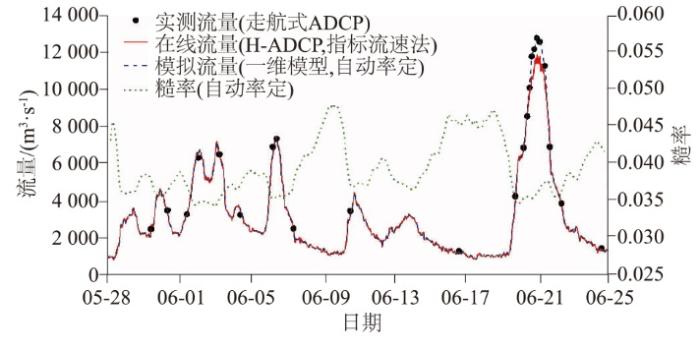
图2 2022年流量自动率定结果和糙率变化过程

Fig.2 Results of automatic flow calibration and roughness variation process in 2022

3.2 BP神经网络训练结果

采用兰溪站及3个辅助水位计测得的2022年、2023年共9场洪水流量和水位数据,进行模型自动率定,以兰溪站、金华江、衢江和下游的水位与糙率作为模型训练数据集。BP神经网络层数为100层,激活函数取ReLU函数,损失函数采用均方误差最小函数,学习率取0.1,学习率取值较小虽然使得训练过程缓慢,但可保证训练计算的稳定性。根据训练好的水位糙率关系输入一维水动力模型中进行计算得到兰溪站断面流量计算精度以评估BP神经网络模型,计算结果如图3所示。从计算结果可知:①水动力模型的计算流量过程与实测流量过程吻合良好,过程决定系数为0.99,在20220621场次洪水中采用指标流速法计算洪峰流量的相对误差为7.02%,而采用水动力模型计算洪峰流量的相对误差为1.75%;②中低水位时流量模拟精度高于高水位时的流量模拟精度,这是由于中低水的水位糙率训练数据量比较大,根据BP神经网络训练的水位糙率关系就比较准确。未来将监测到的实测大洪水作为训练数据不断更新BP神经网络关系,高水位时的流量计算精度可进一步提高。
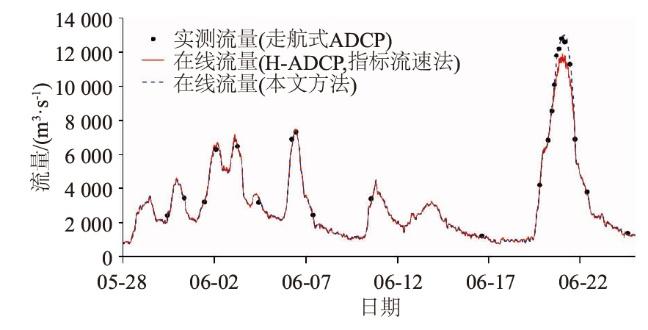
图3 2022年兰溪断面计算流量过程与实测流量过程对比(模型训练)

Fig.3 Comparison between simulated and measured flow process of Lanxi section in 2022 (model training)

3.3 BP神经网络预测结果

采用2024年3场洪水期间的兰溪站、金华江、衢江、下游的水位为输入,利用BP神经网络进行关系训练,然后根据水位校正糙率,输入一维水动力模型进行兰溪测站断面流量计算,计算结果如图4所示。从计算结果可知:①水动力模型的计算流量过程与实测流量过程吻合良好,过程决定系数为0.998,表明BP神经网络训练水位糙率关系是准确的;②与模型训练结果一样,在中低水位时的流量模拟精度高于高水位时的流量模拟精度。
图4 2024年兰溪断面计算流量与实测流量对比 (模型预测)

Fig.4 Comparison between calculated and measured flow process at Lanxi section in 2024 (model prediction)

3.4 对比分析

选择3场较大的场次洪水,采用指标流速法和水动力模型的计算洪峰流量和实测洪峰流量的相对误差统计见表1。由表1可知,3场洪水采用指标流速法计算洪峰流量的相对误差为2.9%~7.0%,水动力模型计算洪峰流量的相对误差为1.7%~2.7%,水动力模型的洪水流量计算精度均高于指标流速法。其原因是,指标流速法在建立指标流速和断面平均流速关系时,仅采用走航式实测流量来率定相关关系,导致洪峰流量模拟误差较大;而水动力模型使用实测流量自动率定模型糙率数,根据实时上下游水位来校正糙率进行模型在线计算流量,采用较多的实时水位信息校正同化模型参数,从而提高了断面在线流量计算精度。
表1 3场洪水的洪峰流量计算精度统计

Table 1 Statistics of accuracy of peak flow calculation for three flood events

洪水
场次
编号
洪峰流量
实测值/
(m3·s-1)
指标流速法 水动力模型
计算值/
(m3·s-1)
相对误
差/%
计算值/
(m3·s-1)
相对误
差/%
20220621 12 800 11 900 7.0 13 020 1.7
20240619 7 080 7 340 3.7 6 955 1.8
20240626 10 200 10 500 2.9 10 480 2.7

4 结论与展望

(1)一维水动力模型利用上下游水位实现了水文测站流量在线高精度计算。以兰溪水文站为例验证了一维水动力模型的适用性,尤其是大洪水高水位过程的流量计算精度较指标流速法有显著提高。
(2)一维水动力模型适用于位于河道上游或中游、河床断面稳定、可忽略泥沙冲淤影响的水文测站的流量在线计算。
(3)下一步将针对受涨落潮、泥沙冲淤等变化影响的水文测站,利用上下游水位、断面监测流速等信息对一维或三维水动力模型同化计算,对本文一维水动力模型进行改进完善,深入开展水文测站的流量在线计算研究。
[1]
韦立新, 蒋建平, 曹贯中. 基于ADCP实时指标流速的感潮段断面流量计算[J]. 人民长江, 2016, 47(1): 27-30.

(WEI Li-xin, JIANG Jian-ping, CAO Guan-zhong. Study on Sectional Flow Calculation in Tidal Reach by ADCP Real-time Index Velocity[J]. Yangtze River, 2016, 47(1): 27-30. (in Chinese))

[2]
肖林. 组合式流量在线监测系统在变动回水断面的应用[J]. 水文, 2018, 38(3): 69-72, 61.

(XIAO Lin. Application of Combined On-line Flow Monitoring System in Variable Backwater Section[J]. Journal of China Hydrology, 2018, 38(3): 69-72, 61. (in Chinese))

[3]
杜兴强, 沈健, 樊铭哲. H-ADCP流量在线监测方案在高坝洲的应用与改进[J]. 水文, 2018, 38(6): 81-83.

(DU Xing-qiang, SHEN Jian, FAN Ming-zhe. Application and Improvement of H-ADCP Online Monitoring Program at Gaobazhou Station[J]. Journal of China Hydrology, 2018, 38(6): 81-83. (in Chinese))

[4]
门玉丽, 夏军, 叶爱中. 水位流量关系曲线的理论求解研究[J]. 水文, 2009, 29(1): 1-3, 62.

(MEN Yu-li, XIA Jun, YE Ai-zhong. Theoretical Equation of Stage-discharge Relation Curve[J]. Journal of China Hydrology, 2009, 29(1): 1-3, 62. (in Chinese))

[5]
罗铭, 丁锐, 黄尔, 等. 山区河流水位流量关系曲线研究[J]. 工程科学与技术, 2019, 51(5):137-142.

(LUO Ming, DING Rui, HUANG Er, et al. Study on Stage-Discharge Relationship Curve in Mountain Rivers[J]. Advanced Engineering Sciences, 2019, 51(5): 137-142. (in Chinese))

[6]
PETERSEN-ØVERLEIR A. Modelling Stage-Discharge Relationships Affected by Hysteresis Using the Jones Formula and Nonlinear Regression[J]. Hydrological Sciences Journal, 2006, 51(3): 365-388.

DOI

[7]
舒大兴, 周忠远. 两因素同时校正法推求河道洪水流量[J]. 河海大学学报, 1995, 23(3):51-57.

(SHU Da-xing, ZHOU Zhong-yuan. River Discharge Data Derived by Two Simultaneously Corrected Factors Method[J]. Journal of Hohai University (Natural Sciences), 1995, 23(3): 51-57. (in Chinese))

[8]
FREAD D L. Computation of Stage-discharge Relationships Affected by Unsteady Flow[J]. Journal of the American Water Resources Association, 1975, 11(2): 213-228.

DOI

[9]
LEE K, MUSTE M. Refinement of the Fread Method for Improved Tracking of Stream Discharges during Unsteady Flows[J]. Journal of Hydraulic Engineering, 2017, 143(6): 06017003.

DOI

[10]
杨清伟, 廖翔, 包文君, 等. 汛期连续洪水情形下长江下游Z-Q关系曲线分析[J]. 重庆交通大学学报(自然科学版), 2018, 37(1): 62-65, 115.

DOI

(YANG Qing-wei, LIAO Xiang, BAO Wen-jun, et al. Z-Q Relationship Curve Analysis for the Lower Reaches of the Yangtze River in the Case of Continuous Flood in Flood Season[J]. Journal of Chongqing Jiaotong University (Natural Science), 2018, 37(1): 62-65, 115. (in Chinese))

[11]
丁佩, 罗小峰, 刘星璐, 等. 受回水变动与洪水涨落综合影响的水位流量关系研究[J]. 水文, 2022, 42(6):7-12.

(DING Pei, LUO Xiao-feng, LIU Xing-lu, et al. Study on Stage Discharge Relationship Affected by the Comprehensive Influence of Backwater and Flood[J]. Journal of China Hydrology, 2022, 42(6): 7-12. (in Chinese))

[12]
陈瑞祥, 谢自银, 许钦, 等. 基于一维水动力学的水位流量关系研究[J]. 水电能源科学, 2018, 36(3): 113-117.

(CHEN Rui-xiang, XIE Zi-yin, XU Qin, et al. Modeling Stage-discharge Relationship Based on One-dimensional Hydrodynamic Theory[J]. Water Resources and Power, 2018, 36(3): 113-117. (in Chinese))

[13]
王文种, 刘宏伟, 彭安帮, 等. 水口水电站坝下治理工程实施后尾水位-流量关系分析[J]. 水电能源科学, 2019, 37(9): 21-23, 54.

(WANG Wen-zhong, LIU Hong-wei, PENG An-bang, et al. Analysis of Tail Water Level-discharge Relationship after Implementing below Dam Treatment Project of Shuikou Hydropower Station[J]. Water Resources and Power, 2019, 37(9): 21-23, 54. (in Chinese))

[14]
NIHEI Y, KIMIZU A. A Method for Evaluation of River Velocity and Discharge with A New Assimilation Technique[J]. Doboku Gakkai Ronbunshu, 2005(803):155-160.

[15]
李光炽, 周晶晏, 张贵寿. 用卡尔曼滤波求解河道糙率参数反问题[J]. 河海大学学报(自然科学版), 2003, 31(5): 490-493.

(LI Guang-chi, ZHOU Jing-yan, ZHANG Gui-shou. Inverse Analysis of River Channel Roughness Parameter by Use of Kalman Filter[J]. Journal of Hehai University (Natural Sciences), 2003, 31(5): 490-493. (in Chinese))

[16]
葛守西, 程海云, 李玉荣. 水动力学模型卡尔曼滤波实时校正技术[J]. 水利学报, 2005, 36(6): 687-693.

(GE Shou-xi, CHENG Hai-yun, LI Yu-rong. Real Time Updating of Hydrodynamic Model by Using Kalman Filter[J]. Journal of Hydraulic Engineering, 2005, 36(6): 687-693. (in Chinese))

[17]
王船海, 吴晓玲, 周全. 卡尔曼滤波校正技术在水动力学模型实时洪水预报中的应用[J]. 河海大学学报(自然科学版), 2008, 36(3): 300-305.

(WANG Chuan-hai, WU Xiao-ling, ZHOU Quan. Application of Kalman Filter Technique in Real-time Flood Forecasting[J]. Journal of Hohai University (Natural Sciences), 2008, 36(3): 300-305. (in Chinese))

[18]
李三平, 方益铭, 陈婉莹, 等. H-ADCP系统在回水顶托场合的应用: 以兰溪水文站流量测验为例[J]. 浙江水利科技, 2021, 49(3): 83-86, 90.

(LI San-ping, FANG Yi-ming, CHEN Wan-ying, et al. Application of H-ADCP System in Backwater Jacking: A Case Study of Discharge Measurement at Lanxi Hydrological Station[J]. Zhejiang Hydrotechnics, 2021, 49(3): 83-86, 90. (in Chinese))

[19]
RUMELHART D E, HINTON G E, WILLIAMS R J. Learning Representations by Back-propagating Errors[J]. Nature, 1986, 323(6088): 533-536.

DOI

[20]
李鑫, 刘艳丽, 朱士江, 等. 基于新安江模型和BP神经网络的中小河流洪水模拟研究[J]. 中国农村水利水电, 2022(1): 93-97.

(LI Xin, LIU Yan-li, ZHU Shi-jiang, et al. Research on the Flood Simulation of Medium and Small Rivers Based on Xin’anjiang Model and BP Neural Network[J]. China Rural Water and Hydropower, 2022(1): 93-97. (in Chinese))

Outlines

/