Rock-Soil Engineering

Approximate Theoretical Analysis of Stress in Anchorage Section of Pressure Cable Affected by Anchorage Angle

  • YE Hong , 1, 2 ,
  • TAO Ting-quan 3 ,
  • LI Yan 1, 2 ,
  • CHEN Yan-ping 2
Expand
  • 1 School of Civil Engineering and Architecture, Wuhan University of Technology, Wuhan 430070, China
  • 2 School of Transportation Engineering, Wuhan Technical College of Communications, Wuhan 430065, China
  • 3 CCCC-FHDI Engineering Co., Ltd., Guangzhou 510230, China

Received date: 2023-08-19

  Revised date: 2023-11-01

  Online published: 2025-01-21

Abstract

To more accurately investigate the anchorage mechanism of pressure cables,in consideration of plane stress conditions,we derived the approximate theoretical solutions for both the compressive stress of the grouting body of pressure anchor cable and the shear stress between anchor solid and rock-soil layer based on Mindlin’s fundamental solution. Through example analysis,we revealed an inverse relationship between the anchorage angle and the stress distribution curve of the grouting body, as well as a power function relationship between the anchorage angle and the peak stress of the grouting body in the anchoring section. The anchorage angle significantly influences both the compressive stress of the grouting body at the anchoring section and the shear stress at the interface between anchor solid and rock-soil layer. These findings not only enrich the understanding of the pressure cable anchorage mechanism but also provide valuable references for the development and application of new anchoring technologies. Additionally,they offer theoretical support for the design of pressure anchor cables in rock and soil engineering.

Cite this article

YE Hong , TAO Ting-quan , LI Yan , CHEN Yan-ping . Approximate Theoretical Analysis of Stress in Anchorage Section of Pressure Cable Affected by Anchorage Angle[J]. Journal of Changjiang River Scientific Research Institute, 2025 , 42(1) : 136 -143 . DOI: 10.11988/ckyyb.20230906

开放科学(资源服务)标识码(OSID):

0 引言

压力型锚索作为一种结构复杂的新型锚固措施[1],由于其具有承载力高、防腐性能好、浆体不易开裂等诸多优点[2],充分发挥了灌浆体受压和钢绞线受拉的材料性能[3],具有实用、安全、经济的特点[4]。目前压力型锚索已被广泛的应用于洞室加固、边坡支护、滑坡整治、基础锚固等各工程领域,同时许多学者已对该项加固技术开展深入研究,致使该技术发展迅速[5]
虽然岩土体加固理论不断被完善(其中压力型锚索锚固机理的理论研究取得了较多成果)[6],但由于岩土体的多样性、复杂性和不确定性[7],导致压力型锚索锚固机理的理论研究成果还不够成熟,还不能完全满足当前工程的实际需要[8]
近期关于压力型锚索锚固机理的理论研究成果有:王勇华等[9]基于三线型剪切-滑移模型理论研究了黄土地区压力型锚索的锚固机理;赵圳等[10]引入强度折减系数考虑钻孔注浆的挤压效应理论推导了压力型锚索锚固段的剪应力和轴力的数学表达式;周刚等[11]考虑分数黏弹性模型,结合弹性空间Kelvin理论解,推导出了压力型锚索锚固段应力的黏弹性解析解;李艳等[12]结合锚索预应力变化和锚索孔周边软弱岩土体蠕变之间的耦合效应关系,基于明德林(Mindlin)理论解推导了圆形均布荷载作用下压力型锚索锚固段处应力的解析解。目前关于倾角对锚索锚固效应影响的研究成果主要如下:冯俊伟等[13]、林杭等[14]、黄明辉等[15]、温彦良等[16]、孟海东等[17]和牛奋蹄等[18]通过数值模拟方法分析了倾角对锚杆(索)将拉力传至稳定岩土层的影响,研究了锚杆(索)系统倾角的作用机理;甘伟[19]通过模型试验对比分析了单一倾角锚杆和多倾角组合锚杆对边坡的支护效果;江建洪等[20]采用摩尔-库伦强度理论推导考虑倾角影响的扩大头锚杆极限端压力和抗拔力的表达式,从力学机制层面解释土体黏聚力、内摩擦角和扩大头埋深对极限端压力随锚杆倾角变化的影响。以上关于压力型锚索锚固机理的理论研究成果很少考虑锚索倾角因素,关于锚索倾角对锚索锚固效应影响的研究成果则主要是通过数值模拟方法得到的,采用理论方法和试验方法的研究成果也很少,显然忽略锚索倾角影响压力型锚索锚固机理的理论研究不符合工程实际需要。为了使压力型锚索锚固机理的理论研究成果更加接近工程实际,本文拟以Mindlin理论解中的应力数学解为基础,结合压力型锚索锚固段注浆体所受荷载的特点和平面应力状态的应力分析[21],考虑锚索倾角因素对压力型锚索锚固段处注浆体的压应力和剪应力进行理论分析,以此进一步丰富压力型锚索锚固机理的理论研究内容。

1 弯曲锚固段剪应力推导

1.1 Mindlin理论

基于布西奈斯克(Boussinesq)理论解,美国学者Mindlin于1936年推导出了直角坐标系下竖向集中力Pv和水平向集中力Ph分别作用在弹性半无限空间内任一点的应力数学解和位移数学解,该数学解即为Mindlin理论解[22],目前Mindlin理论解被广泛的应用到岩土工程中[23]
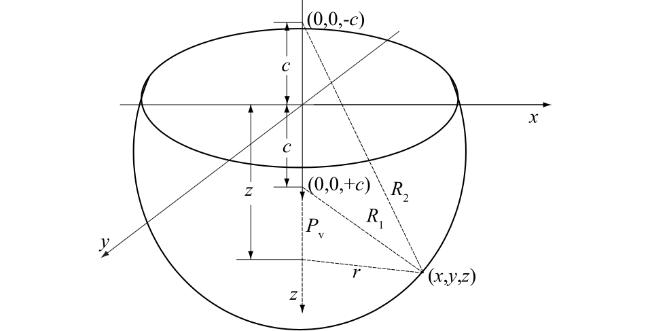
直角坐标系下竖向集中力Pv作用在弹性半无限空间内任一点的应力解示意图如图1所示,其应力数学解为式(1)—式(6)[22]
图1 竖向集中力作用下明德林理论解示意图

Fig.1 Schematic diagram of Mindlin’s theoretical solution under vertical single force

σ v x = P v 8 π ( 1 - μ ) ( 1 - 2 μ ) ( z - c ) R 1 3 - 3 x 2 ( z - c ) R 1 5 + ( 1 - 2 μ ) [ 3 ( z - c ) - 4 μ ( z + c ) ] R 2 3 - 3 ( 3 - 4 μ ) x 2 ( z - c ) - 6 c ( z + c ) [ ( 1 - 2 μ ) z - 2 μ c ] R 2 5 - 30 c x 2 z ( z + c ) R 2 7 - 4 ( 1 - μ ) ( 1 - 2 μ ) R 2 ( R 2 + z + c ) ( 1 - x 2 R 2 ( R 2 + z + c ) - x 2 R 2 2   ;

σ v y = P v 8 π ( 1 - μ ) ( 1 - 2 μ ) ( z - c ) R 1 3 - 3 y 2 ( z - c ) R 1 5 +

( 1 - 2 μ ) [ 3 ( z - c ) - 4 μ ( z + c ) ] R 2 3 -

3 ( 3 - 4 μ ) y 2 ( z - c ) - 6 c ( z + c ) [ ( 1 - 2 μ ) z - 2 μ c ] R 2 5 -

30 c y 2 z ( z + c ) R 2 7 - 4 ( 1 - μ ) ( 1 - 2 μ ) R 2 ( R 2 + z + c ) ( 1 -

y 2 R 2 ( R 2 + z + c ) - y 2 R 2 2   ;

σ v z = P v 8 π ( 1 - μ ) - ( 1 - 2 μ ) ( z - c ) R 1 3 + ( 1 - 2 μ ) ( z - c ) R 2 3 -  

3 ( z - c ) 3 R 1 5 - 3 ( 3 - 4 μ ) z ( z + c ) 2 - 3 c ( z + c ) ( 5 z - c ) R 2 5 -

30 c z ( z + c ) 3 R 2 7   ;

τ v y z = P v y 8 π ( 1 - μ ) - 1 - 2 μ R 1 3 + 1 - 2 μ R 2 3 - 3 ( z - c ) 2 R 1 5 -

3 ( 3 - 4 μ ) z ( z + c ) - 3 c ( 3 z + c ) R 2 5 - 30 c z ( z + c ) 3 R 2 7   ;

τ v z x = P v x 8 π ( 1 - μ ) - 1 - 2 μ R 1 3 + 1 - 2 μ R 2 3 - 3 ( z - c ) 2 R 1 5 -

3 ( 3 - 4 μ ) z ( z + c ) - 3 c ( 3 z + c ) R 2 5 - 30 c z ( z + c ) 2 R 2 7   ;

τ v x y = P v x y 8 π ( 1 - μ ) - 3 ( z - c ) R 1 5 - 3 ( 3 - 4 μ ) ( z + c ) R 2 5 +

4 ( 1 - μ ) ( 1 - 2 μ ) R 2 ( R 2 + z + c ) ( 1 R 2 + z + c - 1 R 2 ) - 30 c z ( z + c ) R 2 7  
直角坐标系下水平集中力Ph作用在弹性半无限空间内任一点的应力解示意图如图2所示,其应力数学解为式(7)—式(12)[22]
图2 水平集中力作用下明德林理论解示意图

Fig.2 Schematic diagram of Mindlin’s theoretical solution under horizontal single force

$\begin{array}{c} \sigma_{\mathrm{h} x}=\frac{P_{\mathrm{h}} x}{8 \pi(1-\mu)}\left[-\frac{1-2 \mu}{R_{1}^{3}}+\frac{(1-2 \mu)(5-4 \mu)}{R_{2}^{3}}-\frac{3 x^{2}}{R_{1}^{5}}-\right. \\ \frac{3(3-4 \mu) x^{2}}{R_{2}^{5}}-\frac{4(1-\mu)(1-2 \mu)}{R_{2}\left(R_{2}+z+c\right) 2}(3- \\ \left.\frac{x^{2}\left(3 R_{2}+z+c\right)}{R_{2}^{2}\left(R_{2}+z+c\right)}+\frac{6 c}{R_{2}^{5}}\left(3 c-(3-2 \mu)(z+c)+\frac{5 x^{2} z}{R_{2}^{2}}\right)\right] ; \end{array}$
$\begin{array}{c} \sigma_{\mathrm{hy}}=\frac{P_{\mathrm{h}} x}{8 \pi(1-\mu)}\left[\frac{1-2 \mu}{R_{1}^{3}}+\frac{(1-2 \mu)(3-4 \mu)}{R_{2}^{3}}-\frac{3 y^{2}}{R_{1}^{5}}-\right. \\ \frac{3(3-4 \mu) y^{2}}{R_{2}^{5}}-\frac{4(1-\mu)(1-2 \mu)}{R_{2}\left(R_{2}+z+c\right) 2}(1- \\ \left.\frac{y^{2}\left(3 R_{2}+z+c\right)}{R_{2}^{2}\left(R_{2}+z+c\right)}+\frac{6 c}{R_{2}^{5}}\left(c-(1-2 \mu)(z+c)+\frac{5 y^{2} z}{R_{2}^{2}}\right)\right] ; \end{array}$

σ h z = P h x 8 π ( 1 - μ ) 1 - 2 μ R 1 3 - 1 - 2 μ R 2 3 - 3 ( z - c ) 2 R 1 5 -

3 ( 3 - 4 μ ) ( z + c ) R 2 5 + 6 c R 2 5 ( c + ( 1 - 2 μ ) ( z + c ) + 5 z ( z + c ) 2 R 2 2 ) ;

τ h y z = P h x y 8 π ( 1 - μ ) - 3 ( z - c ) R 1 5 - 3 ( 3 - 4 μ ) ( z + c ) R 2 5 +

6 c R 2 5 ( 1 - 2 μ ) + 5 z ( z + c ) R 2 2 )   ;

τ h z x = P h 8 π ( 1 - μ ) - ( 1 - 2 μ ) ( z - c ) R 1 3 + ( 1 - 2 μ ) ( z - c ) R 2 3 -

3 x 2 ( z - c ) R 1 5 - 3 ( 3 - 4 μ ) x 2 ( z + c ) R 2 5 - 6 c R 2 5 ( z ( z + c ) -

( 1 - 2 μ ) x 2 - 5 x 2 z ( z + c ) R 2 2 )   ;
$\begin{array}{c} \tau_{\mathrm{hxy}}=\frac{P_{\mathrm{h}} y}{8 \pi(1-\mu)}\left[-\frac{1-2 \mu}{R_{1}^{3}}+\frac{1-2 \mu}{R_{2}^{3}}-\frac{3 x^{2}}{R_{1}^{5}}-\frac{3(3-4 \mu) x^{2}}{R_{2}^{5}}-\right. \\ \frac{4(1-\mu)(1-2 \mu)}{R_{2}\left(R_{2}+z+c\right)^{2}}\left(1-\frac{x^{2}\left(3 R_{2}+z+c\right)}{R_{2}^{2}\left(R_{2}+z+c\right)}-\frac{6 c z}{R_{2}^{5}}(1-\right. \\ \left.\left.\frac{5 x^{2}}{R_{2}^{2}}\right)\right]。 \end{array}$
在明德林(Mindlin)理论解的式(1)—式(12)中,σvx、σvy、σvz、τvyz、τvzx、τvxy为竖向集中力作用在弹性半无限空间内任一点的主应力和剪应力,σhx、σhy、σhz、τhyz、τhzx、τhxy为水平集中力作用在弹性半无限空间内任一点的主应力和剪应力μ为弹性半无限空间体的泊松比;xyz为直角坐标系中的坐标分量,c为作用点至半无限平面的距离,其中R1= x 2 + y 2 + ( z - c ) 2= r 2 + ( z - c ) 2,R2= x 2 + y 2 + ( z + c ) 2= r 2 + ( z + c ) 2;其他参数含义详见参考文献[21]。

1.2 锚索锚固体所受应力推导

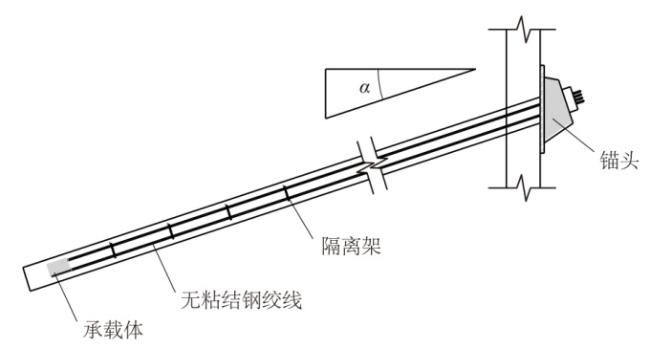
压力型锚索体系由锚头、无粘结钢绞线、承载体、注浆体等组成(如图3所示)[24],在使用过程中考虑灌浆饱满度和垂直分力的共同影响其倾角宜采用10°~35°[2]。压力型锚索的工作原理是通过无粘结钢绞线将预应力由底部承载体传递给锚固段,使底部注浆体受压[25]。压力型锚索承载体前注浆体的破坏形式主要有承压板附近注浆体的受压破坏和注浆体与岩土层间的剪切破坏[26],因此锚索锚固体与岩土层间的剪应力和注浆体受到的压应力是本文的主要研究对象。
图3 压力型锚索体系示意图

Fig.3 Schematic diagram of pressure anchor cable system

总结前人经验,在实际工程中通常将注浆体和岩土体近似看为同性弹性体,其力学性质在任何方向一致[27];结合已有研究结果,压力型锚索锚固体与岩土层间的剪应力和注浆体受到的压应力轴对称分布[28]。因此,可令式(1)—式(12)中的y=0,研究过程由位于三维直角坐标系中进行简化到在XOZ平面直角坐标系中进行。另外,考虑到在XOZ平面中τvyzvxy=0、τhyzhxy=0,且σvy和σhy垂直于XOZ平面,根据这种特殊空间点应力状态的应力分析可不考虑σvy和σhy的影响[29]

σ v x = P v 8 π ( 1 - μ ) ( 1 - 2 μ ) ( z - c ) R 1 3 - 3 x 2 ( z - c ) R 1 5 +

( 1 - 2 μ ) [ 3 ( z - c ) - 4 μ ( z + c ) ] R 2 3 -

3 ( 3 - 4 μ ) x 2 ( z - c ) - 6 c ( z + c ) [ ( 1 - 2 μ ) z - 2 μ c ] R 2 5 -

30 c x 2 z ( z + c ) R 2 7 - 4 ( 1 - μ ) ( 1 - 2 μ ) R 2 ( R 2 + z + c ) ( 1 -

x 2 R 2 ( R 2 + z + c ) - x 2 R 2 2 - x 2 R x 2   ;

σ v z = P v 8 π ( 1 - μ ) ( 1 - 2 μ ) ( z - c ) R 1 3 + ( 1 - 2 μ ) ( z - c ) R 2 3 -

3 ( z - c ) 3 R 1 5 - 3 ( 3 - 4 μ ) z ( z + c ) 2 - 3 c ( z + c ) ( 5 z - c ) R 2 5 - 30 c z ( z + c ) 3 R 2 7   ;

τ v z x = P v x 8 π ( 1 - μ ) - 1 - 2 μ R 1 3 + 1 - 2 μ R 2 3 - 3 ( z - c ) 2 R 1 5 -

3 ( 3 - 4 μ ) z ( z + c ) - 3 c ( 3 z + c ) R 2 5 - 30 c z ( z + c ) 2 R 2 7   ;

σ h x = P h x 8 π ( 1 - μ ) - 1 - 2 μ R 1 3 + ( 1 - 2 μ ) ( 5 - 4 μ ) R 2 3 - 3 x 2 R 1 5 -

3 ( 3 - 4 μ ) x 2 R 2 5 - 4 ( 1 - μ ) ( 1 - 2 μ ) R 2 ( R 2 + z + c ) 2 ( 3 - x 2 ( 3 R 2 + z + c ) R 2 2 ( R 2 + z + c ) +

6 c R 2 5 ( 3 c - ( 3 - 2 μ ) ( z + c ) + 5 x 2 z R 2 2 )   ;

σ h z = P h x 8 π ( 1 - μ ) 1 - 2 μ R 1 3 - 1 - 2 μ R 2 3 - 3 ( z - c ) 2 R 1 5 -

3 ( 3 - 4 μ ) ( z + c ) 2 R 2 5 + 6 c R 2 5 ( c + ( 1 - 2 μ ) ( z + c ) +   5 z ( z + c ) 2 R 2 2 )   ;

τ h z x = P h 8 π ( 1 - μ ) - ( 1 - 2 μ ) ( z - c ) R 1 3 + ( 1 - 2 μ ) ( z - c ) R 2 3 -

3 x 2 ( z - v c ) R 1 5 - 3 ( 3 - 4 μ ) x 2 ( z + c ) R 2 5 - 6 c R 2 5 ( z + ( z + c ) -

( 1 - 2 μ ) x 2 - 5 x 2 z ( z + c ) R 2 2 )  
在式(13)—式(18)中,其中R1= x 2 + ( z - c ) 2,R2= x 2 + ( z + c ) 2 [30]。式(13)—式(15)为平面直角坐标系下竖向集中力Ph作用得到的压力型锚索锚固段任意点的应力状态,式(16)—式(18)为水平集中力Ph作用得到的压力型锚索锚固段任意点的应力状态。通过应力叠加原理[31],由式(13)-式(18)可得到平面直角坐标系中任一集中力P作用下压力型锚索锚固段任意点的应力状态,如式(19)。
σ x = σ v x + σ h x   ; σ z = σ v z + σ h z   ; τ x z = τ v z x + τ h z x  
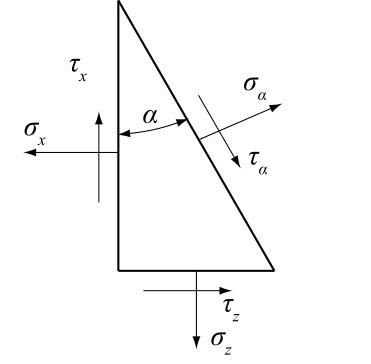
平面应力状态的应力分析,即在材料力学和弹性力学中通过坐标旋转变换得到某点的应力公式(如图4所示),也称为斜面应力公式,如式(20),常用于工程设计中[32],少量研究结果表明平面应力状态的应力分析可对压力型锚索锚固段某点的正应力和剪应力进行分析[29]
σ α = σ x + σ z 2 + σ x - σ z 2 c o s 2 α - τ z x s i n 2 α   ; τ α = σ x + σ z 2 s i n 2 α + τ z x c o s 2 α  
图4 平面应力状态应力分析示意图

Fig.4 Stress analysis in plane stress state

通过对式(19)式(20)的平面应力状态(σxσzτzx)进行应力分析,考虑锚索倾角可得压力型锚索锚固段注浆体受到的法向正应力σα,如式(21);同理可得到压力型锚索锚固段与岩土层间的切向剪应力τα,如式(22)。
σ α = σ x + σ z 2 + σ x - σ z 2 c o s ( π - 2 α ) -   τ z x s i n ( π - 2 α )   ;
τ α = ( σ x - σ z ) / 2 + s i n 2 α + τ z x c o s 2 α  
式(21)中σα为压力型锚索锚固段注浆体受到的压应力,式(22)中τα为压力型锚索锚固段与岩土层间的剪应力。

2 算例

以二广高速公路(粤境)怀集至三水段某高边坡压力型锚索现场试验参数为基础,参考芮瑞等关于压力型锚索锚固段受力特性分析结果[33],结合《建筑边坡工程技术规范》(GB 50330—2013)中有关参数要求,开展算例分析。压力型锚索加固初步设计参数如下:该高边坡为材料性能相对均匀的风化变质砂岩,其中坡体变质砂岩的泊松比为μ=0.3,单轴饱和抗压强度为20.72~30.56 MPa;锚索孔深5 m,承载体位于锚索孔4.5 m深处,锚索所受轴向拉力为P=100 kN,通过力的分解可得到半无限体内竖向集中力Pv=Pcosα和水平集中力Ph=Psinα,锚索倾角α位于10°~35°之间[2]。拟通过式(21)和式(22)分别研究压力型锚索倾角对注浆体受到的压应力分布和锚固段与岩土层间的剪应力分布的影响。
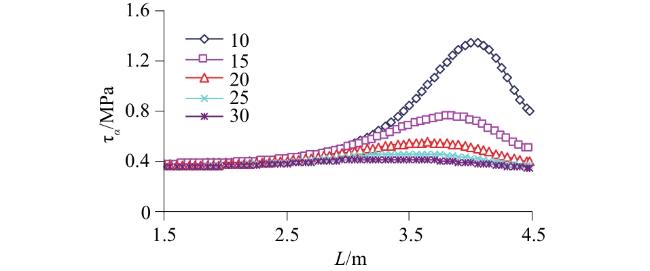
如果此算例中压力型锚索倾角(锚索轴线与水平面的夹角)分别为10°、15°、20°、25°和30°时,图5为压力型锚索锚固段注浆体受到的压应力分布曲线,图6为压力型锚索锚固段与岩土层间的剪应力分布曲线,表1图5图6不同倾角应力分布曲线锚索锚固段应力峰值,图7为不同锚索倾角锚固段应力峰值分布曲线。
图5 注浆体受到的压应力分布曲线

Fig.5 Curves of compressive stress distribution for the grouting body

图6 锚固段与岩层间的剪应力分布曲线

Fig.6 Curves of shear stress distribution between anchoring section and rock

图7 不同锚索倾角锚固段应力峰值分布曲线

Fig.7 Peak stresses of anchoring section with different anchorage angles

表1 不同锚索倾角锚固段应力峰值

Table 1 Peak stresses of anchoring section with different anchorage angles

倾角/
(°)
压应力峰
值/MPa
剪应力峰
值/MPa
倾角/
(°)
压应力峰
值/MPa
剪应力峰
值/MPa
10 1.431 07 1.344 09 25 0.252 79 0.460 64
15 0.696 87 0.752 60 30 0.161 14 0.415 65
20 0.404 86 0.550 10
表1可知:锚索倾角为10°时压力型锚索锚固段与岩土层间的剪应力峰值为1.344 09 MPa,与芮瑞等研究成果中的数值模拟结果接近[33]
图5表1可知:锚索倾角越大,注浆体受到的压应力分布曲线越平缓,相应的压应力峰值越小;反之,锚索倾角越小,注浆体受到的压应力分布曲线也越陡峭,相应的压应力峰值也越大。即注浆体受到的压应力分布曲线随倾角的增加而逐渐平缓,压应力峰值逐渐减小。
图6表1可知:锚索倾角越小,锚固段与岩土层间的剪应力分布曲线就越陡峭,相应的剪应力峰值也越大;锚索倾角越大,锚固段与岩土层间的剪应力分布曲线就越平缓,相应的剪应力峰值也越小。即锚固段与岩土层间的剪应力分布曲线随倾角的减小而逐渐陡峭,剪应力峰值逐渐增加。
图7可知:注浆体受到的压应力峰值分布曲线和锚固段与岩土层间的剪应力峰值分布曲线均按幂函数变化,且应力峰值随着锚索倾角的逐渐增加而逐渐减小。
锚索倾角对应力分布曲线和应力峰值的影响主要是因力的分解可得到的竖向集中力Pv=Pcosα、水平集中力Ph=Psinα和平面应力状态分析中的sin(π-α)、cos(π-α)共同作用的结果;同理,锚索倾角对锚固段与岩土层间的剪应力分布曲线和剪应力峰值的影响主要是由力的分解中的sinα、cosα和平面应力状态分析(式(22))中的sin2α、cos2α共同影响的结果。

3 结论

基于Mindlin理论和平面应力状态的应力分析推导了压力型锚索锚固段应力近似理论解,通过算例分析了锚索倾角对压力型锚索锚固段注浆体应力的影响,获得的主要结论如下:
(1)压力型锚索锚固段注浆体受到的压应力分布曲线和锚固段与岩土层间的剪应力分布曲线同锚索倾角之间存在负相关关系,随锚索倾角的增加而趋于平缓,随锚索倾角的减小而趋于陡峭。
(2)压力型锚索锚固段注浆体受到的压应力峰值和锚固段与岩土层间的剪应力峰值同锚索倾角之间也存在负相关关系,且锚索锚固段应力峰值分布曲线按幂函数变化,锚索倾角逐渐增加应力峰值逐渐减小,锚索倾角逐渐减小应力峰值逐渐增加。
考虑倾角影响压力型锚索锚固段应力的近似理论分析是目前压力型锚索锚固机理理论研究内容之一,虽然本文取得了一些理论研究成果,但还需要通过工程实践来进一步验证,以提高精准度。
[1]
王勇华, 王小勇, 牛云彪, 等. 黄土地区压力型锚索锚固机理数值模拟研究[J]. 地下空间与工程学报, 2020, 16(增刊2): 693-701.

(WANG Yong-hua, WANG Xiao-yong, NIU Yun-biao, et al. Numerical Simulation Research on Anchoring Mechanism of Compression Anchors in Loess Areas[J]. Chinese Journal of Underground Space and Engineering, 2020, 16(Supp. 2): 693-701. (in Chinese))

[2]
GB 50330—2013, 建筑边坡工程技术规范[S]. 北京: 中国建筑工业出版社, 2014.

(GB 50330—2013, Technical Code for Building Slope Engineering[S]. Beijing: China Architecture & Building Press, 2014. (in Chinese))

[3]
叶红, 陶廷权, 李艳. 地震作用下压力型锚索锚固段受力状态理论分析[J]. 长江科学院院报, 2023, 40(4): 107-112, 118.

DOI

(YE Hong, TAO Ting-quan, LI Yan. Theoretical Stress Analysis of Anchorage Section of Pressure Anchor Cable under Earthquake[J]. Journal of Changjiang River Scientific Research Institute, 2023, 40(4): 107-112, 118. (in Chinese))

[4]
GB 50086—2015, 岩土锚杆与喷射混凝土支护工程技术规范[S]. 北京: 中国计划出版社, 2016.

(GB 50086—2015, Technical Code for Engineering of Ground Anchoring and Shotcrete Support[S]. Beijing: China Planning Press, 2016. (in Chinese))

[5]
叶红, 陈燕平. 耦合效应下压力型锚索锚固机理的拟静力分析[J]. 长江科学院院报, 2020, 37(8): 89-94.

DOI

(YE Hong, CHEN Yan-ping. Pseudo-static Force Analysis of Anchorage Mechanism of Pressure-type Cable under Coupling Effect[J]. Journal of Yangtze River Scientific Research Institute, 2020, 37(8): 89-94. (in Chinese))

DOI

[6]
屈文涛, 马丽娜, 田晓, 等. 压力分散型锚索锚固段应力分布及影响参数分析[J]. 水利与建筑工程学报, 2021, 19(5): 23-27.

(QU Wen-tao, MA Li-na, TIAN Xiao, et al. Analysis of Stress Distribution and Influence Parameters in Anchorage Section of Pressure Dispersing Anchor Cable[J]. Journal of Water Resources and Architectural Engineering, 2021, 19(5): 23-27. (in Chinese))

[7]
苏滔, 彭少民. 岩土体地源介质库的类型与工程特性[J]. 武汉理工大学学报, 2007, 29(增刊2): 157-161.

(SU Tao, PENG Shao-min. Types and Engineering Characteristics of Geo-Media Reservoirs in Rock and Soil Masses[J]. Journal of Wuhan University of Technology, 2007, 29(Supp. 2): 157-161. (in Chinese))

[8]
张春文, 张艳, 徐民, 等. 公路高边坡压力分散型锚索锚固段应力分布规律理论研究[J]. 价值工程, 2022, 41(23): 114-116.

(ZHANG Chun-wen, ZHANG Yan, XU Min, et al. Theoretical Study on the Stress Distribution Law of the Anchorage Section of Anchor Cable with Pressure Dispersion Type on the High Slope of Highway[J]. Value Engineering, 2022, 41(23): 114-116. (in Chinese))

[9]
王勇华, 熊二刚, 王小勇. 黄土中压力型锚索锚固段应力分析[J]. 力学季刊, 2020, 41(2): 231-239.

DOI

(WANG Yong-hua, XIONG Er-gang, WANG Xiao-yong. Research on Anchoring Stress of Compression Anchors in Loess Areas[J]. Chinese Quarterly of Mechanics, 2020, 41(2): 231-239. (in Chinese))

DOI

[10]
赵圳, 许明. 压力型锚索锚固段剪应力数学解[J]. 路基工程, 2021(2): 31-34.

(ZHAO Zhen, XU Ming. Mathematical Solution of Shear Stress in Anchoring Section of Pressure Anchor Cable[J]. Subgrade Engineering, 2021(2): 31-34. (in Chinese))

[11]
周刚, 牛洁楠, 张维维, 等. 服从分数黏弹性模型的压力型锚索力学分析[J]. 信阳师范学院学报(自然科学版), 2020, 33(3):473-479.

(ZHOU Gang, NIU Jie-nan, ZHANG Wei-wei, et al. Mechanical Analysis of Pressure Type Cables Subject to Fractional Viscoelastic Model[J]. Journal of Xinyang Normal University (Natural Science Edition), 2020, 33(3): 473-479. (in Chinese))

[12]
叶红, 李艳. 基于Mindlin解耦合效应下压力型锚索的受力分析[J]. 武汉理工大学学报, 2019, 41(10):40-44.

(YE Hong, LI Yan. Force Analysis of Pressure Anchor Cable Based on Coupling Effect and Mindlin Solution[J]. Journal of Wuhan University of Technology, 2019, 41(10): 40-44. (in Chinese))

[13]
冯俊伟, 冯光明, 郑保才. 大倾角煤层回采巷道锚杆支护的数值模拟分析[J]. 煤炭工程, 2007, 39(2): 73-75.

(FENG Jun-wei, FENG Guang-ming, ZHENG Bao-cai. Analysis on Numerical Simulation of Bolt Support for Mining Gateway in Deep Inclined Seam[J]. Coal Engineering, 2007, 39(2): 73-75. (in Chinese))

[14]
林杭, 钟文文, 熊威, 等. 锚杆长度与边坡坡率对最优锚固角的影响[J]. 岩土工程学报, 2014, 36(增刊2):7-11.

(LIN Hang, ZHONG Wen-wen, XIONG Wei, et al. Effect of Bolt Length and Slope Rate on Optimum Anchorage Angle[J]. Chinese Journal of Geotechnical Engineering, 2014, 36(Supp. 2): 7-11. (in Chinese))

[15]
黄明辉, 陈乐意. 基于桩锚支护的基坑锚杆安置倾角优化分析[J]. 南昌航空大学学报(自然科学版), 2018, 32(2): 92-98.

(HUANG Ming-hui, CHEN Le-yi. Optimization Analysis of Inclination Angle of Anchor Rod of Foundation Pit Based on Pile-anchor Support[J]. Journal of Nanchang Hangkong University (Natural Sciences), 2018, 32(2): 92-98. (in Chinese))

[16]
温彦良, 路增祥. 基于FLAC3D的不同锚索组合角度锚固效应研究[J]. 煤炭技术, 2018, 37(8): 17-19.

(WEN Yan-liang, LU Zeng-xiang. Research on Anchorage Effect on Different Combination Angle of Anchor Cable Based on FLAC3D[J]. Coal Technology, 2018, 37(8): 17-19. (in Chinese))

[17]
孟海东, 崔小晋, 刘占宁. 缓倾斜煤层顶锚杆与锚索最佳角度组合研究[J]. 煤炭技术, 2018, 37(6): 1-3.

(MENG Hai-dong, CUI Xiao-jin, LIU Zhan-ning. Study on Optimal Combination of Roof Bolt and Anchor Cable of Slanted Coal Seam[J]. Coal Technology, 2018, 37(6): 1-3. (in Chinese))

[18]
牛奋蹄, 弓培林, 苏超, 等. 锚索角度对顶板剪切错动的控制作用及模拟研究[J]. 煤炭技术, 2022, 41(10):39-43.

(NIU Fen-ti, GONG Pei-lin, SU Chao, et al. Study on Control Effect and Simulation of Anchor Cable Angle on Roof Shear Dislocation[J]. Coal Technology, 2022, 41(10): 39-43. (in Chinese))

[19]
甘伟. 多倾角组合锚杆边坡支护模型试验[J]. 公路交通技术, 2018, 34(1):14-17.

(GAN Wei. Model Test for Multi-dip Combined Bolt Side Slope Support[J]. Technology of Highway and Transport, 2018, 34(1): 14-17. (in Chinese))

[20]
江建洪, 曾庆义, 马健. 考虑倾角影响的扩大头锚杆极限抗拔力[J]. 哈尔滨工业大学学报, 2022, 54(2):154-161.

(JIANG Jian-hong, ZENG Qing-yi, MA Jian. Ultimate Pullout Capacity of End-expanded Ground Anchors Considering Inclined Angle Effect[J]. Journal of Harbin Institute of Technology, 2022, 54(2): 154-161. (in Chinese))

[21]
叶红, 陈燕平. 基于Mindlin基本解的压力型锚索受力分析[J]. 金属矿山, 2015(4):114-118.

(YE Hong, CHEN Yan-ping. Force Analysis of Pressure-type Cable Based on Mindlin Basic Solution[J]. Metal Mine, 2015(4):114-118. (in Chinese))

[22]
MINDLIN R D. Force at a Point in the Interior of a Semi-Infinite Solid[J]. Physics, 1936, 7(5): 195-202.

[23]
王士杰, 张梅, 张吉占. 对Mindlin解求地基附加应力的进一步探讨[J]. 四川建筑科学研究, 2000, 26(1): 51-54.

(WANG Shi-jie, ZHANG Mei, ZHANG Ji-zhan. Calculating the Vertical Additional Stress in Soil by Using Mindlin’s Formula[J]. Building Science Research of Sichuan, 2000, 26(1): 51-54. (in Chinese))

[24]
叶红, 夏元友, 刘笑合, 等. 风化岩体中压力型锚索锚固长度设计方法[J]. 武汉理工大学学报, 2011, 33(1):100-103.

(YE Hong, XIA Yuan-you, LIU Xiao-he, et al. Design Method of Anchorage Length of the Pressure-type Anchor Cable in Weathered Rock[J]. Journal of Wuhan University of Technology, 2011, 33(1): 100-103. (in Chinese))

[25]
杨庆, 朱训国, 栾茂田. 压力型锚索锚固段应力分布及影响参数分析[J]. 岩石力学与工程学报, 2006, 25(增刊2): 4065-4070.

(YANG Qing, ZHU Xun-guo, LUAN Mao-tian. Analysis of Stress Distribution and Influential Parameters of Anchorage Segment of Pressure-type Cable[J]. Chinese Journal of Rock Mechanics and Engineering, 2006, 25(Supp. 2): 4065-4070. (in Chinese))

[26]
卢黎, 黎亮, 邓宇, 等. 压力型锚索承载板前砂浆体破坏机制试验研究[J]. 岩土工程学报, 2013, 35(11):2110-2116.

(LU Li, LI Liang, DENG Yu, et al. Failure Mechanism of Mortar in Front of Bearing Plate of Compression Type Anchor Cables[J]. Chinese Journal of Geotechnical Engineering, 2013, 35(11):2110-2116. (in Chinese))

[27]
叶红, 陈燕平. 风化岩体中压力型锚索抗震性能的数值模拟分析[J]. 武汉理工大学学报, 2015, 37(1):63-69.

(YE Hong, CHEN Yan-ping. Numerical Simulation on Seismic Performance of Pressure-type Anchorage Cable in Weathered Rock[J]. Journal of Wuhan University of Technology, 2015, 37(1):63-69. (in Chinese))

[28]
叶红, 盛建龙, 吝曼卿, 等. 风化岩体中压力型锚索锚固机理的研究[J]. 科学技术与工程, 2012, 12(36):9865-9869.

(YE Hong, SHENG Jian-long, LIN Man-qing, et al. Study on Anchored Mechanism of Pressure-type Anchorage Cable in Weathered Rock[J]. Science Technology and Engineering, 2012, 12(36): 9865-9869. (in Chinese))

[29]
叶红. 一种特殊空间点应力状态的应力分析[J]. 武汉交通职业学院学报, 2020, 22(3): 80-83.

(YE Hong. Stress Analysis of the Stress State of a Special Spatial Point[J]. Journal of Wuhan Technical College of Communications, 2020, 22(3): 80-83. (in Chinese))

[30]
夏元友, 叶红, 刘笑合, 等. 风化岩体中压力型锚索锚固段的剪应力分析[J]. 岩土力学, 2010, 31(12):3861-3866.

(XIA Yuan-you, YE Hong, LIU Xiao-he, et al. Analysis of Shear Stress along Pressure-type Anchorage Cable in Weathered Rock Mass[J]. Rock and Soil Mechanics, 2010, 31(12): 3861-3866. (in Chinese))

[31]
朱宗奎, 鲁岩. 基于锚固应力叠加控制原理的多层支护数值模拟实验研究[J]. 实验技术与管理, 2023, 40(4):125-132.

(ZHU Zong-kui, LU Yan. Experimental Study on Numerical Simulation of Multi-layer Support Based on Principle of Anchor Stress Superposition Control[J]. Experimental Technology and Management, 2023, 40(4):125-132. (in Chinese))

[32]
胡恒山, 宋永佳. 斜面应力公式的适用条件[J]. 力学与实践, 2019, 41(4): 445-448.

(HU Heng-shan, SONG Yong-jia. Conditions for the Application of the Stress Transformation Formula[J]. Mechanics in Engineering, 2019, 41(4): 445-448. (in Chinese))

[33]
芮瑞, 夏元友, 顾金才, 等. 压力分散型锚索锚固段受力特性试验分析[J]. 岩土工程学报, 2012, 34(5): 917-923.

(RUI Rui, XIA Yuan-you, GU Jin-cai, et al. Field Test and Mechanical Analysis of Anchorage Segment of Pressure-dispersion Anchors[J]. Chinese Journal of Geotechnical Engineering, 2012, 34(5): 917-923. (in Chinese))

Outlines

/