Soil and Water Conservation and Ecological Restoration

Ecological Quality Assessment of Megacities and Response to Land Use Change: A Case Study of Wuhan

  • FENG Yan ,
  • MA Hao-yan
Expand
  • School of Urban Construction, Yangtze University, Jingzhou 434100, China

Received date: 2025-02-16

  Revised date: 2025-04-01

  Accepted date: 2025-04-07

  Online published: 2025-06-03

Abstract

[Objective] This study aims to conduct a scientific and objective dynamic assessment of ecological quality in megacities to monitor the spatiotemporal changes and to analyze the effects of land use transition on ecological quality, thereby providing insights and recommendations for addressing the safety and ecological issues arising from spatial expansion and spatial factor aggregation in megacities. [Methods] We selected the urban area of Wuhan, Hubei Province, which was newly designated as a megacity in 2022, as the research subject. First, we collected Landsat remote sensing images, digital elevation model (DEM), land use data, and other required datasets from reliable online scientific repositories. Subsequently, the remote sensing ecological index (RSEI) method was applied to systematically process and analyze the remote sensing images to extract the spatiotemporal dynamics of urban ecological quality. Second, Moran’s I was used to perform spatial autocorrelation analysis of the RSEI results to quantify the spatial dependence and clustering characteristics of ecological environment changes, enabling the identification of hotspots and coldspots of ecological quality changes. Finally, ecological quality changes were spatially coupled with land use change data using spatial overlay analysis and statistical correlation methods to derive the quantitative relationship between spatiotemporal changes in ecological quality and land use transition processes. [Results] (1) During the study period, Wuhan’s overall ecological quality exhibited a fluctuating upward trend, with the mean value increasing from 0.57 in 2014 to 0.63 in 2023. The improvement was most pronounced from 2014 to 2017, when the mean RSEI rose from 0.57 to 0.64. (2) Moran’s I for Wuhan’s ecological quality was 0.32, and the “high-high” clusters in the local spatial autocorrelation analysis exhibited spatial continuity, indicating that the ecological quality of Wuhan showed a pronounced spatial clustering pattern. (3) Ecological degradation was mainly concentrated on the periphery of the central urban area, indicating that construction expansion in Wuhan contributed to an overall decline in ecological quality. Meanwhile, ecological quality improved along the shorelines at the confluence of the Yangtze River and the Han River and around wetlands such as East Lake and Liangzi Lake, demonstrating the effectiveness of Wuhan’s ecological restoration initiatives. (4) Analysis of ecological quality changes across land use types further showed that disparities within Wuhan’s built environment widened during the study period. Specifically, the gap in ecological quality between construction land and cultivated land increased from 0.34 in 2014 to 0.38 in 2023, suggesting that the ecological cost of converting cultivated land to construction land increased. [Conclusion] (1) Wuhan’s riverbank and wetland restoration activities have a significant positive impact on ecological quality improvement. Therefore, future efforts should continue to promote ecological governance initiatives such as landscape enhancement in urban renewal areas, riverbank protection, and wetland conservation. (2) In subsequent ecological governance, Wuhan should, while following socioeconomic development, consider the spatial agglomeration characteristics of regional ecological quality changes and adopt region-specific measures for hotspots with sharp ecological degradation, such as appropriate artificial restoration and landscape enhancement. (3) From the perspective of ecological quality advancement, Wuhan, as a megacity, should place greater emphasis on intensive urban development by slowing its expansion pace in line with socioeconomic needs and promoting the ecological renewal of existing urban built-up spaces to improve the ecological quality of human settlements. (4) The data indicate a significant ecological quality gap between cultivated land, forest land, and other ecological spaces and construction land. Therefore, Wuhan should strengthen the supervision and protection of cultivated land and forest land during urban construction and development to mitigate substantial ecological losses arising from land transition.

Cite this article

FENG Yan , MA Hao-yan . Ecological Quality Assessment of Megacities and Response to Land Use Change: A Case Study of Wuhan[J]. Journal of Changjiang River Scientific Research Institute, 2026 , 43(3) : 88 -97 . DOI: 10.11988/ckyyb.20250105

0 引言

人类社会经济的可持续发展离不开良好的生态环境基础。然而,近年来随着经济快速发展和人口高度聚集,中国形成了众多千万人口以上的超大城市,超高的建设密度也给城市生态环境带来了更大压力[1-3]。因此,准确客观地评估城市的生态环境质量,全面掌握其时空演变特征,了解其与土地利用变化之间的定量关系,对于超大城市生态环境修复和发展规划制定工作具有重要参考意义。
近年来,遥感技术由于数据易获取、监测范围大等优势被广泛应用于城市生态环境监测领域,成为生态环境评价的有效手段[4-6]。基于遥感数据的生态质量评价方法很多,如基于植被指数的植被覆盖分析[7]、基于水体指数评估水环境[8-10]、利用热岛温度评价城市热岛效应[11-12]。但是,这些方法都是基于单因素的生态质量评价。事实上,生态环境受到多种因素的共同影响,单一遥感指数无法客观、全面地反映区域生态质量变化。因此,在此基础上徐涵秋[13]提出了基于遥感的生态指数,该指数集成了最为直观反映生态环境的绿度、湿度、干度和热度4项指标,并利用主成分分析法得到权重,从而实现对区域生态质量的客观评价,这种方法近年在城市生态评价研究中也得到了广泛应用[14-16]
目前讨论生态质量变化的原因多是应用地理探测器分析自然因素和社会因素对生态质量变化的影响程度[17-19],但这些分析只能明确各因素的作用强度,而不能定量分析城市建设决策对生态质量的影响。随着国土空间规划的逐渐深入,土地利用变化逐渐成为城市建设决策的直接反映[20],定量评价各类土地的生态质量变化趋势有助于评估生态城市建设实践的有效性[14],分析土地利用变化伴随的生态质量变化有助于明确城市建设决策的生态成本。
武汉作为新晋的超大城市,过去十余年间在快速发展的同时也面临许多环境和生态挑战[21]。基于以上原因,本文利用Landsat遥感影像数据构建遥感生态指数(Remote Sensing Ecological Index,RSEI)模型,监测近10 a来武汉市生态质量演变及其空间异质性特征,并探究土地利用变化与生态质量的定量关系[14],从而分析武汉城市建设决策的生态成本,以期为武汉市城市建设和环境保护提供理论依据。

1 研究地区和数据来源

1.1 研究地区概况

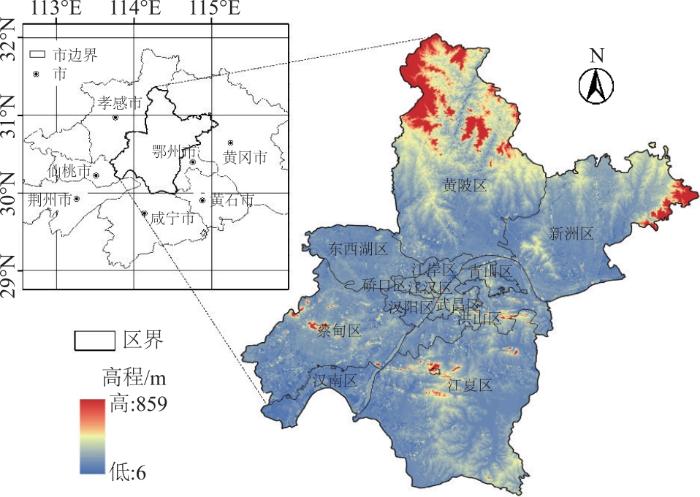
武汉市是长江中游城市群的核心城市之一,下辖13个市辖区(图1),总面积8 494.41 km2,2024年初常住人口高达1 377.4万。过去十余年间武汉市常住人口常年稳步增长,人民对城市建设的需求也逐渐增大,导致武汉市经济建设与城镇用地扩张,快速城镇化与生态环境的矛盾日益突出,生态系统服务功能逐渐弱化。因此,研究武汉生态质量时空演变及其对土地利用变化的响应极为重要[22]
图1 武汉市地理位置示意图

Fig.1 Location map of Wuhan City

1.2 数据来源

本文数据来源主要有3部分。
(1)高程数据(Digital Elevation Model,DEM):武汉市DEM数据,来自地理空间数据云。
(2)Landsat遥感影像数据:数据源自美国地质调查局(USGS),选取2014—2023年生长期相近时间(7—8月份)的Landsat7-ETM、Landsat8-OLI影像,空间分辨率为30 m[23-24],用于计算本文RSEI模型所需的干度、绿度、热度、湿度4项指标。数据预先进行大气校正、辐射定标等预处理,并经过去云、裁剪、合成,此外,还计算了改进的归一化差异水体指数从而对较大面积水体进行掩膜。
(3)土地利用数据:1985—2023年的土地利用(Land Use and Land Cover Change,LUCC)数据源于中国土地覆盖数据集(China Land Cover Dataset,CLCD)[25],该数据集利用Landsat数据构建时空特征,结合随机森林分类器得到分类结果,并运用包含时空滤波和逻辑推理的后处理方法进一步提高了结果的时空一致性,总体准确率达到80%。该数据集将中国土地利用类型划分为农田、草地、不透水面等9种。
本文选取2014年、2017年、2020年、2023年四景土地利用数据分析武汉市近10 a土地利用情况,后续进行生态质量计算时不包含水体。

2 研究方法

2.1 遥感生态指数

遥感生态指数模型利用遥感影像数据计算绿度指标(归一化植被指数)、湿度指标(土壤湿度WET)、干度指标(归一化土壤指数NDSI)和热度指标(地表温度LST),再运用主成分分析法客观赋权,提取第一主成分后进行归一化处理得到RSEI指数,从而对研究区生态质量进行综合评估[26]

2.1.1 绿度指标NDVI

绿度指标可以准确描述研究区地表植被覆盖和生长情况[27],计算式为
N D V I = ρ N I R - ρ R ρ N I R + ρ R  
式中:ρNIR为近红外波段的地表反射率;ρR为红光波段的地表反射率。

2.1.2 湿度指标WET

湿度指标由缨帽变换湿度分量表示[28]。由于Landsat7和Landsat8影像传感器不同,其湿度指标的提取公式[29-30]有些差别,分别如下。
TM数据:
W E T = 0.031   5 ρ b l u e + 0.202   1 ρ g r e e n + 0.310   2 ρ r e d + 0.159   4 ρ n i r - 0.680   6 ρ s w i r 1 - 0.610   9 ρ s w i r 2   ;
OLI数据:
W E T = 0.150   9 ρ b l u e + 0.197   3 ρ g r e e n + 0.327   9 ρ r e d + 0.340   6 ρ n i r - 0.711   2 ρ s w i r 1 - 0.457   2 ρ s w i r 2  
式中:ρblueρgreenρredρnirρswir1ρswir2分别为TM和OLI数据蓝、绿、红、近红外、短红外1、短红外2波段的反射率。

2.1.3 干度指标NDSI

干度指标由裸土指数(SI)和建筑指数(IBI)的集成指数(NDBSI)[31]来表示。
裸土指数(SI):
S I = [ ( ρ s w i r 1 + ρ r e d ) - ( ρ b l u e + ρ n i r ) ] / [ ( ρ s w i r 1 + ρ r e d ) + ( ρ b l u e + ρ n i r ) ]  
建筑物指数(IBI):
I B I = { 2 ρ s w i r 2 / ( ρ s w i r 1 + ρ n i r ) - [ ρ n i r / ( ρ r e d + ρ n i r ) + ρ g r e e n / ( ρ s w i r 1 + ρ g r e e n ) ] } / { 2 ρ s w i r 2 / ( ρ s w i r 1 + ρ n i r ) + [ ρ n i r / ( ρ r e d + ρ n i r ) + ρ g r e e n / ( ρ s w i r 1 + ρ ) ] }  
干度指标(NDBSI):
N D B S I = [ S I + I B I ] / 2  

2.1.4 热度指标LST

热度指标是指Landsat热红外波段经过反演得到的地表温度。Landsat8 TIRS选取B10来反演地表温度[32],Landsat7 ETM数据则基于B6反演。计算式为:
L λ = g a i n   ×   D N   +   b i a s   ,
T = K 2 / l n ( K 1 / L λ + 1 )  
式中:Lλ为传感器处光谱辐射亮度;DN为像元值;T为传感器处温度; K1K2为波段校准常数; gain为频带缩放的增益因子;bias为频带缩放偏置因子。
传感器处温度经过比辐射率纠正得到LST,即
L S T = T / [ 1 + (   λ T / ρ ) l n ε ]  
式中:λ表示TM传感器B6和OLI传感器B10的中心波长,ρ=1.438×10⁻²mk;ε表示表面发射率,纠正后的LST即地表温度。

2.1.5 综合生态指数的构建

由于各分量在数值单位和大小上的差异,在综合之前需要对数据进行归一化处理。计算式为
N i = ( I i - I m i n ) / ( I m a x - I m i n )  
式中:Ii为某因子的像元值;IminImax分别表示各指标的最小和最大值。经式(10)归一化后,采用主成分分析法(Principal Component Analysis,PCA)对4个生态指标进行线性变换得到第一主成分(PC1)[33]。计算式为
R S E I 0 = 1 - P C 1 [ f ( N D V I , W E T , L S T , N D B S I ) ]   ,
R S E I = (   R S E I 0 - R S E I 0 _ m i n ) ( R S E I 0 _ m a x - R S E I 0 _ m i n )  
式中:PC1为计算得到的第一主成分。RSEI0为转置后结果,RSEI0_max、RSEI0_min分别为 RSEI0的最大值和最小值。
最终得到的RSEI区间为[0,1],值越大表示生态环境质量越好。最后结合徐涵秋[26]的研究成果将RSEI以0.2为间隔分为5个等级。

2.2 空间自相关

使用全局Moran指数(Moran’s I)衡量全局空间自相关[17],全局自相关系数I1计算式为
I 1 = n i = 1 N j = 1 N w i j ( x i - x - ) ( x j - x - ) i = 1 N j = 1 N w i j i = 1 N ( x i - x - ) 2    
式中:n表示网格数量;xixj分别表示ij网格中遥感生态指数均值;wij表示权重矩阵; x -表示研究范围内遥感生态指数均值。
使用局部空间自相关分析,分析武汉市范围内各区域生态质量与其相邻地区之间的相似性和差异性[25],从而识别热点区域。局部自相关系数I2计算式为
I 2 = n ( x i - x - ) j w i j ( x j - x - ) i ( x i - x - ) 2  

3 研究结果

3.1 武汉市生态环境质量时空分布

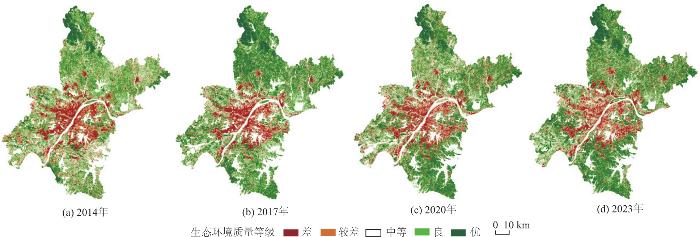
统计2014—2023年武汉市遥感生态指数时空分布(图2)后发现,在时间上武汉市生态环境质量整体呈现波动性上升趋势。其中2014—2017年生态环境质量上升最为明显,RSEI均值由0.57增加到0.64,鉴于武汉市自2005年开始生态环境的不断恶化[34],本次上升很大程度上得益于自2010年开展的各项生态保护行动的有效落实[35];2017—2020年生态质量稍有下降,RSEI均值由0.64降为0.61,这是城市社会经济快速发展以及生态保护政策时滞效应共同作用的结果;2020—2023年生态质量均值上升至0.63,这是由于疫情导致的建设放缓以及前期“园林城市”建设、湿地保护等生态保护措施的持续作用[36-38]
图2 武汉2014—2023年RSEI等级分级

Fig.2 Classification of RSEI grades in Wuhan (2014-2023)

从空间分布来看,武汉市生态环境退化情况主要出现在中心城区外围,如西南部汉南区、西部蔡甸区以及东西湖区,与研究期间城市外围扩张以及开发区建设情况相符[39]。与此同时,两江交汇处的老城区以及东湖、梁子湖等湿地周边的生态质量在研究期间有着明显的改善,这得益于武汉市开展的旧城区景观提升、生态岸线修复、湿地保护等各项举措[40]
分析武汉市各等级RSEI面积及占比(表1)可以发现,武汉市生态环境质量较为稳定,高质量区域逐渐增多。从整体来看,2014年、2017年、2020年、2023年武汉市生态环境质量中等以上面积占比分别为77.96%、80.55%、77.23%、79.58%,稳定在80%左右,整体生态条件较好。从研究期间变化趋势来看,生态环境质量等级为优的区域占比明显增加,而等级为中等的区域变化趋势与之完全相反。这说明在研究期间可能有部分区域生态质量由中等转化为良或优,反映了武汉市对于耕地等生态条件中等区域的整治效果较为明显;等级为良的区域占比缓慢下降;差和较差的区域占比基本趋于稳定。
表1 武汉2014—2023年各等级RSEI面积及占比

Table 1 Areas and proportions of different RSEI grades in Wuhan (2014-2023)

RSEI 生态环境
质量等级
2014年 2017年 2020年 2023年
面积/km2 比例/% 面积/km2 比例/% 面积/km2 比例/% 面积/km2 比例/%
[0.8, 1.0] 1 156.71 15.55 2 182.58 30.38 1 995.60 27.08 2 427.57 32.52
[0.6, 0.8) 2 650.32 35.62 2 465.14 34.32 2 265.20 30.37 2 234.06 29.93
[0.4, 0.6) 中等 1 993.37 26.79 1 138.75 15.85 1 457.77 19.78 1 278.37 17.13
[0.2, 0.4) 较差 974.34 13.10 760.01 10.58 921.10 12.50 850.45 11.39
[0, 0.2) 664.84 8.94 637.18 8.87 730.90 9.92 673.72 9.03

3.2 武汉市生态环境质量时空变化

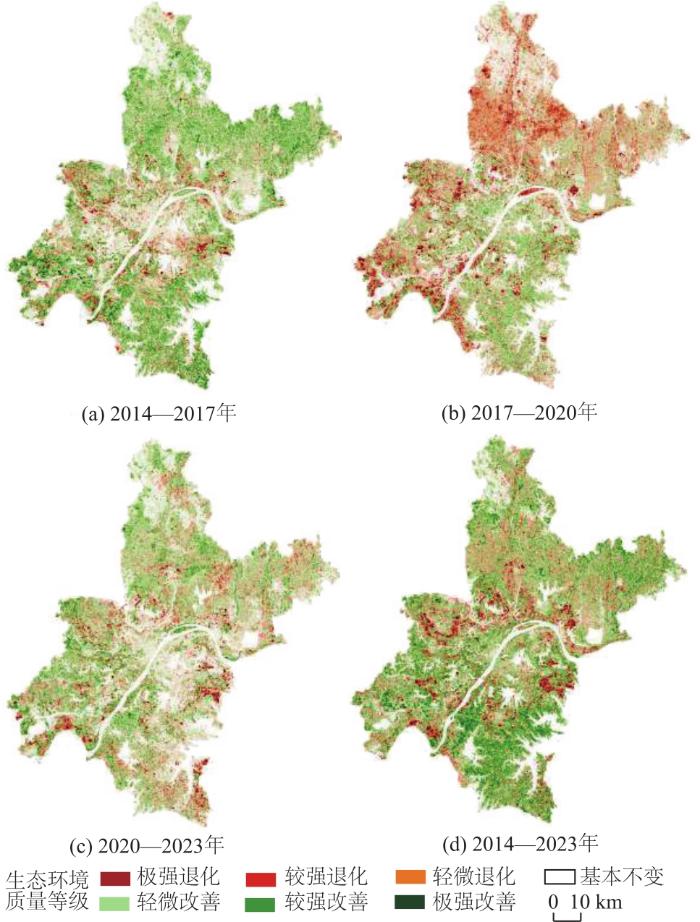
为分析武汉市生态环境质量的时空变化,对各年份RSEI进行差值分析。分析结果根据正负分为改善和退化,再以0.1为间隔将结果分为极强退化、较强退化、轻微退化、基本不变、轻微改善、较强改善、极强改善7大等级(图3),并将数据均值作为变化整体评分(表2)。
图3 武汉2014—2023年RSEI时空变化分级

Fig.3 Classification of RSEI spatiotemporal changes in Wuhan (2014-2023)

表2 武汉2014—2023年RSEI时空变化各等级面积及占比

Table 2 Areas and proportions of RSEI spatiotemporal changes at different grades in Wuhan (2014-2023)

变化类型 变化等级 2014—2017年 2017—2020年 2020—2023年 2014—2023年
面积/km2 比例/% 面积/km2 比例/% 面积/km2 比例/% 面积/km2 比例/%
极强退化 123.87 258.93 164.70 223.24
退化 较强退化 207.14 15.16 491.32 32.41 271.18 19.92 351.26 21.56
轻微退化 776.88 1 596.26 1 003.77 993.43
基本不变 2 904.10 39.73 3 139.47 43.36 3 261.76 45.14 2 278.83 31.34
轻微改善 2 328.87 1 424.79 1 923.27 2 068.88
改善 较强改善 722.65 45.11 258.26 24.23 464.02 34.94 947.70 47.09
极强改善 245.62 70.83 137.76 407.64
生态质量变化整体评分 0.065 4 -0.028 9 0.026 3 0.062 6
从空间分布来看,武汉市生态环境质量整体呈改善趋势,沉湖湿地、安山湿地等重要生态保护区呈现极强改善,中心城区主要为轻微改善和较强改善,汉南区、东湖高新技术开发区以及东西湖区等地由于城市建设开发出现了局部退化现象。
分析各时间段RSEI变化情况所占面积大小及百分比(表 2)发现,退化情况主要发生于2017—2020年期间,退化占比达到32.41%,其中大部分为轻微退化;而改善阶段主要为2014—2017年,改善占比达到45.11%。此外2020—2023年也有明显改善情况,改善占比超过1/3。9 a间,改善区域远多于退化区域,说明武汉市生态环境质量存在显著提升。

3.3 武汉市生态环境质量空间聚集性
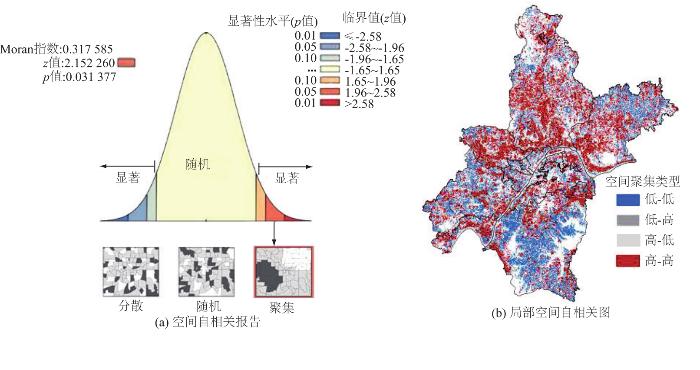
基于生态环境质量时空变化分析后,进一步分析样本点的全局和局部空间自相关性从而确定生态环境质量变化的空间聚集性。通过全局空间自相关分析得到Moran指数为0.32,具有显著性,其中z值标准差>1.96且p<0.05(图4(a)),表明武汉市生态环境质量的变化有95%的概率在空间上并非随机分布。通过进一步局部空间自相关分析可以发现武汉市生态环境质量变化呈现出聚集分布的特点(图4(b)), 生态环境质量上升区域主要位于中心城区、湿地周边,生态环境质量下降区域主要位于汉南区东部以及江夏区东北部等新开发地区。
图4 RSEI 时空变化的空间自相关报告和局部空间自相关

Fig.4 Spatial autocorrelation report and local spatial autocorrelation map of RSEI spatiotemporal changes

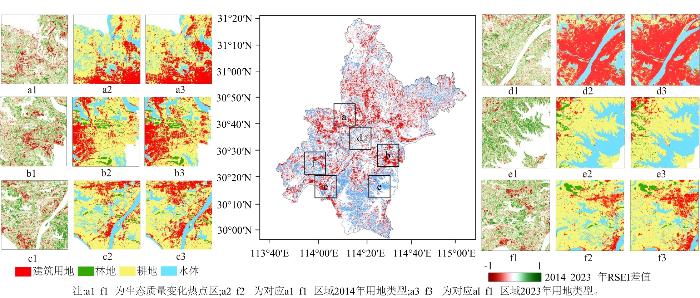
图5 2014—2023 年武汉市生态质量变化聚集区域

Fig.5 Cluster areas of ecological quality changes in Wuhan (2014-2023)

具体来看,可识别出六处生态质量变化热点区域(图5中a1、b1、c1、d1、e1、f1),通过对比热点区域2014年和2023年用地类型将其按变化原因分为3类:持续的开发建设活动使得中心城区周边平原地带生态质量锐减,东西湖区南部(图5中a2、a3)、江夏区东北部(图5中b2、b3)以及汉南区东北部(图5中c2、c3)建设用地扩张明显,部分地区RSEI降幅可达0.581,是以上变化过程的典型代表;与之相对,旧城区绿化设施的逐渐完善有助于生态质量的提升,如汉口、汉阳区域(图5中d2、d3)随着江滩生态公园建设的不断完善,区域生态环境质量平均上升0.065;另外,河湖湿地周边区域生态保护行动的有效开展也是生态质量上升的主要因素,江夏区南部梁子湖周边(图5中e2、e3)林地明显增多,该区域生态环境质量平均上升0.148,蔡甸区(图5中f2、f3)湿地范围内的建设用地有所减少,整体RSEI上升了0.125。

3.4 生态环境质量对土地利用变化的动态响应

2014—2023年研究区域各用地类型中,森林转化面积74.11 km2,耕地(农田)转化面积433.3 km2,建设用地(不透水面)转化面积3.39 km2,详见表3。三者转化面积之和超过整体转化面积的85%,是研究区域最主要的用地类型,因此选择这三者作为研究对象。为进一步分析3种用地类型的生态质量变化情况,采用1 km×1 km的渔网提取研究区域各年份的RSEI,并利用分区统计工具,统计3种用地类型RSEI的均值变化情况,具体结果见图6。作为重要的自然生态系统,森林的RSEI均值在研究期间有轻微波动但整体上升,由2014年的0.850上升至2023年的0.890,增幅4.7%。耕地和建设用地作为两大人工生态系统,表现出不同的变化趋势,耕地的RSEI均值在2017年至2020年有轻微下降但整体呈上升趋势,由2014年的0.591增加到2023年的0.678,增幅达到14.6%。而建设用地的生态质量在研究期间平稳上升,9 a间RSEI均值由0.253上升至0.293。
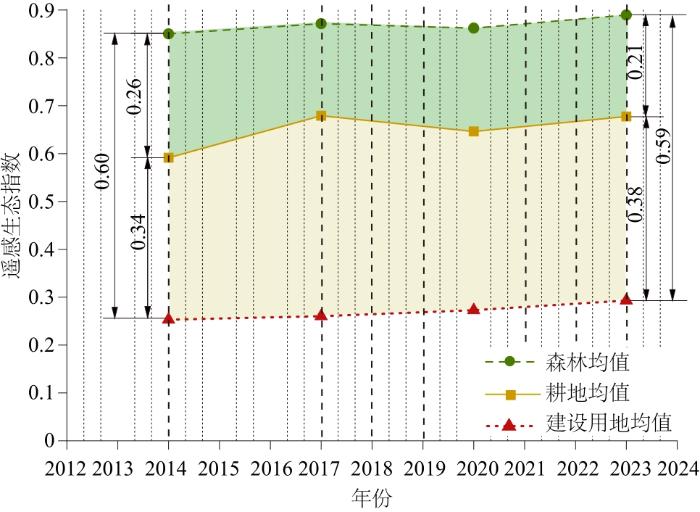
图6 武汉市2014—2023年森林、耕地、建设用地RSEI变化趋势

Fig.6 Trend of RSEI changes of forest, cultivated land and construction land in Wuhan City from 2014 to 2023

表3 武汉市2014—2023年土地利用转移矩阵

Table 3 Land use transfer matrix in Wuhan from 2014 to 2023km2

土地利用类型 不透水面 草地 灌木 裸地 农田 森林 水体 2023年总计
不透水面 992.69 0.75 0 0.09 252.96 0.54 16.27 1 263.29
草地 0.00 0.19 0.00 0 0.61 0.01 0.01 0.82
灌木 0.00 0.00 0.00 0.00 0.00 0.00 0.00 0.00
裸地 0.00 0.04 0.00 0.06 0.02 0.00 0.11 0.23
农田 0.55 0.64 0.00 0.03 5 216.27 73.46 262.4 5 553.35
森林 0.00 0.26 0.01 0.00 103.28 563.09 0.17 666.8
水体 2.84 0.01 0.00 0.00 76.43 0.1 1 010.88 1 090.27
2014年总计 996.08 1.89 0.01 0.18 5 649.57 637.19 1 289.84
用地转化量 3.39 1.70 0.01 0.12 433.3 74.11 278.96
未发生转化面积 7783.19(90.73%) 发生转化面积 794.94(9.27%)

注:数字下划线表示未发生转化面积。

由此可见,近10 a内由于耕地生态水平的不断提升,耕地向建设用地转化所需的生态成本不断扩大,遥感生态指数转化差值由2014年的0.34增加到2023年的0.38。这表明,随着近几年耕地生态质量的快速上升,未来对于城市开发扩张可能需要更加慎重,因为耕地向建设用地转化的生态成本逐渐增加。

3.5 浅析不同用地类型生态质量变化的潜在原因

研究期间武汉市耕地生态质量水平提升最为明显,可能与耕地保护政策有关。武汉市从2020年开始耕地“非农化”“非粮化”专项清理活动,清退了耕地中的违规建设,同时也提高了荒地的生态质量[41];武汉市建设用地的生态质量也有明显上升,尤其是两江交汇处的汉口、汉阳地区。随着我国进入高质量发展阶段,武汉市城市规划建设更加注重生态修复以及人居环境综合改善。一方面,随着社会经济发展,武汉中心城区的产业结构在不断优化,逐渐由现代化服务业取代传统工业,从而导致生态质量较差的工业厂房搬离市区[42]。另一方面,随着武汉市提出创建生态园林城市,各项生态修复和园林绿化方案也相应出台,使得人居环境的生态质量得到优化;武汉市森林生态水平稳步提升,可能与全球气候变暖、二氧化碳浓度提升有关[43],但也离不开武汉市长期坚持的生态保护行动。

4 结论与建议

(1)武汉市生态质量在2014—2023年整体呈波动性上升趋势,生态质量较好(平均RSEI由0.57上升至0.63)。各区域RSEI变化迥异,建设区域外围环状区域生态质量存在明显的下降,中心城区以及河湖湿地周边地区生态质量有所上升,而北部黄陂区的生态质量波动明显。在未来发展过程中要结合社会经济需求放缓增量,加强对存量空间的盘活利用,避免开发建设导致生态质量下降。
(2)研究期间,武汉市生态质量改善区域较多(47.09%),退化区域较少(21.56%)。两江交汇处的中心城区以及河湖湿地周边是生态质量改善的热点区域,表明城市更新和湿地修复对生态质量提升有实质性作用,未来应当持续推进旧城区景观提升和湿地保护等生态治理行动;城镇化发展带来的建设开发使得江夏区东北部等新建开发区成为生态质量退化的热点区域。
(3)武汉市生态质量变化和用地类型转化的关系密切。研究期间,武汉市森林、耕地和建设用地的生态质量都呈上升趋势,而耕地生态质量的增长速率超过了森林和建设用地,使人工环境内部(耕地与建设用地)的生态质量差异逐渐增大,耕地向建设用地转化的生态成本也越来越高。后续城市发展过程中要尽可能避免此类建设行为,要进一步加强耕地保护,避免耕地侵占和林地毁坏。
武汉市后续的生态治理工作应在遵循社会经济发展的前提下,结合区域生态质量变化聚集情况,针对生态热点区域采取因地制宜的措施,结合区域自然条件,丰富景观类型,提升生态质量。通过转变武汉市增量发展模式,加强对存量建设用地的生态化更新来提高建设用地生态质量;通过持续推进山体和湿地生态修复,加强武汉市绿色基础设施建设来增加生态空间,从而提升武汉市整体生态水平。
[1]
陈万旭, 刘志玲, 李江风, 等. 长江中游城市群生态系统服务和城镇化之间的空间关系研究[J]. 生态学报, 2020, 40(15):5137-5150.

(CHEN Wan-xu, LIU Zhi-ling, LI Jiang-feng, et al. Spatial Relationship between Ecosystem Services and Urbanization in Urban Agglomerations in the Middle Reaches of the Yangtze River[J]. Acta Ecologica Sinica, 2020, 40(15): 5137-5150. (in Chinese))

[2]
蔡万刚. 城市规模扩张与环境污染: 理论与实证[J]. 生态经济, 2024, 40 (1): 188-194.

(CAI Wan-gang. Urban Scale Expansion and Environmental Pollution: The Theory and Demonstration[J]. Ecological Economy, 2024, 40 (1): 188-194. (in Chinese))

[3]
王美雅, 徐涵秋. 中外超大城市生态质量遥感评价[J]. 生态与农村环境学报, 2021, 37 (9): 1158-1167.

(WANG Mei-ya, XU Han-qiu. Remote Sensing Evaluation of Ecological Quality of Megacities at Home and Abroad[J]. Journal of Ecology and Rural Environment, 2021, 37 (9): 1158-1167. (in Chinese))

[4]
陈元鹏, 任佳, 王力, 等. 基于多源遥感数据的生态保护修复项目区监测方法评述[J]. 生态学报, 2019, 39(23): 8789-8797.

(CHEN Yuan-peng, REN Jia, WANG Li, et al. Review on Monitoring Methods of Ecological Protection and Restoration Project Area Based on Multi-source Remote Sensing Data[J]. Acta Ecologica Sinica, 2019, 39(23): 8789-8797. (in Chinese))

[5]
WANG R, SUN Y, ZONG J, et al. Remote Sensing Application in Ecological Restoration Monitoring:A Systematic Review[J]. Remote Sensing, 2024, 16(12): 2204.

DOI

[6]
王媛, 杜明义, 杨柳忠, 等. 多源遥感数据支持下的城市生态状况评价[J]. 测绘通报, 2021(11): 16-20.

DOI

(WANG Yuan, DU Ming-yi, YANG Liu-zhong, et al. Assessment of the Urban Ecological Status Based on Multi-source Remote Sensing Data[J]. Bulletin of Surveying and Mapping, 2021(11): 16-20. (in Chinese))

DOI

[7]
皮新宇, 曾永年, 贺城墙, 等. 融合多源遥感数据的高分辨率城市植被覆盖度估算[J]. 遥感学报, 2021, 25(6): 1216-1226.

(PI Xin-yu, ZENG Yong-nian, HE Cheng-qiang, et al. Estimation of High-resolution Urban Vegetation Coverage by Fusing Multi-source Remote Sensing Data[J]. Journal of Remote Sensing, 2021, 25(6): 1216-1226. (in Chinese))

[8]
宋昊, 潘鑫, 谢文英, 等. 基于修正的增强归一化差异水体指数的富营养化水体信息提取研究[J]. 湖泊科学, 2025, 37(2): 378-388, I0002.

(SONG Hao, PAN Xin, XIE Wen-ying, et al. Eutrophic Water Information Extraction Based on Modified Augmented Normalized Difference Water Index[J]. Journal of Lake Sciences, 2025, 37(2): 378-388, I0002.(in Chinese))

DOI

[9]
CHEN P, WANG B, WU Y, et al. Urban River Water Quality Monitoring Based on Self-optimizing Machine Learning Method Using Multi-source Remote Sensing Data[J]. Ecological Indicators, 2023,146:109750.

[10]
MA X, WANG Z, LIU Y. EcologicalRisk Assessment of a Coastal Area Using Multi-source Remote Sensing Images and In-situ Sample Data[J]. Ecological Indicators, 2024, 158: 111470.

DOI

[11]
刘慧民, 马筝悦, 李淼, 等. 基于卫星遥感的城市热岛效应体检评估:以武汉市为例[J]. 西部人居环境学刊, 2023, 38(6):38-45.

(LIU Hui-min, MA Zheng-yue, LI Miao, et al. Examination and Evaluation of Urban Heat Island Effect Based on Satellite Remote Sensing: Taking Wuhan as an Example[J]. Journal of Human Settlements in West China, 2023, 38(6): 38-45. (in Chinese))

[12]
杨翠芹, 何伟, 邾茂盛, 等. 基于气象站和MODIS数据合肥地区城市热岛评价[J]. 中国环境科学, 2023, 43(增刊1): 243-250.

(YANG Cui-qin, HE Wei, ZHU Mao-sheng, et al. Evaluation of Urban Heat Island over Hefei Based on Meteorological Observations and MODIS Data[J]. China Environmental Science, 2023, 43 (Supp. 1): 243-250. (in Chinese)) : 243-250.(in Chinese))

[13]
徐涵秋. 城市遥感生态指数的创建及其应用[J]. 生态学报, 2013(24): 7853-7862.

(XU Han-qiu. Creation and Application of Urban Remote Sensing Ecological Index[J]. Acta Ecologica Sinica, 2013(24): 7853-7862. (in Chinese))

[14]
陈宇骏, 王凌宇, 李悦, 等. 基于遥感生态指数的杭州湾大湾区生态质量演化监测及其对土地利用响应分析[J]. 遥感技术与应用, 2024, 39(3):764-776.

DOI

(CHEN Yu-jun, WANG Ling-yu, LI Yue, et al. Ecological Quality Evolution Monitoring and Land Use Response Analysis of Hangzhou Bay Greater Bay Area Based on Remote Sensing Ecological Index[J]. Remote Sensing Technology and Application, 2024, 39(3):764-776. (in Chinese))

[15]
陈智勇, 吴耀炜, 林港特, 等. 基于遥感生态指数的粤港澳生态环境质量与土地利用变化空间关系[J]. 环境科学, 2024, 45(11): 6433-6447.

(CHEN Zhi-yong, WU Yao-wei, LIN Gang-te, et al. Spatial Relationship between Ecological Environment Quality and Land Use Change in Guangdong-Hong Kong-Macao Based on Remote Sensing Ecological Index[J]. Environmental Science, 2024, 45(11): 6433-6447. (in Chinese))

[16]
辛会超, 郭玮, 王贺封, 等. 基于GEE和RSEI的京津冀地区生态环境质量时序动态评估[J]. 西北林学院学报, 2024, 39(2): 106-114.

(XIN Hui-chao, GUO Wei, WANG He-feng, et al. Time Series Dynamic Assessment of Ecological Environment Quality in the Beijing Tianjin Hebei Region Based on GEE and RSEI[J]. Journal of Northwest Forestry University, 2024, 39(2): 106-114. (in Chinese))

[17]
李文艳, 兰安军, 范泽孟, 等. 黔中城市生态功能区生态环境质量动态评估及其驱动因素分析[J]. 地球物理学进展, 2024, 39(5): 1749-1762.

DOI

(LI Wen-yan, LAN An-jun, FAN Ze-meng, et al. Dynamic Assessment of Ecological Environment Quality and Analysis of Driving Factors in the Ecological Functional Zone of Central Guizhou City[J]. Progress in Geophysics, 2024, 39(5): 1749-1762. (in Chinese))

[18]
GENG J, YU K, XIE Z, et al. Analysis of Spatiotemporal Variation and Drivers of Ecological Quality in Fuzhou Based on RSEI[J]. Remote Sensing, 2022, 14(19): 4900.

DOI

[19]
Y, XIU L, YAO X, et al. Spatiotemporal Evolution and Driving Factors Analysis of the Eco-quality in the Lanxi Urban Agglomeration[J]. Ecological Indicators, 2023, 156: 111114.

DOI

[20]
魏伟, 王雅宁, 尹力, 等. 2000—2020年内蒙古高原国土空间演化生态效应及其影响因素[J]. 2025(6):2968-2984.

(WEI Wei, WANG Ya-ning, YIN Li, et al. Ecological Effects and Influencing Factors of the Territorial Spatial Evolution of the Inner Mongolian Plateau from 2000 to 2020[J]. Acta Ecologica Sinica, 2025(6):2968-2984. (in Chinese))

[21]
何国钰, 张蕾, 雷锡琼, 等. 基于生态系统服务供需簇的武汉都市圈生态风险评估及影响因素[J]. 应用生态学报, 2024, 35(5): 1347-1358.

DOI

(HE Guo-yu, ZHANG Lei, LEI Xi-qiong, et al. Ecological Risk Assessment and Influencing Factors of Wuhan Metropolitan Area Based on Ecosystem Service Supply and Demand Clusters[J]. Chinese Journal of Applied Ecology, 2024, 35(5): 1347-1358. (in Chinese))

[22]
郭懿娴, 孙俊桥, 陈晨, 等. 长江大保护背景下城市沿江生态空间划定与管控研究: 以武汉为例[J]. 华中建筑, 2023, 41(4): 119-123.

(GUO Yi-xian, SUN Jun-qiao, CHEN Chen, et al. Research on the Delineation and Control of Urban Ecological Spaces Along the Yangtze River Under the Background of the Great Protection of the Yangtze River: A Case Study of Wuhan[J]. Huazhong Architecture, 2023, 41(4): 119-123. (in Chinese))

[23]
USGS. Landsat7 ETM Plus Collection2 Level-2 Science Products Guide[K]. Virginia, US:USGS, 2020.

[24]
USGS. Landsat8-9 collection OLI/TIRS2 Level-2 Science Products Guide[K]. Virginia, US:USGS, 2020.

[25]
YANG J, HUANG X. The 30 m Annual Land Cover Dataset and Its Dynamics in China from 1990 to 2019[J]. Earth System Science Data, 2021, 13(8): 3907-3925.

DOI

[26]
徐涵秋. 区域生态环境变化的遥感评价指数[J]. 中国环境科学, 2013, 33 (5): 889-897.

(XU Han-qiu. Remote Sensing Evaluation Index of Regional Ecological Environment Changes[J]. China Environmental Science, 2013, 33 (5): 889-897. (in Chinese))

[27]
HUANG S, TANG L, HUPY J P, et al. A Commentary Review on the Use of Normalized Difference Vegetation Index (NDVI) in the Era of Popular Remote Sensing[J]. Journal of Forestry Research, 2021, 32(1): 1-6.

DOI

[28]
CRIST E P. A TM Tasseled Cap Equivalent Transformation for Reflectance Factor Data[J]. Remote Sensing of Environment, 1985, 17(3): 301-306.

DOI

[29]
HUANG C, WYLIE B, YANG L, et al. Derivation of a Tasselled Cap Transformation Based on Landsat 7 At-satellite Reflectance[J]. International Journal of Remote Sensing, 2002, 23(8): 1741-1748.

DOI

[30]
ALI BAIG M H, ZHANG L, SHUAI T, et al. Derivation of a Tasselled Cap Transformation Based on Landsat 8 At-satellite Reflectance[J]. Remote Sensing Letters, 2014, 5(5): 423-431.

DOI

[31]
LIU Y, MENG Q, ZHANG L, et al. NDBSI: A Normalized Difference Bare Soil Index for Remote Sensing to Improve Bare Soil Mapping Accuracy in Urban and Rural Areas[J]. Catena, 2022, 214: 106265.

DOI

[32]
MALIK M S, SHUKLA J P, MISHRA S. Relationship of LST, NDBI and NDVI Using Landsat-8 Data in Kandaihimmat Watershed, Hoshangabad, India[J]. Indian Journal of Geo-Marine Sciences, 2019, 48(1): 25-31.

[33]
徐涵秋, 邓文慧. MRSEI指数的合理性分析及其与RSEI指数的区别[J]. 遥感技术与应用, 2022, 37(1):1-7.

DOI

(XU Han-qiu, DENG Wen-hui. Rationality Analysis of MRSEI Index and Its Difference from RSEI Index[J]. Remote Sensing Technology and Application, 2022, 37 (1): 1-7. (in Chinese))

[34]
李红星, 黄解军, 梁友嘉, 等. 基于遥感生态指数的武汉市生态环境质量评估[J]. 云南大学学报(自然科学版), 2020, 42(1):81-90.

(LI Hong-xing, HUANG Jie-jun, LIANG You-jia, et al. Ecological Environment Quality Assessment of Wuhan City Based on Remote Sensing Ecological Index[J]. Journal of Yunnan University (Natural Sciences Edition), 2020, 42(1): 81-90. (in Chinese))

[35]
陈伟, 何蕾, 金梦旖. 共治视角下生态保护与利用的规划探索及实践:以武汉市为例[J]. 城乡规划, 2024(2):75-84.

(CHEN Wei, HE Lei, JIN Meng-yi. Exploration and Practice of Ecological Protection and[J]. Urban & Rural Planning, 2024(2): 75-84. (in Chinese))

[36]
赵曦. 新冠疫情对房地产市场的外部性冲击实证分析与评价[J]. 中国房地产, 2022(17): 33-42.

(ZHAO Xi. Empirical Analysis and Evaluation of the External Impact of COVID-19 on the Real Estate Market[J]. Real Estate Economy, 2022(17): 33-42. (in Chinese))

[37]
余馨云. 创建国家生态园林城市背景下的武汉城市道路绿化提升策略及实践[J]. 现代园艺, 2024, 47(20):168-170,173.

(YU Xin-yun. Strategies and Practices for Improving Urban Road Greening in Wuhan under the Background of Creating a National Ecological Garden City[J]. Contemporary Horticulture, 2024, 47(20): 168-170, 173.(in Chinese))

[38]
常晋. 《武汉宣言》引领全球湿地保护[J]. 生态经济, 2023, 39 (1): 9-12.

(CHANG Jin. The Wuhan Declaration Leads Global Wetland Conservation[J]. Ecological Economy, 2023, 39 (1): 9-12. (in Chinese))

[39]
敬丽莉, 贺晨静, 廖俊雯. 武汉东湖高新区建设用地扩张时空演变特征研究[C]// 2024中国城市规划年会. 合肥:中国城市规划学会, 2024.

(JINGLi-li, HEChen-jing, LIAO Jun-wen. Research on the Spatiotemporal Evolution Characteristics of Construction Land Expansion in Wuhan Donghu High Tech Zone[C]// Beautiful China, Co-construction, Co-governance and Sharing:Proceedings of the 2024 China Urban Planning Annual Conference. Hefei: Urban Planning Society of China, 2024. (in Chinese))

[40]
梁芳源, 李鹏, 程维金, 等. 武汉城市湿地景观格局及生态系统服务功能演变轨迹与驱动机制[J]. 环境工程, 2023, 41(1):105-111.

(LIANG Fang-yuan, LI Peng, CHENG Wei-jin, et al. Evolution Trajectory and Driving Mechanism of Urban Wetland Landscape Pattern and Ecosystem Service Function in Wuhan[J]. Environmental Engineering, 2023, 41(1): 105-111. (in Chinese))

[41]
赵玉枭, 肖谋良, 崔鑫涛, 等. 非粮化耕地土壤健康评价: 以浙江省宁波市东吴镇为例[J]. 应用生态学报, 2024, 35(10): 2785-2793.

DOI

(ZHAO Yu-xiao, XIAO Mou-liang, CUI Xin-tao, et al. Soil Health Evaluation of Non-grain Cultivated Land:A Case Study of Dongwu Town, Ningbo City, Zhejiang Province, China[J]. Chinese Journal of Applied Ecology, 2024, 35(10): 2785-2793. (in Chinese))

[42]
杨昕晨, 袁满, 黄亚平, 等. 武汉都市圈制造业空间格局特征及演化机制分析[J]. 世界地理研究, 2025, 34(7):1-15.

(YANG Xin-chen, YUAN Man, HUANG Yaping, et al. Analysis of the Spatial Pattern and Impact Mechanism of Manufacturing Production in Wuhan Metropolitan Area[J]. World Regional Studies, 2025, 34(7): 1-15. (in Chinese))

[43]
方运霆, 刘冬伟, 段伊行, 等. 气候变暖对森林生态系统碳汇功能的影响:机制、方法和主要进展[J]. 生态学杂志, 2024, 43(9):2551-2565.

(FANG Yun-ting, LIU Dong-wei, DUAN Yi-xing, et al. Effects of Climate Warming on Carbon Sink of Forest Ecosystems: Mechanisms, Methods, and Progresses[J]. Chinese Journal of Ecology, 2024, 43(9):2551-2565. (in Chinese))

DOI

Outlines

/