

0 引言
近年来,在数字化、信息化的热潮中,数字孪生技术逐步迈入各行各业,而数字孪生流域作为推动智慧水利工程建设的关键工作之一,也面临着新的挑战。对于数字孪生流域来说,构建能够对真实世界进行模拟的数字孪生体,是研究的重点工作之一。数字孪生体的构建需要生成高精度的三维虚拟场景,在三维场景的基础上,还需要结合水体的动力过程、水文数据,力求还原流域中水文过程及要素,最终将场景与动力过程结合,形成真实性强,可视化、动态化效果好的数字孪生体,以满足数字孪生流域的构建需求[1]。但当前已有的数字孪生流域系统或平台中,在数字孪生体的构建上大多都存在场景精度及动态化效果欠佳,动力过程不够精确,与使用者交互性较差等问题。如何结合河流及湖泊等流域的数据、模型和计算等基本要素,提高河湖数字孪生体的精度,以及动态可视化效果及交互性,是当前数字孪生流域技术研究的重要内容[2] 。
针对流域数字孪生体的研究中,三维场景构建与水动力过程模拟是两个至关重要的部分。传统的三维场景构建即是对地形进行建模,通过获取数据生成地形底座,在此基础上模拟地形上的各种自然景观及水体等元素。辛佳佳[3]、陈宁等[4] 、彭铄雅[5]、相增辉[6] 利用场景图形开发库OSG(OpenSceneGraph)及OSG Ocean平台,构建了海洋场景的泡沫模拟及洞庭湖流域可视化模拟等场景。Belhadj等[7]、Muraoka等[8] 、Yang等[9]、Paris等[10]和Argudo等[11]对山脊、降雪、沙漠及冰川等三维场景下的自然景观模拟方法进行了研究。以上研究针对自然场景的三维构建,大多只围绕单一元素进行构建,并没有对自然场景进行高精度还原制作。而由于湖河等流域场景及自然环境结构复杂、场景中元素多样,上述传统场景构建方法并不能满足河湖流域数字孪生体场景的高仿真度需求。
在流域数字孪生体的构建中,是否能够包含足够精确的水动力过程模拟是影响孪生体真实性的关键因素。传统的水动力过程仿真方法常依赖数值模拟和试验数据,通过表格或图像对流域内的水文过程及各种要素进行表示。国外的水动力数值模拟研究起步较早,已有一批功能较为完善的应用计算软件。其中具有代表性的有MIKE系列、HEC系列、Delft3D、EFDC模型等[12],这些模拟系统均是集建模、数值模拟计算以及图形可视化于一体,在泥沙输移模拟、洪水预报、洪水淹没范围确定、溃坝模拟等方面多有应用。而国内学者针对不同场景、不同条件下的河湖流域,同样进行了大量的水动力模拟研究。陈海梅等[13]、陈琼[14] 、苟少杰[15]和熊勇峰等[16]针对国内的河流或水库等水域建立了一维及二维水动力过程模型,使用专业计算软件对流域中水动力变化过程进行了模拟分析和研究。上述研究方法及传统软件通常侧重于精确的计算和模拟,但可能无法与数字孪生体所需要的三维场景与可视化效果进行结合,针对该问题,也有学者进行了基于三维场景的水动力可视化效果研究。焦向伟[17] 、潘立武[18] 、陈瑞华等[19] 综合Web 3D平台、C++/CLI技术和OSG以及FLOW3D软件等结合了三维场景及动力模型的模拟软件平台,搭建了湖泊或水电站三维场景并实现了特定水文过程的动态可视化模拟。而这些模拟研究虽然都在一定程度上实现了水动力模型与三维场景的结合,但三维场景中水体的流动性较差,针对小型场景的效果尚可但不适用于大型河湖场景构建与渲染。
随着可视化仿真技术的快速发展,游戏引擎的应用逐渐在数字孪生技术的开发上崭露头角。常见的游戏引擎有虚幻引擎UE(Unreal Engine)、Unity 3D、CryEngine、Maya等,它们具有强大的系统表现、控制和可视化能力,可达到逼真的视觉渲染和动态模拟效果。近几年国内外许多学者都致力于探索基于游戏引擎的数字孪生体开发研究,Chandramouli等[20] 和孔志远[21]使用Unity3D平台,并结合三维建模软件对河道洪水淹没过程和海事决策场景进行了模拟研究。Lu等[22]、 Yin等[23] Chen等[24]、张舒南等[25]、鲁瀚友等[26] 、郭正扬等[27] 利用UE平台对多个湖泊、河流及其他区域构建了三维场景并进行渲染,同时针对不同的自然或水文过程变化进行了可视化模拟与仿真,获得了良好的动态效果。
上述研究中,国外学者利用游戏进行三维可视化系统的研发,普遍更注重三维场景的渲染,强调“沉浸式”体验。而国内学者利用游戏引擎针对特定河湖区域的场景搭建也取得了一些成果。国内外研究的成果都证明了游戏引擎在流域数字孪生体构建方面的极大潜力,但是目前的研究更多倾向于自然环境过程变化的物理模拟以及可视化体验上,还缺乏结合水动力过程与水文要素的孪生体相关研究。
本研究将游戏引擎用于高仿真度流域数字孪生体的构建。针对河流、湖泊场景,研究河湖三维场景构建与水动力过程模拟方法,利用游戏引擎的三维场景构建与渲染能力,弥补传统方法中虚拟场景不够逼真、水体模拟动态效果不够好以及动力过程不够可靠的问题,并加入对模拟过程中水文数据的提取方法,形成一个兼具河湖三维场景与水动力过程模拟功能的数字孪生体框架。旨在解决传统流域数字孪生体框架中三维场景真实度不足、水体动力过程模拟效果欠佳问题,同时进一步提升场景和模拟的可视化及交互性。
1 研究方法
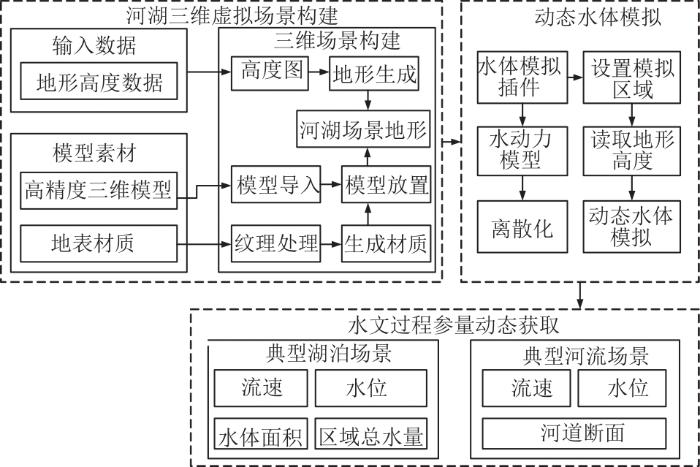
研究选择了虚幻引擎5(UE5)作为实现平台,利用UE5中地形与三维模型的构建功能,输入地形数据生成高精度河湖三维场景的地形与环境。再使用引擎中的水体模拟插件,与水动力模型相结合,对河湖水动力过程进行动态模拟。最后对水体模拟过程中的水文参量进行动态化提取与计算,形成具备高精度河湖场景与水动力过程的数字孪生体框架。研究方法中主要包含三维虚拟场景构建、动态水体模拟和水文过程参量动态获取等几个步骤。数字孪生场景构建流程如图1所示。
1.1 虚幻引擎5功能简介
虚幻引擎5(UE5)是由美国游戏开发公司Epic Game于2021年发布的第五代游戏引擎,具有强大的实时渲染功能,并为开发者提供多样的工具集和技术支持。利用UE5的蓝图(Blue Prints)系统可引入数学模型对物理过程进行精确模拟与计算,或对场景及物体进行控制。蓝图系统是UE5自带的可视化脚本编程系统,它可以让使用者无需熟练的编程技能即可创建复杂的场景逻辑和功能,如场景设计、事件和交互行为等。
本研究中使用了UE5的地形系统和高精度三维模型素材库来构建河湖三维场景的地形与环境,河湖水动力过程的模拟通过水体模拟插件实现。此外,利用蓝图系统还可实现在场景模拟过程中动态读取实时数据,从而获取或计算得到所需水文过程参量。
1.2 河湖三维虚拟场景构建
三维虚拟场景搭建是构建河湖流域数字孪生体的基础步骤,包括地形底板数据生成、地表材质构建、自然环境模型添加等部分,以确保生成的虚拟场景能够准确表示流域的地形及环境。
UE5中地形塑造主要利用了高度图的方法,高度图是用于表示地形高度的二维图像,每个像素上都包含了相应位置地形的高度信息。将获取到的地形DEM数据转化为16位png格式高度图文件导入UE5地形系统中,并利用地形编辑功能如雕刻、平滑、平整、侵蚀、噪声等,按照使用者的需求描绘或修改地形的特定细节,最终形成满足需求的地形底板。
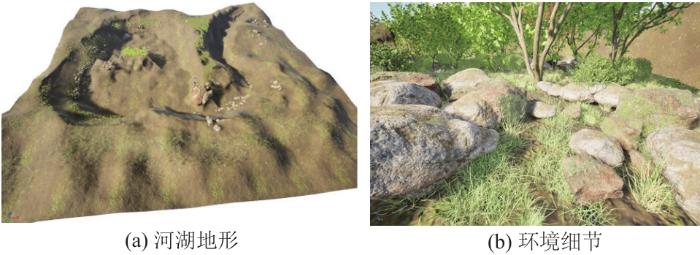
地表材质贴图与环境三维模型均来自UE5中集成的高精度三维模型素材库,通过近距离的摄影测量技术获得,该技术对现实环境中的目标对象进行多角度的近距离拍摄,得到一系列高分辨率的照片,并通过计算机视觉算法转化为三维模型,能够高精度地提取出物体表面的纹理细节。利用UE5中的材质系统可对导入的地表材质贴图进行编写,将色彩图、法线图、粗糙度图等纹理图进行组合,并设置UV映射,构建出能够反应地表样貌的材质。UV映射是将三维模型的表面与二维纹理图像匹配的技术,通过将每个顶点映射到二维坐标系,使得纹理可以被正确地应用到模型的表面。此外,由素材库中获取的三维模型可通过程序化添加植被和网格体功能,按预设好的模型大小范围、密度等属性向场景中添加,作为模拟不同植被覆盖情况下河湖水动力过程的基础,并提高三维虚拟场景的整体准确性。UE5中的河湖三维场景地形与环境模型细节如图2所示。
1.3 河湖动态水体模拟
本文中河湖水体动态模拟与水动力过程通过UE5中水体模拟插件Fluid Flux实现,它的原理是基于浅水方程模型,在高度场网格上对水体更新进行计算,根据相邻单元中地面和水的高度差计算并更新流体运动和扩散效果,该插件中水动力模型原理如章节1.3.1所示。但由于该插件本身更多是服务于游戏引擎流体效果的模拟,故根据工程分析需求进行改进,加入摩擦源项,提高模型的精度。
1.3.1 改进Fluid Flux水动力模型
1.3.1.1 Fluid Flux中水体模型
Fluid Flux的仿真实现基于二维浅水方程模型[30],水体模拟方程为
式中: 代表导数运算符;假设重力沿 轴作用。则二维模拟的平面是 平面, 和 是空间坐标; 是水深度;t为时间; 是水下地形的 方向坐标, 是水面高度的 方向坐标,η=H+h, 是流体的水平速度,其中u、w分别为速度v在x方向和z方向的分量; 是重力加速度; 和aext z分别为外部加速度在 和 方向上的分量。
根据欧拉流场视角,在二维平面上使用网格将模拟域进行离散,将高度 和 定义在每个网格中心,平面上速度分量 定义在网格边界,然后对高度场和速度场进行时间正向积分,得到高度场和速度场的更新公式。在本文中,使用米(m)作为距离单位,使用秒(s)作为时间单位。网格间距和模拟的时间步长分别用Δx和Δt表示。
将质量守恒方程导数进行合并,可表示为
将式(2)在模拟网格上进行离散化,可得到高度场变化量的更新方程为
网格边界上的速度场通过水面高度梯度来进行更新,与高度场同理,将动量方程变形后进行离散化,可得到速度场变化量的更新方程为
1.3.1.2 水体模拟模型的改进
上述Fluid Flux中水体模拟未考虑工程分析中外部源项带来的影响。工程分析中基于静水压强假定,沿水深方向对Navier-Stokes方程进行积分,并忽略风应力和科氏力项,简化可得一般情况下带源项的二维浅水方程,其守恒格式为
式中:U为状态向量;F和G分别为x和z方向的通量向量;S为源项。
式中: 和 分别表示 和 方向的水底坡度源项; 和 分别为 和 方向的底部摩擦源项; 为曼宁系数。
采用有限体积法求解上述方程。得到更新方程为
式中:F、G的下标i、 j为 方向和 方向上单元网格的序号;Δx和Δz即前文定义的网格间距(由于本文采用正方形网格故Δz=Δx); 为网格点 的源项。
对比式(4)和式(8)可发现,Fluid Flux中速度更新方程主要通过相邻网格间水面高程差进行迭代,对比工程分析的更新方程并未考虑底部摩擦源项部分,故按式(8)形式对式(4)进行优化改进,添加底部摩擦源项,改进后速度场变化量的更新方程为
Fluid Flux的更新方程在UE5中的材质系统进行编写,将关键变量设置为可变参数,模拟运行时通过蓝图程序对参数进行输入和修改,从而达到在场景中更新和渲染的效果。
1.3.1.3 UE5中水体模型的实现方法
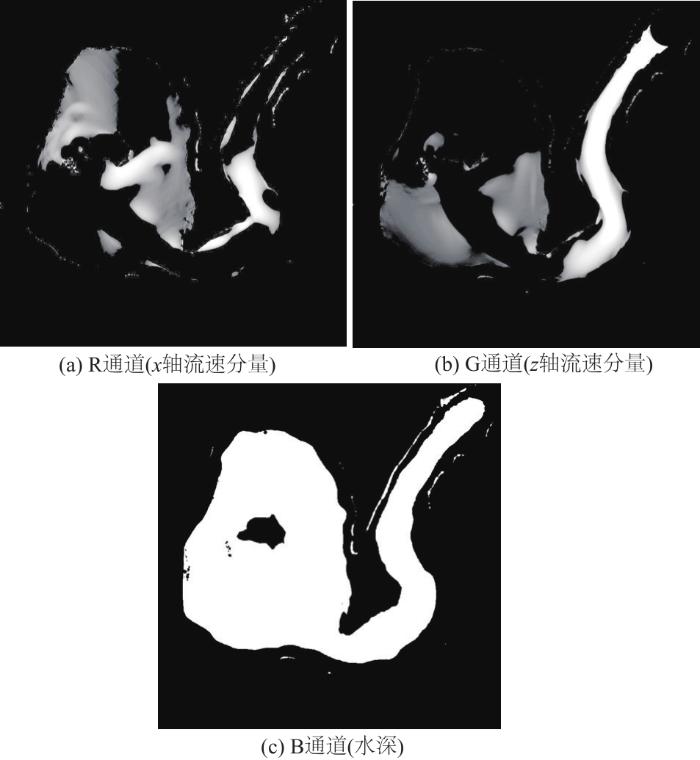
UE5模拟过程中,整个模拟区域网格上的地形高度、水深、流速等数据都通过渲染目标进行临时储存。渲染目标是一个接收渲染结果的纹理或图形数据,一般包含R、G、B、A四个通道,利用渲染目标可实现模拟过程中状态和数据的更新与动态提取。如流速和水深分别储存在同一渲染目标的不同通道中,流速储存在R和G通道中(分别代表x轴和z轴速度分量),水深储存在B通道中,颜色越亮代表数值越大,如图3所示。
Fluid Flux中的高度场和速度场更新方程根据式(3)和式(4)在材质蓝图中进行编写,模拟过程中通过蓝图程序以包含高度、速度更新程序的材质为基础创建动态材质实例并读取关键参数实现水深和流速的迭代更新。更新程序中将储存地形高度、水深、流速等数据的渲染目标作为输入量读取进程序中,通过计算得到下一时刻各个位置上新的流速和水深等数据。
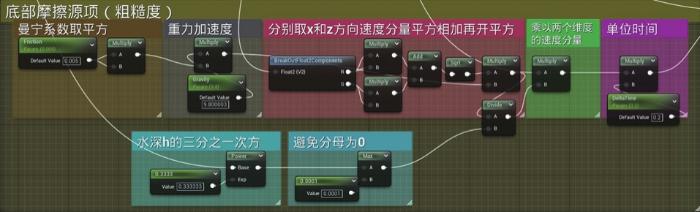
根据式(7)中底部摩擦项和式(9)速度场更新方程,在原有更新程序基础上进行改进,在速度更新蓝图中进行底部摩擦项编写,其中速度、水深参量通过渲染目标R、G、B通道分别进行获取。计算得到摩擦项结果后再与原有速度更新部分结合,形成改进后的更新程序。摩擦项的蓝图程序如图4所示。
1.3.2 水文过程参量获取与计算方法
水体模拟过程中,多类水文参量储存在渲染目标中,图像中每个像素点对应河湖虚拟场景中的对应网格上的数据。使用UE5蓝图系统、生成程序化网格体功能及材质系统,可在湖河场景模拟中设计场景交互、调整参数,并获取和计算模拟过程中的水文过程参量。
(1)流速、水深数据。通过蓝图中按像素读取渲染目标上数据的函数功能,可读取到对应场景位置的实时流速和水位数据。利用UV映射,选择模拟场景中任意位置时,都可以定位到渲染目标上的对应位置,从而获取不同通道上的流速或水深数据。
(2)流域面积计算。流域面积计算是指对某一时刻模拟场景中水体所覆盖的表面积进行计算,反映了环境中水体的分布情况。利用UE5中生成程序化网格体功能可将模拟中水体转化为由大量三角形组成的静态网格体,并获取其几何顶点数据。通过三角形面积计算方法可对水体的静态网格体表面积进行计算,最终得到流域面积。
(3)流域总水量计算。总水量是指在某一流域或流域内的所有水体的总量,可通过读取渲染目标中保存的模拟区域中水深数据进行计算。利用UE5蓝图中的根据像素区域读取渲染目标数据功能,可从渲染目标中读取所有像素上的水深,与模拟区域单位面积相乘求和,则得到了流域中总水量,它能够直观反应河湖场景下的当前储水量,对水资源的可持续管理有着重要意义。
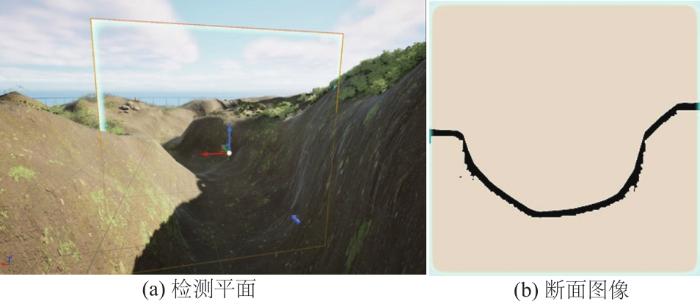
(4)河道断面数据获取。河道断面是指在某一横向剖面上对河床形态、河道宽度、深度等的描述,可通过放置透明检测平面网格体垂直切割河道地形的方式进行获取。利用UE5材质中Distance To Nearest Surface节点,可获取到河道断面的形状并反映在检测平面上,如图5所示。在模拟运行时也可通过移动检测平面实时获取任意位置的断面数据。河道断面反映了河流的横向形态特征,是计算河道断面流量的重要依据。
2 河湖数字孪生体构建示范案例
2.1 90°弯道溃坝场景模拟
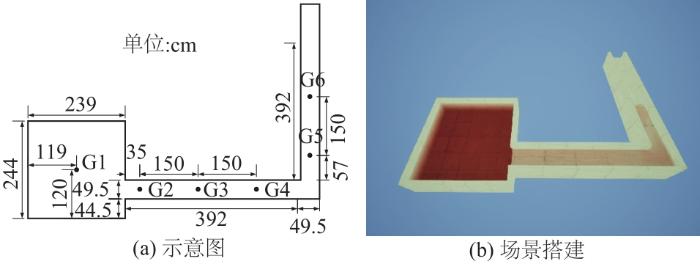
为验证本文中水动力过程模拟效果,采用水库溃坝场景实例进行模拟。该试验起初是由UCL大学的Frazao等[31]完成,上游为239 cm(长)×244 cm(宽)的矩形水库,下游河道为宽49.5 cm的L型矩形断面,河道上端和下端均长约400 cm,下游河道底部高程比水库高程高33 cm。河道与水库内无坡度,河道出口端为自由出口,水库初始水位高于河道底部20 cm,曼宁系数设置为0.012。设置6个测点分别检测水位变化,G1测点位于水库中央,G2—G4测点位于弯道上游,各测点间距均为150 cm,G5—G6测点位于弯道下游,两点间距150 cm。模拟时直接进入溃坝过程产生水流。模型平面示意图和场景搭建如图6所示。
总模拟时长为40 s,图7为在不同测点(G1—G6)水位模拟值随时间的变化图像。
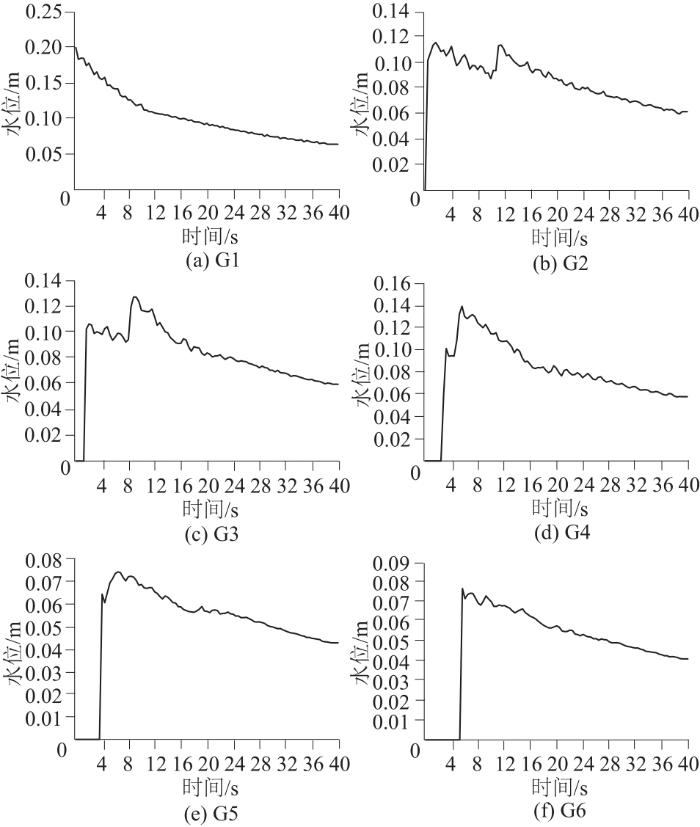
由图7可以看到G1点的水位呈现持续降低的趋势,下降的幅度随着时间逐步减少;G2、G3和G4点都位于河道上游,因弯道对水波的反弹作用呈现出水位突然增大的现象,G4点因为离弯道最近,故水位最大值出现较早。而G5、G6点位于弯道之后,水流受到弯道的调整作用,水位的变化过程更加平缓。从整体结果来看,本模型对水动力过程的模拟效果足够可信,且面对类似于地形存在突变的溃坝水流试验,也能够较好地进行模拟。
2.2 不同植被覆盖情况下的淹没模拟
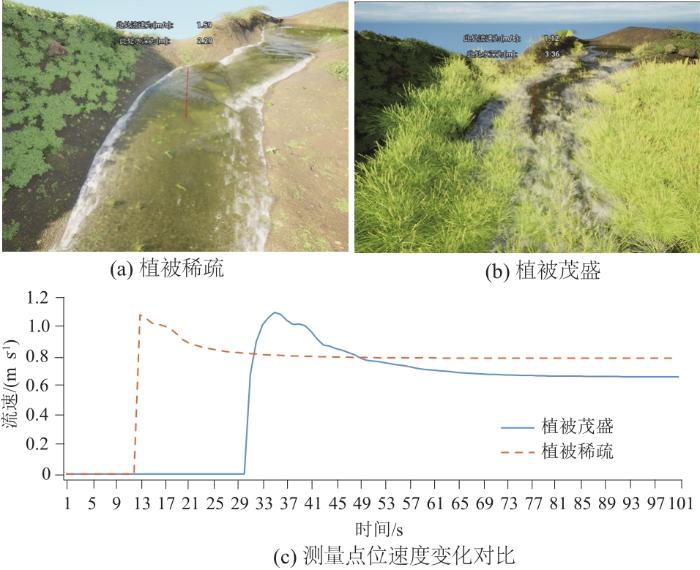
为模拟河湖环境中植被不同覆盖程度对水流产生的影响,分别设计植被茂盛和稀疏的场景,测量水流淹没过程中固定位置流速的变化。模拟场景中,初始位置输入点位流速为0 m/s,测量点位距离水流输入点位79 m,模拟过程总时长60 s,场景除植被覆盖外,地形相同模拟场景及测量流速对比如图8所示。
2.3 典型河湖数字孪生体场景模拟
本文研究方法构建了典型河湖数字孪生体示范场景,该场景展示了在UE5中构建的河道与湖泊的地形环境与水体模拟效果。该模拟场景具备动态化的模拟效果与水文过程参量提取功能,场景及用户界面(User Interface,UI)如图9所示。
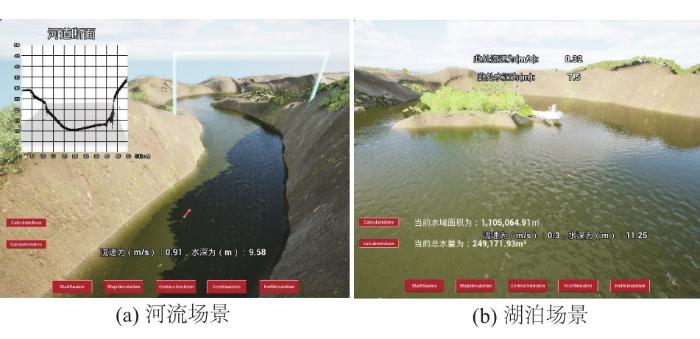


使用者可通过操作UI上的按钮对模拟进程进行控制,可定点检测流速和水深的实时变化,以及选择场景中的任意位置获取当前时刻的水深和流速。此外,场景中设置的断面检测组件可以读取所在位置的河道断面,在模拟中可随时移动该组件以更改检测位置。此外,可在模拟过程中计算当前时刻的湖泊面积、总水量等水文过程参量,读取与计算到的水文过程参量均可进行可视化展示,便于数据的清晰获取及进行后续处理。该湖河数字孪生体场景后续可服务于河流径流的模拟与湖泊水文数据监测等应用需求。
3 结论与讨论
本文针对河流、湖泊三维场景的构建及场景中水动力过程模拟方法进行了研究,并利用UE5成功构建了兼具高精度河湖三维场景与水动力过程模拟功能的数字孪生场景,实现了水文过程数据的提取与计算,并设计UI,为形成三维数字孪生场景平台打下了基础。具体结论如下:
(1)明确了在UE5环境中构建河湖三维场景的方法,使用地形系统与高度数据生成地形底板,引入高精度摄影测量模型丰富地表环境,提高了构建河湖三维场景时的仿真度。
(2)从工程分析角度对UE5中Fluid Flux的水动力模型进行了改进,添加了曼宁系数影响的摩擦项,并设计模拟场景验证了不同地形及植被粗糙度对水流模拟的影响,提高了不同环境三维场景下水动力过程模拟的精度。
(3)在河湖三维场景中实现对模拟过程中各水文要素的动态提取与计算,形成完整的三维场景河湖水动力过程模拟方法。该方法具备完整的场景构建、水动力过程模拟和水文参量提取与计算功能,提高了三维场景模拟过程中数据获取及处理的效率。
但是,本文的河湖数字孪生体构建方法仍存在一定的局限性:目前无法模拟水流冲刷对地形造成的影响和变化,故本文研究的方法对于河床冲淤幅度较为明显的河湖还存在短板;同时,在不同季节植被情况对水流影响的模拟上,无法精确模拟出水流上涨或淹没使得小型植物消亡的效果,后续应进一步优化模型,力求还原水流冲击对地形或植被产生的影响。此外,本文水动力模型源项中仅添加了底部摩阻项的影响,后续应在结合模拟效果和性能优化的考虑下优化模型,添加更多物理影响因素,以与真实世界中的数据进行对接,进一步实现与真实世界交互的数字孪生场景构建等。