Water-related Disasters

A Bibliometric Review and Prospect of Research Progress on Drought-Flood Abrupt Alternation

  • LU Qing , 1, 2 ,
  • TU Guan-yu , 1, 2, 3, 4 ,
  • YAN Bing 3, 4, 5 ,
  • ZHAO Dong-sheng 6
Expand
  • 1 School of Surveying and Geoinformation Engineering, East China University of Technology, Nanchang 330013, China
  • 2 Jiangxi Provincial Key Laboratory of Watershed Ecological Process and Information, East China University of Technology, Nanchang 330013, China
  • 3 Department of Energy Research, Jiangxi Academy of Sciences, Nanchang 330096, China
  • 4 Jiangxi Provincial Key Laboratory of Greenhouse Gas Accounting and Carbon Reduction, Jiangxi Academy of Sciences, Nanchang 330096, China
  • 5 Jiangxi Carbon Neutralization Research Center, Jiangxi Academy of Sciences, Nanchang 330096, China
  • 6 Institute of Geographical Sciences and Natural Resources Research, Chinese Academy of Sciences, Beijing 100101, China

Received date: 2024-12-17

  Revised date: 2025-04-07

  Accepted date: 2025-04-09

  Online published: 2025-06-03

Abstract

[Objective] Drought-flood abrupt alternation (DFAA), characterized by high suddenness, strong complexity, and great destructive power, has emerged as a significant risk source threatening regional ecological security and social sustainable development. This study aims to systematically review the progress of DFAA research, clarify its development trajectory, research hotspots, and knowledge structure, identify existing research gaps, and provide scientific guidance for future research directions. [Methods] Based on Web of Science (WOS) Core Collection and China National Knowledge Infrastructure (CNKI) database, Chinese and English publications related to drought-flood abrupt alternation (DFAA) between 2005 and 2024 are systematically retrieved. The bibliometric analysis tool CiteSpace software is utilized to visually analyze annual publication trends, keyword co-occurrences, and keyword bursts. On this basis, existing research is summarized and compared from three dimensions—identification methods, causal mechanisms, and disaster impacts—and, accordingly, optimization pathways for future research are proposed. [Results] (1) From 2005 to 2024, a total of 322 DFAA-related publications were issued globally, with China accounting for 53.2%. The development of CNKI literature went through three stages: preliminary exploration (2005-2010), rapid development (2011-2018), and stable development (2019-2024). Publications in the WOS have accelerated since 2018 and reached a peak in 2023, reflecting a rapid increase in international attention. (2) Domestic research focuses on the spatiotemporal evolution patterns and atmospheric circulation mechanisms of DFAA, with keyword bursts concentrated in trend analysis, spatiotemporal characteristics, and low-frequency oscillations. International research places greater emphasis on the long-term changes of DFAA and its ecological impacts in the context of climate change, with hotspot keywords including the Yangtze River, vegetation, and climate change. (3) First, there is a lack of a unified, multi-scale coupled DFAA identification system, as existing indices are mostly limited to a single temporal scale and consider limited factors in index construction. Second, causal analysis relies excessively on meteorological factors, with insufficient consideration of underlying surface changes and human activities. Third, impact assessment focuses on agricultural yield reduction and vegetation response, while research on the long-term impacts on urban resilience, water resource security, socio-economic systems, and ecosystem service functions remains inadequate. [Conclusion] Research on DFAA is currently at a critical stage of transitioning from phenomenon description to mechanism analysis and comprehensive impact assessment. Future research should focus on constructing a comprehensive identification indicator system that integrates multiple temporal scales and considers regional heterogeneity, while integrating multi-source data such as precipitation, soil moisture, temperature, topography, and vegetation to improve the accuracy and applicability of event identification. Future efforts are needed to deepen investigations into the formation mechanisms of DFAA and to strengthen regional comparisons and global-scale correlation analysis. In addition, the dimensions of impact research should be expanded to systematically assess the compound effects of DFAA on urban infrastructure, water resource allocation, ecological service functions, and socio-economic resilience, and to establish long-term monitoring networks that can provide scientific support for disaster risk management and climate adaptation policy formulation.

Cite this article

LU Qing , TU Guan-yu , YAN Bing , ZHAO Dong-sheng . A Bibliometric Review and Prospect of Research Progress on Drought-Flood Abrupt Alternation[J]. Journal of Changjiang River Scientific Research Institute, 2026 , 43(2) : 111 -119 . DOI: 10.11988/ckyyb.20241276

0 引言

随着气候变化和人类活动日益加剧,全球环流系统与水平衡正遭受破坏,导致极端气象灾害频繁出现[1],对人类社会与生态环境可持续发展构成严重威胁[2]。另外,降水异常引起的干旱或洪涝事件已经在全球范围内造成超1 000亿美元的损失,影响数亿人口的生命安全[3]。相较干旱或洪涝灾害单个事件,由干旱和洪涝快速交替形成的旱涝急转(Drought-Flood Abrupt Alternation,DFAA)事件对人类社会和自然环境造成的影响更为严重[4]。旱涝急转作为一种极端复合水文气象灾害,主要包括干旱转变为洪涝、洪涝转变为干旱[5],该灾害会引起农作物减产、城市内涝、泥石流、水源污染、土地硬化等[6-7]。因此,研究旱涝急转可为区域灾害预警、监测与防治提供技术支持。
目前研究主要关注旱涝急转的识别方法、成因与影响。本研究利用文献计量分析工具,对旱涝急转的研究热点、识别方法、成因及影响进行综述并对其未来研究方向进行展望。

1 数据与方法

1.1 数据收集

本研究使用中国知网(China National Knowledge Infrastructure,CNKI)和Web of Science(WOS)数据库进行文献检索,检索时段为2005—2024年,检索日期为2024年6月22日。在CNKI和WOS数据库上设置并搜索“旱涝急转、drought flood abrupt alternation、dry wet abrupt alternation”等中英文主题词,筛选出185篇中文文献和137篇英文文献,总计322篇文献。

1.2 文献计量分析

本研究选择CiteSpace6.1.6软件计量文献,设置关键词作为节点类型并对样本数据进行标准化、有序可视化分析,其主要包括发文量变化趋势、关键词共现、关键词突现分析。

1.3 旱涝急转的定义
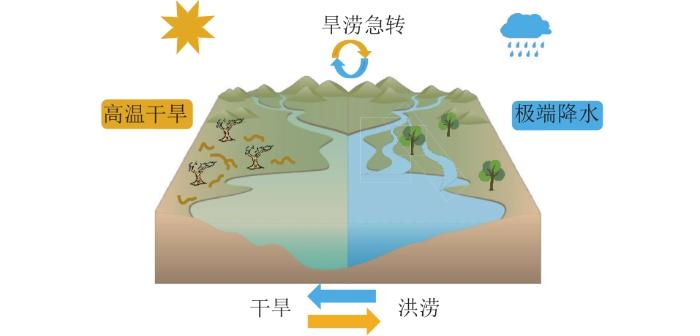
目前,学术界对于旱涝急转现象尚未达成一致的定义准则。基于现有研究成果,本研究综合分析并提出了对旱涝急转的界定。旱涝急转,亦称为干旱与洪涝快速交替现象,指前期降水量显著低于正常水平形成干旱灾害,后期发生强降水事件引发洪涝灾害;或者,前期发生极端降水事件形成洪涝灾害,后期降水量急剧减少、出现高温干旱事件的气象水文过程,此现象由于干旱和洪涝转变过程的急遽性,往往引发较单一旱灾或涝灾更为严重的影响[8]。旱涝急转地理概念示意如图1所示。
图1 旱涝急转地理概念示意

Fig.1 Geographic conceptual diagram of DFAA

2 检索结果分析

2.1 旱涝急转文献发文量变化趋势

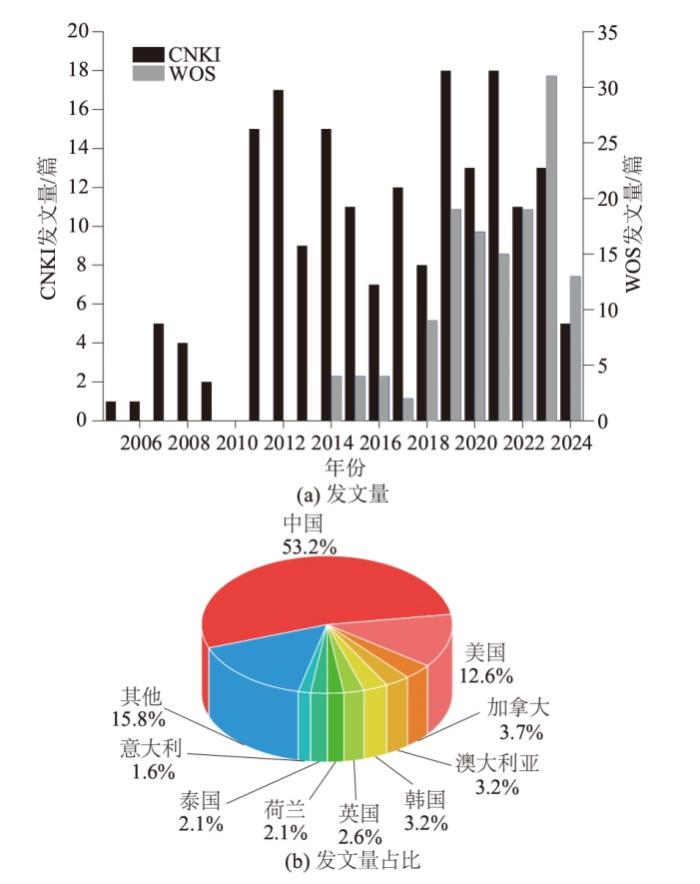
2005—2024年旱涝急转文献发文量情况如图2所示。由图2(a)可以看出,CNKI和WOS旱涝急转文献发文量随时间递进整体呈上升趋势,CNKI旱涝急转文献发文量明显多于WOS,CNKI与WOS旱涝急转文献发文量变化特征存在差异。
图2 2005—2024年旱涝急转文献发文量情况

Fig.2 Number of publications on DFAA and proportion of major publishing countries (2005-2024)

CNKI旱涝急转文献发文量变化可划分为3个发展阶段,初步发展阶段(2005—2010年),发文量较少,发文量仅占总发文量的7%,主要针对旱涝急转判定指标进行研究;快速发展阶段(2011—2018年),发文量迅速增加,较初步发展阶段增加了7倍,发文量占总发文量的51%,在2011年出现激增,主要针对长江中下游地区旱涝急转进行研究,这与2011年在长江中下游地区出现的旱涝急转事件有关[9];稳定发展阶段(2019—2024年),发文量占总发文量的42%,并于2019和2021年达到峰值,在此期间旱涝急转识别新方法逐渐出现。
WOS旱涝急转文献发文量变化可划分为2个阶段,初步发展阶段(2005—2017年),发文量较少,发文量仅占总发文量的10%,此阶段国外相关研究较少;快速发展阶段(2018—2024年),发文量逐渐增加,发文量占总发文量的90%,在2023年达到峰值,此阶段国外学者开始探索旱涝急转新的识别方法与成因。
图2(b)可以看出,2005—2024年,中国旱涝急转文献发文量占比最高,占总发文量的53.2%;其次是美国,占总发文量的12.6%;再者是加拿大,占总发文量的3.7%。

2.2 关键词共现分析
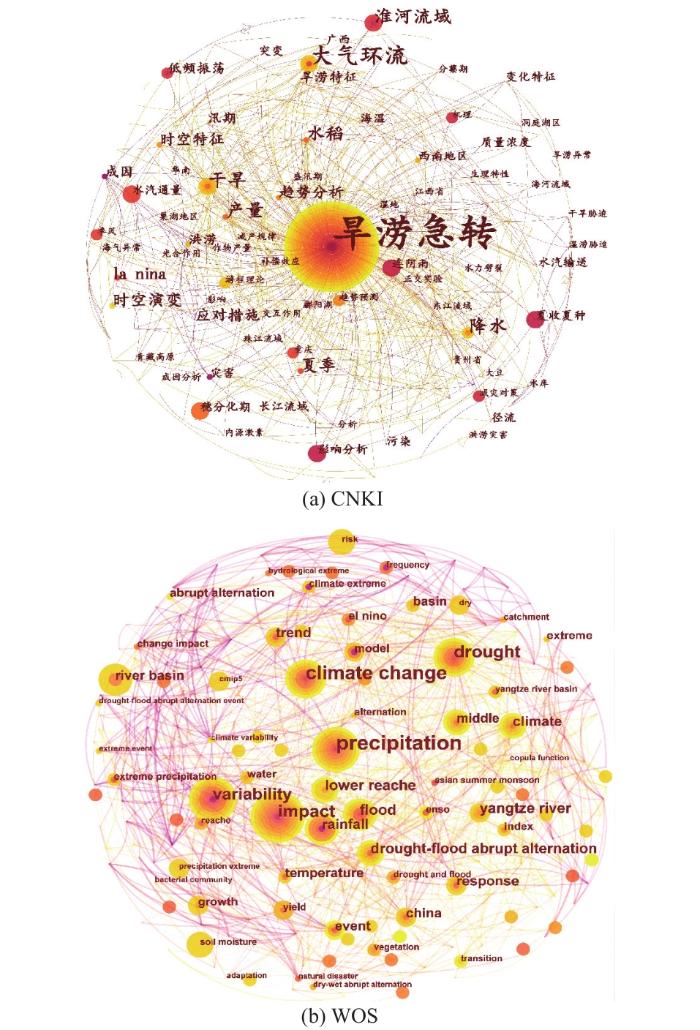
CNKI与WOS的关键词共现情况如图3所示,关键词共现是指在一组文献中,两个或多个关键词在不同文献中共同出现的现象,图中的节点越大代表关键词出现的频次越高。由图3可以看出,CNKI出现频次较多的关键词主要有旱涝急转、大气环流、降水、干旱、趋势分析、时空演变、产量等,表明国内学者主要关注旱涝急转的时空分布规律及形成机制;WOS出现频次较多的关键词主要有precipitation、climate change、drought、drought-flood abrupt alternation、variability、impact等,表明国外学者主要关注气候变化下旱涝急转变化情况及其影响。
图3 CNKI与WOS的关键词共现图

Fig.3 Keyword co-occurrence network of CNKI and WOS

2.3 关键词突现分析

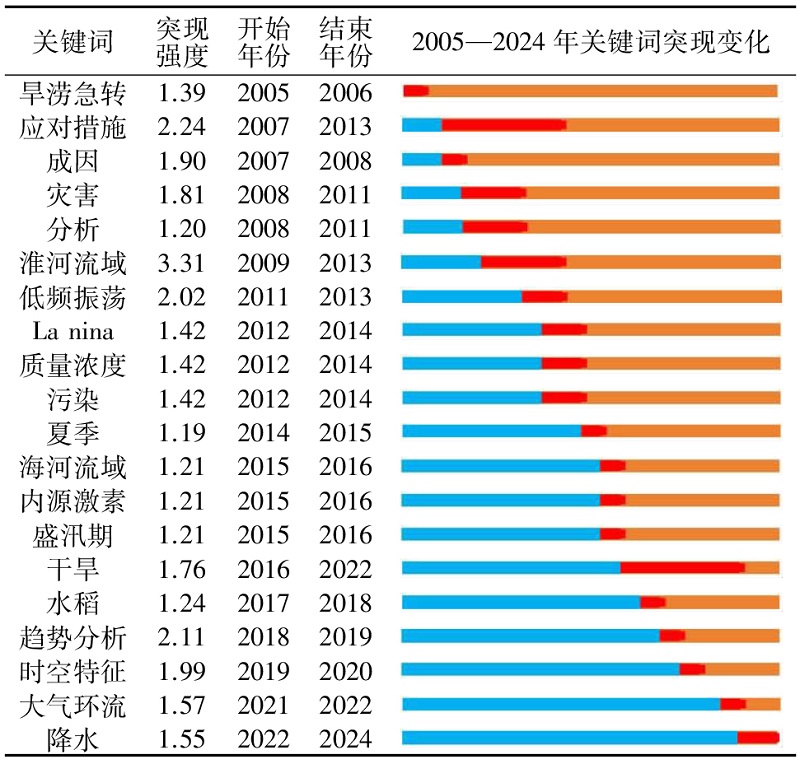
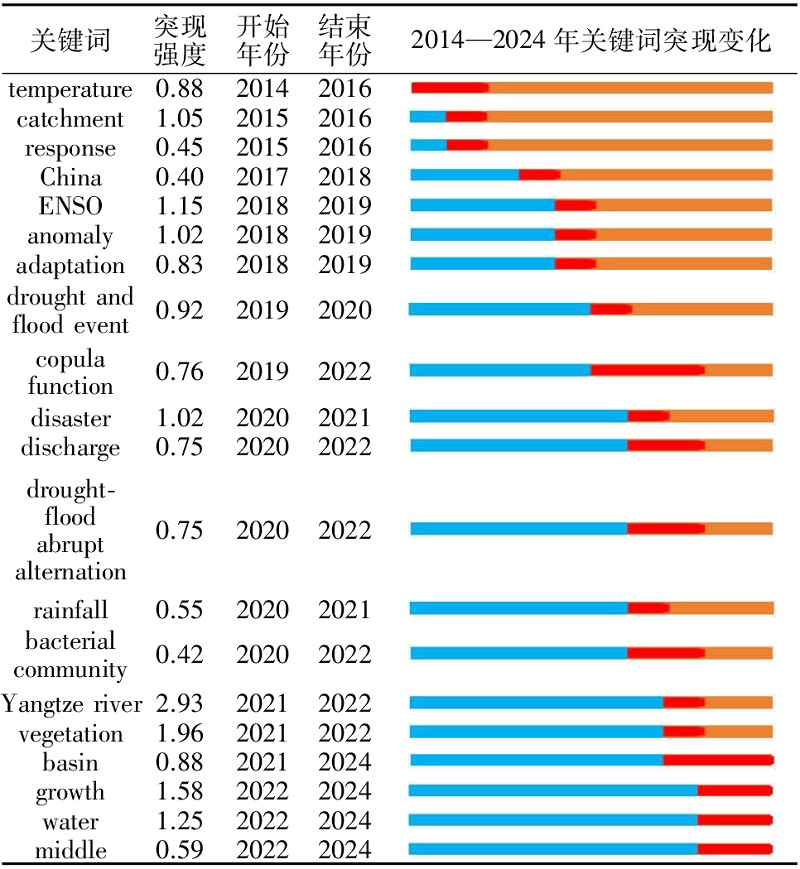
CNKI和WOS旱涝急转研究领域2005—2024年突现关键词如表1表2所示,关键词突现是指某个关键词在特定时间段内出现频率突然显著增加的;现象关键词突现强度是某个关键词在特定时间段内出现频率的突然增长程度,其基于CiteSpace软件中Burst Detection功能计算得到。
表1 CNKI旱涝急转研究领域前20突现关键词

Table1 Top 20 burst keywords in DFAA research field (CNKI)

注:红色代表关键词突现持续时间,蓝色代表关键词还未出现的时段,橙色代表关键词出现但没有突现的时段。下同。

表2 WOS旱涝急转研究领域前20突现关键词

Table 2 Top 20 burst keywords in DFAA research field (WOS)

表1可知,淮河流域、低频振荡、趋势分析、时空特征等关键词突现强度较高,为1.99~3.31,表明其为该时间段内的关键主题;干旱、应对措施、分析等关键词突现持续时间较长,为4~7 a,表明其为该领域的基础性研究方向。因此,近年来国内研究热点主要集中在趋势分析、时空特征、大气环流、降水等方面。
表2可知,Yangtze river、vegetation、growth、water、ENSO等关键词突现强度较高,为1.15~2.93,亦表明其为该时间段内的关键主题;copula function、basin等关键词突现持续时间较长,为3~4 a,亦表明为该领域的基础性研究方向。因此,目前,Yangtze river、vegetation、basin、growth等是国外旱涝急转领域的研究热点,这些热点也代表未来几年的发展趋势。

3 旱涝急转研究进展

3.1 旱涝急转识别方法

构建合理精准的旱涝急转识别指数是研究旱涝急转识别的关键。目前,结合水文、气象等影响要素得到了多种评估指数。2006年首次定义了旱涝急转并提出了长周期旱涝急转指数(Long-cycle Drought-Flood Abrupt Alternations Index,LDFAI)[10]。然而,LDFAI因时间尺度较长,难以有效捕捉季节内或短周期的旱涝快速转换过程。为此,后续研究改进提出了短周期旱涝急转指数(Short-cycle Drought-Flood Abrupt Alternation Index,SDFAI)[11],其改变了各影响因素的权重系数与时间尺度,使得旱转涝识别精度更高。与此同时,旱涝并存指数(Drought-Flood Coexistence Index,DFCI)[12]尝试从气候统计角度识别季节尺度内的旱涝共存现象,但其忽略相关物理机制的年际差异,与真实旱涝急转事件存在较大偏差。为提升适用性,部分研究指向了气象干旱指标,如标准化降水指数(Standardized Precipitation Index,SPI)。该指数在识别旱涝急转上,其计算方法简单,但在不同时间尺度上适用性较差[13]。相比之下,标准化前期降水指数(Standardized Antecedent Precipitation Index,SAPI)考虑了干旱累积效应,解决了SPI计算中不合理干旱加剧问题[14]。然而,由于SAPI进行了标准化,对于旱涝事件频率的季节性与差异性的表现还存在不足。
上述指数由于时间尺度较大,未考虑旱涝转换时间,会出现前期干旱与后期洪涝在数值上相互抵消的旱涝中和现象。为此,日尺度旱涝急转指数(Daily-scale Dry-Wet Abrupt Alternation Index,DWAAI)[15]将前后期旱涝程度、急转时间快慢纳入计算框架。但该指数中急转程度权重系数α取值依赖于实践经验,主观性强。因此,涂新军等[16]提出了改进的标准化旱涝急转指数(Standardized Drought-Wetness Abrupt Alternation Index,SDWAI),该指数与传统旱涝指数的判定分级一致。但在考虑气象水文因素时,判定指数时间尺度的选取对研究结果的影响还需探讨,且未显示旱涝交替的速度。针对上述问题,融合了时间尺度与转换速度信息的多尺度标准化旱涝急转指数(Multi-scale Standardized Drought-flood Abrupt Alternation Index,MSDFAI)通过SPI对旱涝事件的出现进行条件判断,同时考虑旱涝交替速度的影响,能全面地展现旱涝急转事件[17]
在考虑其他因素的旱涝急转指标上,有研究表明,标准化加权平均降水指数(Standardized Weighted Average Precipitation Index,SWAP)与标准化径流指数(Standardized Runoff Index, SRI)能够更好地反映旱涝历时、强度以及急转时间节点等信息,适用性较好[18]。另外,标准化降水蒸散指数(Standardized Precipitation Evapotranspiration Index, SPEI)综合考虑降水与蒸散的影响,与只考虑降水因素的判定方法相比,拥有更高的准确性[19];在此基础上,有学者构建了旱涝急转强度指数(DFAA Magnitude Index, DFAAMI),并表明DFAAMI能够更合理地反映旱涝急转的特征[20];另有研究考虑农业用水因素,构建了标准化前期降水蒸散指数(Standardized Antecedent Precipitation Evapotranspiration Index, SAPEI)[21],该指数量化了农田用水预算并考虑田间先前水分条件的携带效应。此外,最新研究则强调多因素变量协同,特别是土壤水分的引入。例如,多因素标准化旱涝急转指数(Multi-factor Standardized DFAA Index, MSDFI)[22]与土壤水分浓度指数(Soil Moisture Concentration Index, SMCI)[23]通过综合气象、水文及陆面过程信息,在捕捉旱涝急转事件方面展现出更强的物理机制与适用性。
综上所述,尽管旱涝急转识别指数表现出良好的适用性,但仍存在一些限制。指数大多侧重于一个或几个因素,如降水、径流、蒸散等,未来应考虑更多的相关因素,如地形、土壤特性、植被覆盖等,构建更为全面的综合指数。例如,地形会影响降水的分布和径流的形成,从而影响不同地形条件下旱涝急转的特征和机制;土壤特性决定了水分的存储和运移,对旱涝急转的发生发展有重要影响。此外,现有研究在时间尺度选取上还不够精细,对于不同时间尺度下旱涝急转的特征和识别方法研究不足。未来应深入探讨从日尺度到年际尺度等多时间尺度下的旱涝急转规律,以及如何根据不同的时间尺度需求优化现有指数或开发新的指数。现有主要的旱涝急转指数见表3
表3 国内外旱涝急转评估指数

Table 3 DFAA assessment indices at home and abroad

指数名称 时间尺度 考虑因素 数据需求
标准化旱涝急转指数
(SDWAI)
降水 多年日降水量
长周期旱涝急转指数
(LDFAI)
降水 多年日降水量
旱涝并存指数
(DFCI)
降水 多年日降水量
标准化降水指数
(SPI)
降水 多年日降水量
短周期旱涝急转指数
(SDFAI)
降水 多年日降水量
日尺度旱涝急转指数
(DWAAI)
降水 多年日降水量
标准化前期降水指数
(SAPI)
降水 多年日降水量
标准化径流指数
(SRI)
径流 多年日径流量
标准化加权平均降水
指数(SWAP)
加权平均降水 多年日降水量
标准化降水蒸散指数
(SPEI)
降水、蒸散发 多年日降水量、
气温
标准化前期降水蒸散
指数(SAPEI)
降水、
作物潜在蒸散发
多年日降水量、
气温
旱涝急转强度指数
(DFAAMI)
降水、蒸散发 多年日降水量、
气温
多尺度标准化旱涝
急转指数(MSDFAI)
降水、时间、
交替速度
多年日降水量
多因素标准化旱涝
急转指数(MSDFI)
降水、蒸散、
土壤水分
多年月降水、
蒸散、土壤水分
土壤水分浓度指数
(SMCI)
土壤水分 多年日土壤水分

3.2 旱涝急转成因研究

旱涝急转的形成与大气环流的异常变化密切相关。在长江中下游地区,西北太平洋副热带高压、南亚高压以及高空西风急流等共同作用,显著影响该地区的降水分布和强度[24]。在此背景下,暴雨频次的增加和降水强度的增强是导致旱涝急转事件频发的关键气候驱动因素[25]。进一步研究指出,降水变率的增加主要由大气水汽相关的热力学因素驱动,这一机制与气候变暖时大气翻转环流强度减弱的观测结果相符[26]。除大气内部变化外,海温异常在旱涝急转的形成中也扮演着重要角色。特别是拉尼娜事件,对旱涝急转事件的出现具有一定的先兆指示意义,41%的旱涝急转事件出现在拉尼娜的减弱阶段或结束后的8个月之内[27]。此外,海温异常与地区的降水联系紧密,通过改变大气环流和水汽输送模式,对旱涝急转的形成起到重要作用[28]。同时,区域水汽收支失衡与平均水汽压变化也是引发旱涝急转的重要因素,水汽输送的突变可能导致降水的急剧增加或减少,进而引发旱涝急转[29]。除大尺度气候因素外,地形条件对旱涝急转的局地形成具有不可忽视的影响。在中国西南地区,复杂地形条件和季风系统的协同作用塑造了独特的气候地理环境,使部分生态地理区更易出现旱涝急转[30]。具体来说,山脉的阻挡和海拔高度的变化,会影响降水的空间分布和强度,进而影响旱涝急转的发生。同时,季风的影响时间和强度的变化则进一步加剧降水时空分布不均,增加旱涝急转风险[31]
近年来,研究视角逐步拓展至人类活动的影响。城市化相关因子对旱涝急转产生了不同程度的影响,其中烟粉尘排放量对旱涝急转的影响最大[32]。一方面,城市扩张不仅改变下垫面性质、增加地表径流,还通过城市热岛效应扰动局地能量与水汽循环,增加降水的不稳定性,从而加剧旱涝急转风险[33]。另一方面,水利工程与农业活动也具有一定影响作用,水库的调蓄作用可以在一定程度上调节河流的径流量,减少旱涝急转事件的发生频率和强度;农业活动如灌溉和农田管理则通过改变土壤湿度和植被覆盖,进而影响降水的下渗和蒸发,对旱涝急转的发生起到一定的调节作用[34]
旱涝急转的形成机制是多种因素综合作用的结果,目前的成因研究大多以局部区域进行分析,未来需要考虑全国或全球尺度的形成机制,深入探究不同区域旱涝急转的驱动因素及其相互作用机制。同时,还需要加强对人类活动对旱涝急转形成影响的研究,特别是城市化、环境污染等因素对旱涝急转事件形成的影响机制,为制定更有效的防灾减灾策略提供科学依据。旱涝急转成因示意如图4所示。
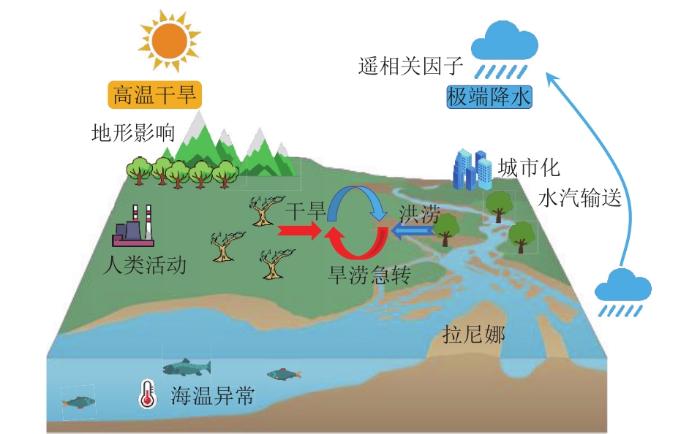
图4 旱涝急转成因示意图

Fig.4 Conceptual diagram of causes of DFAA

3.3 旱涝急转灾害影响研究

旱涝急转对农业生产的影响是目前研究关注的重要问题之一。已有研究发现,旱涝急转对农作物的生理特性产生影响,例如,在轻涝条件下旱涝急转对水稻根系具有补偿效应,而重涝则会产生抑制甚至破坏作用[35]。针对不同作物品种的研究进一步揭示了响应的差异性,如旱对花生叶片相对含水量的影响大于涝,说明作物对“旱”与“涝”的敏感性存在不对等性[36]。此外,在不同旱涝急转强度条件下,植物体内生长促进激素的形成受到抑制,同时其代谢产物可能异常积累,进一步干扰植物正常生理代谢过程[37]。在旱涝急转对农作物的产量影响上,轻涝不会加快玉米叶片的衰老,还会对籽粒的饱满度起到稳定作用,而重旱与重涝所产生的叠加损伤效应则是造成减产的重要因素[38]。除了影响生理特性与产量外,旱涝急转也会对农产品品质产生影响。以水稻为例,不同淹涝水平是影响水稻大部分品质指标(如粒长、透明度等)的主要因素[39]
相比之下,目前针对旱涝急转对生态环境影响的研究仍相对匮乏,现有研究多集中于土壤、水质及植被等特定领域。研究发现旱涝急转事件显著增加了水质污染的风险,尤其是在干旱向洪涝转变的过程中,水质污染的风险达到峰值[40];此外,旱涝急转还会影响土壤结构并造成孔隙度增加,加剧土壤中磷元素的流失[41]。更深层次的影响体现在土壤微生物群落上,旱涝急转会影响土壤微生物群落的结构和功能,进而破坏土壤生态系统的稳定性[42]。在植被方面,涝转旱过程尤其具有挑战性,不仅抑制植物恢复生长,还可能改变植被的群落结构和分布格局,进而影响生态系统的稳定性和服务功能[43]。值得注意的是,旱涝急转对经济社会发展的影响研究较少,现有研究多关注单一干旱或洪涝事件对城市的影响,对于极端复合旱涝灾害对城市的综合影响尚缺乏深入探讨。因此,未来的研究亟需从区域乃至全球尺度出发,深入探讨旱涝急转现象对城市生态环境的影响机制,以及提出有效的防灾减灾策略。

4 结论与展望

(1)近年来,旱涝急转文献发文量国内国外都呈上升趋势,国内发文量占总发文量的53.2%。CNKI文献发展经历3个阶段:初步探索期(2005—2010年),研究聚焦判定指标;快速发展期(2011—2018年),受2011年长江中下游旱涝急转事件推动,发文量激增;稳定发展期(2019—2024年),新识别方法不断涌现。WOS文献发展则分为两个阶段:2005—2017年为缓慢积累期;2018年后进入快速发展期,2023年达峰值,反映国际研究的加速跟进。
(2)国内研究侧重于旱涝急转的时空演变规律、大气环流机制,关键词突现集中于趋势分析、降水、低频振荡等。国外研究则关注气候变化下旱涝急转的变化及影响,关键词突现集中于Yangtze river、vegetation等。
(3)旱涝急转尚未建立较为全面识别方法;在成因研究上,目前主要关注气象方面的因素,对其他因素的研究较少;在灾害影响上,目前主要集中在对农业活动及植被的影响上,对经济社会发展及城市生态环境的研究较少。
今后相关研究应聚焦以下几方面:
(1)未来的研究需结合日尺度、月尺度等不同时间尺度的旱涝急转指数,通过权重分配或数据融合的方法,提高不同时间尺度下识别的准确性。针对不同空间尺度的特点,开发或选择适宜的识别指数。例如,对于较小空间尺度,可以结合高分辨率的气象数据和水文模型,构建精细化的识别指数;对于较大空间尺度,则注重区域特征的提取和分析,采用更宏观的气象和水文指标进行识别。同时,综合考虑降水、气温、地形、土壤湿度、植被覆盖等多种因素及其交互作用,以构建更全面的评估指标。
(2)在旱涝急转形成机制上,需运用数值模拟和观测数据分析大气环流模式、季风系统、海洋—大气相互作用以及地表过程之间的耦合关系。此外,通过气候模式模拟,分析不同大气环流异常情况下的降水变化特征,以及海洋温度异常对大气环流的影响,从而揭示旱涝急转现象的形成机制。未来的研究要加强区域对比研究,分析区域气候、地形和人类活动等因素对旱涝急转的影响。另外,还需拓展至全球尺度,利用气候模型与遥感数据,阐明不同气候带旱涝急转规律及其对全球变化的响应。
(3)在旱涝急转的影响上,除了对土壤、农作物的影响研究,还需关注旱涝急转对城市发展、水资源、生态环境和社会经济系统的长期影响。例如,研究旱涝急转对城市基础设施的损害、对水资源供需平衡的影响、对生态系统服务功能的长期变化以及对社会经济系统的适应能力的影响。此外,还需建立长期的旱涝急转事件监测网络,收集相关数据,为影响机制的研究提供基础。同时,运用生态系统模型、社会经济模型等,模拟旱涝急转事件对不同系统的长期影响,预测未来可能的变化趋势,为制定应对策略提供科学依据。
[1]
NAUMANN G, CAMMALLERI C, MENTASCHI L, et al. Increased Economic Drought Impacts in Europe with Anthropogenic Warming[J]. Nature Climate Change, 2021, 11(6): 485-491.

DOI

[2]
MOLOTOKS A, SMITH P, DAWSON T P. Impacts of Land Use, Population, and Climate Change on Global Food Security[J]. Food and Energy Security, 2021, 10(1): e261.

DOI

[3]
YANG Y, RODERICK M L, ZHANG S, et al. Hydrologic Implications of Vegetation Response to Elevated CO2 in Climate Projections[J]. Nature Climate Change, 2018, 9(1): 44-48.

DOI

[4]
WU X, JIANG D. Probabilistic Impacts of Compound Dry and Hot Events on Global Gross Primary Production[J]. Environmental Research Letters, 2022, 17(3): 034049.

DOI

[5]
QIAO Y, XU W, MENG C, et al. Increasingly Dry/Wet Abrupt Alternation Events in a Warmer World: Observed Evidence from China during 1980-2019[J]. International Journal of Climatology, 2022, 42(12): 6429-6440.

DOI

[6]
WANG J, RONG G, LI K, et al. Analysis of Characteristics of Dry-Wet Events Abrupt Alternation in Northern Shaanxi, China[J]. Water, 2021, 13(17): 2384.

DOI

[7]
DE SILVA M M G T, KAWASAKI A. Socioeconomic Vulnerability to Disaster Risk: A Case Study of Flood and Drought Impact in a Rural Sri Lankan Community[J]. Ecological Economics, 2018, 152: 131-140.

DOI

[8]
王永峰, 樊立娟. 长江源区旱涝急转事件演变特征[J]. 长江科学院院报, 2023, 40(7): 186-190.

DOI

(WANG Yong-feng, FAN Li-juan. Evolution Characteristics of Abrupt Drought-flood Alternation Events in the Source Region of the Changjiang River[J]. Journal of Changjiang River Scientific Research Institute, 2023, 40(7): 186-190.(in Chinese))

[9]
毕吴瑕, 翁白莎, 王旭, 等. 基于知识图谱的旱涝急转研究进展[J]. 水资源保护, 2021, 37(6): 40-48, 120.

(BI Wu-xia, WENG Bai-sha, WANG Xu, et al. Research Progress of Drought-flood Abrupt Alternation Based on Knowledge Graph[J]. Water Resources Protection, 2021, 37(6): 40-48, 120.(in Chinese))

[10]
WANG S, JIANG R, ZHAOo Y, et al. Quantifying the Drought-flood Abrupt Alternation Events Over Wei River Basin: Dynamic Evolution Characteristics, Driving Factors and Inherent Mechanism[J]. Atmospheric Research, 2025, 323:108185.

DOI

[11]
孙鹏, 刘春玲, 张强. 东江流域汛期旱涝急转的时空演变特征[J]. 人民珠江, 2012, 33(5): 29-34.

(SUN Peng, LIU Chun-ling, ZHANG Qiang. Spatio-temporal Variations of Drought-flood Abrupt Alternation during Main Flood Season in East River Basin[J]. Pearl River, 2012, 33(5): 29-34.(in Chinese))

[12]
吴志伟, 李建平, 何金海, 等. 正常季风年华南夏季“旱涝并存、旱涝急转” 之气候统计特征[J]. 自然科学进展, 2007, 17(12): 1665-1671.

(WU Zhi-wei, LI Jian-ping, HE Jin-hai, et al. Climatic Statistical Characteristics of “Coexistence of Drought and Flood, Rapid Change of Drought and Flood” in Summer in South China in Normal Monsoon Year[J]. Progress in Natural Science, 2007, 17(12): 1665-1671.(in Chinese))

[13]
GOMES M S, DE ALBUQUERQUE CAVALCANTI I F, MÜLLER G V. Droughts in Homogeneous Areas of South America and Associated Processes during the Months of Austral Spring and Summer[J]. Advances in Atmospheric Sciences, 2024, 41(12): 2337-2353.

DOI

[14]
王春林, 邹菊香, 麦北坚, 等. 近50年华南气象干旱时空特征及其变化趋势[J]. 生态学报, 2015, 35(3): 595-602.

(WANG Chun-lin, ZOU Ju-xiang, MAI Bei-jian, et al. Temporal-spatial Characteristics and Its Variation Trend of Meteorological Drought in Recent 50 Years, South China[J]. Acta Ecologica Sinica, 2015, 35(3): 595-602.(in Chinese))

[15]
闪丽洁, 张利平, 张艳军, 等. 长江中下游流域旱涝急转事件特征分析及其与ENSO的关系[J]. 地理学报, 2018, 73(1): 25-40.

DOI

(SHAN Li-jie, ZHANG Li-ping, ZHANG Yan-jun, et al. Characteristics of Dry-wet Abrupt Alternation Events in the Middle and Lower Reaches of the Yangtze River Basin and Their Relationship with ENSO[J]. Acta Geographica Sinica, 2018, 73(1): 25-40.(in Chinese))

DOI

[16]
涂新军, 庞万宁, 陈晓宏, 等. 传统旱涝急转评估指数的局限和改进[J]. 水科学进展, 2022, 33(4):592-601.

(TU Xin-jun, PANG Wan-ning, CHEN Xiao-hong, et al. Limitations and Improvement of the Traditional Assessment Index for Drought-wetness Abrupt Alternation[J]. Advances in Water Science, 2022, 33(4):592-601.(in Chinese))

[17]
WANG L, GUO S, WANG J, et al. A Novel Multi-scale Standardized Index Analyzing Monthly to Sub-seasonal Drought-flood Abrupt Alternation Events in the Yangtze River Basin[J]. Journal of Hydrology, 2024, 633: 130999.

DOI

[18]
赵英, 陈华, 杨家伟, 等. 基于SWAP和SRI的汉江流域旱涝急转时空特征分析[J]. 人民长江, 2020, 51(4): 94-99, 151.

(ZHAO Ying, CHEN Hua, YANG Jia-wei, et al. Spatio-temporal Variations of Drought-flood Abrupt Alternation Events in Hanjiang River Basin Based on SWAP and SRI[J]. Yangtze River, 2020, 51(4):94-99, 151.(in Chinese))

[19]
王艺婷, 黄生志, 黄强, 等. 黄土高原地区干旱可预报性的时空分布与驱动机理[J]. 自然灾害学报, 2024, 33(3): 137-151.

(WANG Yi-ting, HUANG Sheng-zhi, HUANG Qiang, et al. Spatial-temporal Distribution and Driving Mechanism of Drought Predictability in the Loess Plateau[J]. Journal of Natural Disasters, 2024, 33(3): 137-151.(in Chinese))

[20]
ZHANG Y, YOU Q, ULLAH S, et al. Substantial Increase in Abrupt Shifts between Drought and Flood Events in China Based on Observations and Model Simulations[J]. Science of The Total Environment, 2023,876:162822.

[21]
QIAN L, MENG H, CHEN X, et al. Evaluating Agricultural Drought and Flood Abrupt Alternation: A Case Study of Cotton in the Middle-and-lower Yangtze River, China[J]. Agricultural Water Management, 2023,283:108313.

[22]
BAI X, WANG Z, WU J, et al. A Novel Multivariate Multiscale Index for Drought-flood Abrupt Alternations: Considering Precipitation, Evapotranspiration, and Soil Moisture[J]. Journal of Hydrology, 2024, 643: 132039.

DOI

[23]
QIU J, HE C, LIU X, et al. Projecting Dry-wet Abrupt Alternation across China from the Perspective of Soil Moisture[J]. NPJ Climate and Atmospheric Science, 2024, 7: 269.

DOI

[24]
吴志伟, 李建平, 何金海, 等. 大尺度大气环流异常与长江中下游夏季长周期旱涝急转[J]. 科学通报, 2006, 51(14): 1717-1724.

(WU Zhi-wei, LI Jian-ping, HE Jin-hai, et al. Large-scale Atmospheric Circulation Anomaly and Long-term Drought and Flood Sharp Turn in Summer in the Middle and Lower Reaches of the Yangtze River[J]. Chinese Science Bulletin, 2006, 51(14): 1717-1724.(in Chinese))

[25]
谢宇莹, 刘智勇, 林凯荣. 我国旱涝交替事件识别及演变规律[J]. 长江科学院院报, 2021, 38(9): 77-85.

DOI

(XIE Yu-ying, LIU Zhi-yong, LIN Kai-rong. Dry-wet Transition Events in China: Identification, Temporal Dynamics, and Spatial Patterns[J]. Journal of Yangtze River Scientific Research Institute, 2021, 38(9): 77-85.(in Chinese))

DOI

[26]
CHEN Z, LI X, ZHANG X, et al. Global Drought-flood Abrupt Alternation: Spatio-temporal Patterns, Drivers, and Projections[J]. The Innovation Geoscience, 2025, 3(1): 100113.

[27]
SHAN L, ZHANG L, SONG J, et al. Characteristics of Dry-wet Abrupt Alternation Events in the Middle and Lower Reaches of the Yangtze River Basin and the Relationship with ENSO[J]. Journal of Geographical Sciences, 2018, 28(8): 1039-1058.

DOI

[28]
陈旭哲, 范伶俐, 徐建军, 等. 华南汛期旱涝急转特征及其与海温异常的关系[J]. 广东海洋大学学报, 2023, 43(1):68-77.

(CHEN Xu-zhe, FAN Ling-li, XU Jian-jun, et al. Characteristics of Flood-drought Shift in Southern China and Their Relationship with SST Anomaly[J]. Journal of Guangdong Ocean University, 2023, 43(1):68-77.(in Chinese))

[29]
于玲玲, 麦健华, 纪忠萍, 等. 2015年广东开汛前后旱涝急转特征及成因分析[J]. 热带气象学报, 2021, 37(4):611-622.

(YU Ling-ling, MAI Jian-hua, JI Zhong-ping, et al. Analysis of the Abrupt Alternation from Drought to Flood Around the Onset of Rainy Season in Guangdong in 2015[J]. Journal of Tropical Meteorology, 2021, 37(4):611-622.(in Chinese))

[30]
赵东升, 张家诚, 邓思琪, 等. 1960—2018年中国西南地区旱涝急转的时空变化特征[J]. 地理科学, 2021, 41(12):2222-2231.

DOI

(ZHAO Dong-sheng, ZHANG Jia-cheng, DENG Si-qi, et al. Spatio-temporal Characteristics of Drought-flood Abrupt Alternation in the Southwest China from 1960 to 2018[J]. Scientia Geographica Sinica, 2021, 41(12): 2222-2231.(in Chinese))

DOI

[31]
邵骏, 卢满生, 谢珊, 等. 北大西洋涛动对长江源区径流的影响[J]. 长江科学院院报, 2024, 41(11):181-188.

DOI

(SHAO Jun, LU Man-sheng, XIE Shan, et al. Influence of North Atlantic Oscillation on Runoff in the Source Region of the Yangtze River[J]. Journal of Changjiang River Scientific Research Institute, 2024, 41(11): 181-188.(in Chinese))

[32]
何萍, 王盼, 李矜霄, 等. 云南高原昆明市旱涝急转特征及其城市化响应研究[J]. 高原气象, 2021, 40(2):272-280.

DOI

(HE Ping, WANG Pan, LI Jin-xiao, et al. The Research on Characteristics of Dry-wet Abrupt Alternation and the Response with Urbanization in Kunming of Yunnan Plateau[J]. Plateau Meteorology, 2021, 40(2): 272-280.(in Chinese))

DOI

[33]
刘凤丽, 黄国兵. 旱涝急转形成机理及城市防涝减灾体系研究进展[J]. 长江科学院院报, 2012, 29(11):28-32.

(LIU Feng-li, HUANG Guo-bing. Research Progress in Formation Mechanism of Urban Drought-flood Abrupt Alternation and Urban Waterlog Prevention System[J]. Journal of Yangtze River Scientific Research Institute, 2012, 29(11): 28-32.(in Chinese))

DOI

[34]
王容, 李相虎, 薛晨阳, 等. 1960—2012年鄱阳湖流域旱涝急转事件时空演变特征[J]. 湖泊科学, 2020, 32(1): 207-222.

(WANG Rong, LI Xiang-hu, XUE Chen-yang, et al. Spatio-temporal Variations of the Drought-flood Abrupt Alternation Events in the Lake Poyang Basin from 1960 to 2012[J]. Journal of Lake Sciences, 2020, 32(1): 207-222.(in Chinese))

DOI

[35]
袁静, 蒋新会, 黄锦珠, 等. 水稻拔节孕穗期旱涝急转对其生理特性的影响[J]. 水利科技与经济, 2008, 14(4): 259-262.

(YUAN Jing, JIANG Xin-hui, HUANG Jin-zhu, et al. Effects of Fast Conversion from Drought to Waterlogging Stress on Physiological Characteristics of Rice in Jointing-booting Stage[J]. Water Conservancy Science and Technology and Economy, 2008, 14(4): 259-262.(in Chinese))

[36]
周西, 李林, 单世华, 等. 旱涝急转对不同花生品种生理生化指标的影响[J]. 中国油料作物学报, 2012, 34(1): 56-61.

(ZHOU Xi, LI Lin, SHAN Shi-hua, et al. Effect of Abrupt Droughts-floods on Physiology and Biochemistry of Different Peanut Varieties[J]. Chinese Journal of Oil Crop Sciences, 2012, 34(1): 56-61.(in Chinese))

[37]
钟蕾, 汤国平, 陈小荣, 等. 旱涝急速转换对超级杂交晚稻秧苗素质及叶片内源激素水平的影响[J]. 江西农业大学学报, 2016, 38(4): 593-600.

(ZHONG Lei, TANG Guo-ping, CHEN Xiao-rong, et al. Effects of Abrupt Drought-flood Alternation on Seedling Quality and Content of Endogenous Hormone of Leaves in Super Hybrid Late Rice[J]. Acta Agriculturae Universitatis Jiangxiensis, 2016, 38(4): 593-600.(in Chinese))

[38]
熊强强, 钟蕾, 沈天花, 等. 穗分化期旱涝急转对双季超级杂交稻物质积累和产量形成的影响[J]. 中国农业气象, 2017, 38(9): 597-608.

(XIONG Qiang-qiang, ZHONG Lei, SHEN Tian-hua, et al. Effects of Drought-floods Abrupt Alternation during Panicle Differentiation Stage on Matter Accumulation and Yield Formation in Double-season Super Hybrid Rice[J]. Chinese Journal of Agrometeorology, 2017, 38(9): 597-608.(in Chinese))

[39]
龙泓锦, 王辉, 欧阳赞, 等. 水稻品质及产量对灌浆期旱涝急转的响应[J]. 排灌机械工程学报, 2024, 42(9): 938-947.

(LONG Hong-jin, WANG Hui, OUYANG Zan, et al. Response of Rice Quality and Yield to Drought-flood Abrupt Alternation during Grain Filling Period[J]. Journal of Drainage and Irrigation Machinery Engineering, 2024, 42(9): 938-947.(in Chinese))

[40]
YANG Y, WENG B, BI W, et al. Climate Change Impacts on Drought-flood Abrupt Alternation and Water Quality in the Hetao Area, China[J]. Water, 2019, 11(4): 652.

DOI

[41]
BI W, ZHANG D, WENG B, et al. Research Progress on the Effects of Droughts and Floods on Phosphorus in Soil-plant Ecosystems Based on Knowledge Graph[J]. HydroResearch, 2023, 6: 29-35.

DOI

[42]
GAO Y, ZHAO Y, LI P, et al. Responses of the Maize Rhizosphere Soil Environment to Drought-flood Abrupt Alternation Stress[J]. Frontiers in Microbiology, 2023, 14: 1295376.

[43]
SHI W, HUANG S, ZHANG K, et al. Quantifying the Superimposed Effects of Drought-flood Abrupt Alternation Stress on Vegetation Dynamics of the Wei River Basin in China[J]. Journal of Hydrology, 2022, 612: 128105.

DOI

Outlines

/