Hydraulics

Erosion and Wear Characteristics of Y-Shaped Bifurcated Pipes

  • DONG Jing , 1 ,
  • ZHOU Wang-zi 2
Expand
  • 1 Hydraulics Department, Changjiang River Scientific Research Institute, Wuhan 430010, China
  • 2 Changjiang Survey, Planning, Design and Research Co., Ltd., Wuhan 430010, China

Received date: 2024-07-22

  Revised date: 2024-12-26

  Online published: 2025-02-26

Abstract

[Objective] Designing the shape of bifurcated pipes has long been a focus in water diversion projects. Current research on the erosion of pipes by sediment-laden flows remains limited, and studies specifically on the erosion and wear of Y-shaped bifurcated pipes are even rarer. This study aims to investigate the erosion and wear characteristics of Y-shaped bifurcated pipes and optimize their shape. [Methods] We employed numerical simulation and physical model experiments to investigate the solid-liquid two-phase flow within Y-shaped bifurcated pipes during the standalone operation of the main pipe. The influence of an elliptical arc chamfer scheme on the hydraulic and wear characteristics of the bifurcated pipe was explored. The numerical simulation results demonstrated strong consistency with the experimental data, validating the reliability of the numerical simulation method. [Results] (1) During standalone operation of the main pipe, compared with the bifurcated pipe with a circular arc chamfer, the bifurcated pipe with an elliptical arc chamfer had a more open space and gradual variations in the flow cross-section, resulting in smoother internal flow patterns. Its head loss coefficient was smaller, reduced by 6.9% compared to the circular arc chamfer pipe. The local low-pressure distribution at the bifurcation angle significantly improved, and the minimum pressure increased by 1.47 m water head compared with the circular arc chamfer bifurcated pipe, indicating that the elliptical arc chamfer bifurcated pipe could effectively improve the low-pressure distribution and enhance the bifurcated pipe’s cavitation resistance. (2) When the main pipe operated independently, the wear on the bifurcated pipe was most severe near the inlet and outlet of the main pipe, followed by the crotch area, while the branch pipe area experienced the least wear. The particle mass flow rate had the greatest impact on the wear distribution of the bifurcated pipe, followed by the particle impact velocity. By adopting an elliptical arc chamfer, the water flow could move smoothly, and the mass flow rate of particles acting on the pipe walls was reduced, thereby mitigating wear at the main pipe outlet and the crotch area of the bifurcated pipe. The average wear at the corresponding positions was reduced by 22.26% and 21.03%, respectively, compared to the circular arc chamfer bifurcated pipe. [Conclusions] During standalone operation of the main pipe, compared with bifurcated pipes with a circular arc chamfer, bifurcated pipes with an elliptical arc chamfer demonstrate a 1.47 m water head increase in minimum pressure and significant reduction in abrasion at the main pipe outlet and the crotch area. These findings indicate that elliptical arc chamfer bifurcated pipes effectively enhance both cavitation resistance and abrasion resistance of bifurcated pipes, providing valuable references for bifurcated pipe design.

Cite this article

DONG Jing , ZHOU Wang-zi . Erosion and Wear Characteristics of Y-Shaped Bifurcated Pipes[J]. Journal of Changjiang River Scientific Research Institute, 2025 , 42(10) : 104 -110 . DOI: 10.11988/ckyyb.20240769

0 引言

在水利水电工程中,岔管是输水管线中的重要结构,常用于连接大型主管道和小型分支管道。由于气候变暖及水土流失严重,水源含沙量较高[1-2],调水工程引水必引沙。在含沙条件下,岔管不可避免遭受泥沙冲蚀磨损破坏,威胁管线运行安全[3-5]
目前,关于管道冲蚀磨损已有大量研究成果[6-11],重点关注在颗粒浓度、尺寸、硬度及速度对冲蚀磨损的影响[12-15],其中颗粒浓度和速度对冲蚀磨损的影响较大。但相关研究主要集中在矿业和石油化工领域,含沙水流冲蚀管道的研究成果较少,对卜形岔管的冲蚀磨损研究成果则更少。因此,有必要开展卜形岔管冲蚀磨损特性及体型优化研究。
关于岔管体型优化,现有研究重点关注其水力特性和应力分布[16-22],分析导流结构、分岔角大小对上述参数的影响。相关研究表明,在岔管内部设置导流板可平顺岔管水流流态、减小水头损失[23-24],采用较小的分岔角同样可改善岔管水力特性[25-27],研究成果为岔管设计提供了重要参考。但设置导流板结构存在制作工艺复杂、施工困难等缺陷。岔管分岔角越小,分岔角处的应力集中现象越明显,将导致岔管结构破坏[28]。为改善应力集中问题,工程实践中提出了对分岔角进行修圆倒角的方案[29]。但进行倒圆处理后,可能会导致岔管内部流态恶化或出现不利压强分布[30-31]。倒角形状是否能够进一步优化,值得深入探索。
针对上述问题,本文采用数值模拟方法,结合物理模型试验,研究卜形岔管内部固液两相流动,探索了椭圆弧形倒角方案对岔管磨损特性和固液两相流动的影响,研究成果可为岔管设计提供参考。

1 研究方法

1.1 数值模拟
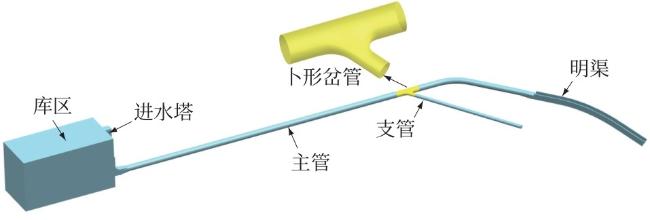
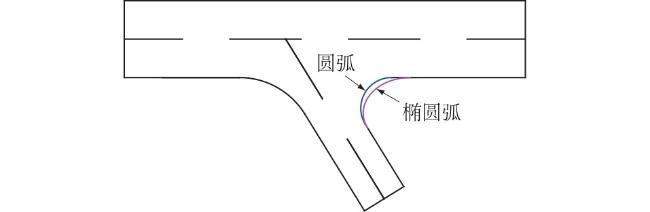
针对某引调水工程卜形岔管开展数值模拟研究,管线布置及岔管结构如图1所示。该岔管主管直径5 m,支管直径3 m,分岔角58°。基于该管线岔管体型,重点探索倒角形状变化对岔管固液两相流动的影响,如图2所示,分别对圆弧形倒角和椭圆弧形倒角进行研究。圆弧形倒角半径为2 m,椭圆弧形倒角长半径为3 m、短半径为2.27 m。
图1 管线布置及卜形岔管结构示意

Fig.1 Schematic diagram of pipeline layout and Y-shaped bifurcated pipe

图2 不同倒角形状示意

Fig.2 Schematic diagram of different chamfer shapes

为准确模拟岔管内部固液两相流动,计算域除卜形岔管外,还包括部分库区、进水塔、主管、支管、末端明渠。对形状复杂的卜形岔管采用适应性更好的四面体网格进行离散,其他部分均采用六面体网格。为准确捕捉管道内部的流动细节,对卜形岔管曲率较大位置的网格进行局部加密,网格总数约125万。
在欧拉-拉格朗日框架下,考虑水流与颗粒间的相互作用,利用RNG k-ε瞬态紊流三维数学模型[32]求解岔管内部水流运动,通过颗粒运动方程[33-34]求解颗粒运动。水流运动控制方程如下:
连续方程为
ρ u i x i = 0  
动量方程为
ρ u i t + x j ρ u i u j = f i - p x i + x j μ + μ t u i x j + u j x i  
式中: ρ为密度; t为时间;xixj为空间坐标(i=1,2,3,j=1,2,3); u i u j分别为速度矢量在i方向、j方向的分量; f i为质量力; p为压力; μ μ t分别为动力黏性系数、紊流黏性系数,μt=Cμρκ2,Cμ=0.09,为经验常数, κ 为湍动能, ε 为湍流耗散率。
采用离散型冲击模型[35]求解颗粒对岔管的冲蚀磨损破坏,磨损模型为
R e r o s i o n = p = 1 N p a r t i c l e m · p C d p f α v b v A f a c e  
式中:Rerosion为磨损率; m · p表示颗粒质量流量;Aface为管壁上网格的面积;?? 为颗粒质量流率,表示单位面积管壁受到磨损作用的颗粒质量;dpαv分别为颗粒作用在管壁的颗粒直径、冲击角度、冲击速度,相应地,C d pf αb v分别表示颗粒直径函数、冲击角度函数、冲击速度函数。
运用Fluent 2021流体分析软件对两种体型岔管的水流运动和磨损特性进行模拟。采用有限体积法对控制方程进行离散,压力与速度耦合通过SIMPLEC算法求解,速度离散采用二阶迎风格式,湍流模型近壁采用标准壁函数处理。
由于主管单独运行时,管道引用流量大、水流流速高,易出现局部低压和高强度磨损分布,故本研究重点分析主管单独运行时岔管内部水力特性和磨损分布。库区进口根据库水位给定压力边界条件,库区顶部给定大气边界条件。明渠出口为自由出流、明渠顶部给定大气边界条件,末端分岔管支管出口断面设置为固壁边界。管道壁面设置为无滑移边界条件。泥沙颗粒直径为110 μm,颗粒质量流量为0.026 5 kg/s,颗粒初始速度为13.5 m/s。

1.2 模型验证
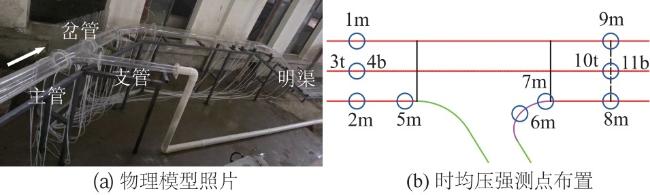
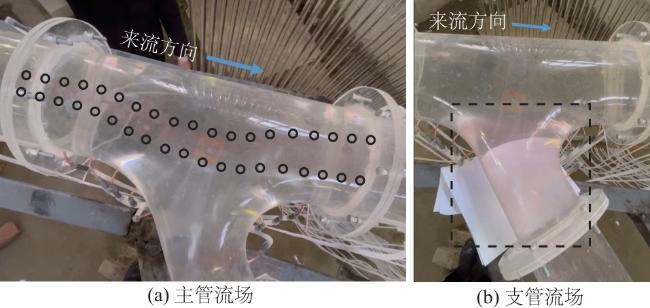
为保证数值模拟方法的可靠性,对椭圆弧形倒角岔管开展物理模型试验研究。本研究中泥沙体积分数约3.6×10⁻⁸(<10-6)可忽略泥沙颗粒之间的相互碰撞,泥沙主要跟随水流运动[36],磨损特征和水流结构密切相关[37-38],故物理模型验证是对流场结构及时均压力等水力特征进行验证。物理模型照片如图3(a)所示。监测主管单独运行时岔管内部流态及壁面时均压强,与岔管在清水运行条件下的数值模拟结果进行对比。岔管流态通过示踪剂法显示,岔管壁面压强通过测压管测量,岔管边壁时均压强测点布置如图3(b)所示,测点编号中的字母t、m、b分别表示岔管顶部、中部、底部测点。
图3 物理模型照片及时均压强测点布置

Fig.3 Physical model photo and layout of time-averaged pressure measurement points

由岔管在清水条件下运行时内部流场数值模拟结果(图4)可知,水流在主管进口附近沿管轴线运动,在主、支管交汇处偏向支管一侧,在支管进口内部形成漩涡结构。图5为模型试验所监测的主管单独运行时岔管内部流场,粉红色为示踪剂,分别用小圆圈和黑色线框标注了红色示踪剂的流动范围。由图5(a)可知,在岔管上游的主管段内部,粉红色示踪剂沿主管轴线方向运动;当运动至主支管交汇处时,粉红色示踪剂略微偏向支管一侧;由图5(b)可知,支管进口附近出现的粉红色示踪剂区域与数值模拟计算得到的支管内部漩涡范围一致,说明支管内部形成了漩涡结构,示踪剂受漩涡卷吸作用而聚集在该区域。由此可知,模型试验得到的岔管内部流场特征与数值模拟结果基本一致。
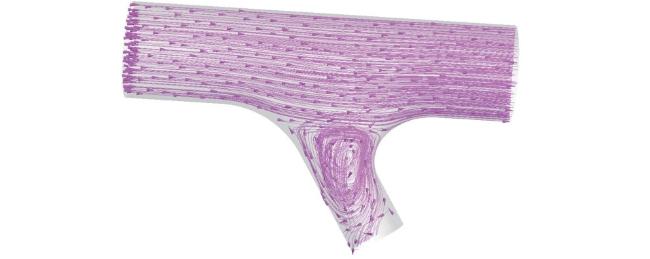
图4 岔管内部流场数值模拟结果

Fig.4 Numerical simulation results of internal flow field in bifurcated pipe

图5 岔管内部流场

Fig.5 Internal flow field of bifurcated pipe

表1为岔管管壁测点时均压强的试验值与数值模拟值,可知,数值模拟值与试验值的边壁时均压强分布规律一致,二者误差范围为0.17%~3.15%。数值模拟结果与试验结果吻合良好,证明了数值模拟方法的可靠性。
表1 时均压强的试验值与模拟值对比

Table 1 Comparison between experimental and simulated values of time-averaged pressure

测点编号 时均压强/(9.81 kPa) 相对误差/%
试验值 模拟值
1m 9.26 8.99 2.94
2m 8.88 8.92 0.48
3t 6.76 6.55 3.15
4b 11.58 11.38 1.77
5m 8.19 8.22 0.35
6m 13.96 14.09 0.94
7m 5.02 5.03 0.17
8m 8.23 8.28 0.57
9m 8.33 8.43 1.15
10t 10.94 10.83 1.03
11b 6.02 5.97 0.88

2 结果与讨论

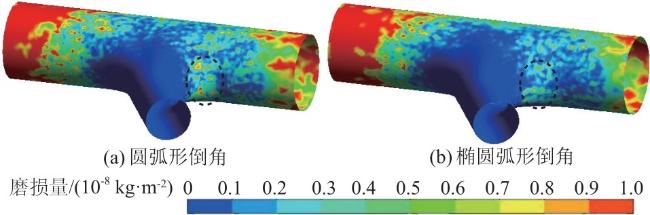
图6为主管单独运行时,圆弧形倒角岔管和椭圆弧形倒角岔管管壁磨损分布云图。可知,2种倒角形式岔管均是主管磨损较严重,尤其是主管进口和出口附近,磨损量均>9×10⁻⁹ kg/m2,而支管磨损较轻,磨损量不超过1×109 kg/m2。对比之下,椭圆弧型倒角岔管裆部磨损明显较轻,平均磨损量较圆弧型倒角岔管降低了21.03%,没有出现图6(a)中黑色虚线圈所示的局部高强度磨损区域;此外,其主管出口附近的高强度磨损面积变小,平均磨损量降低了22.26%。
图6 2种体型岔管管壁磨损分布云图

Fig.6 Contours of erosion-wear distribution on pipe walls of two bifurcated pipe types

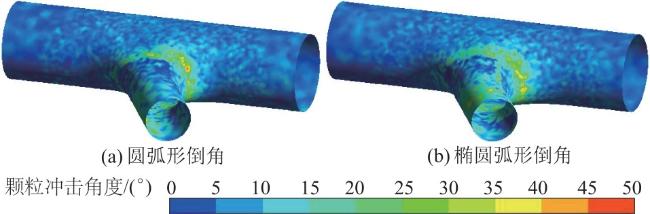
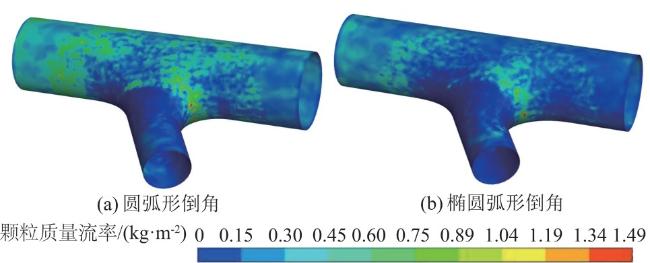
由式(3)可知,岔管表面的磨损量与颗粒粒径、冲击速度、冲击角度及质量流率有关。本研究中颗粒粒径为等值粒径,重点对比分析颗粒作用于2种岔管表面的冲击速度、冲击角度和质量流率,如图7图9所示。由图7可知,颗粒对2种岔管主管的冲击速度明显高于对支管的冲击速度,颗粒对主管的冲击速度集中在5.6~11.2 m/s区间,对支管的冲击速度<2.8 m/s;此外,颗粒对2种岔管下游裆部靠主管附近区域均产生高速冲击(冲击速度>9.8 m/s),且颗粒对圆弧形倒角岔管裆部的冲击速度要明显高于椭圆弧形倒角岔管。就冲击角度而言,颗粒对2种岔管表面的冲击角度分布规律比较一致,较高冲击角度均出现在岔管下游裆部靠近支管一侧的区域(图8)。对比颗粒对2种岔管表面作用的质量流率(图9),可知,冲击圆弧形倒角岔管主管的单位面积的颗粒质量普遍>0.75 kg,而冲击椭圆弧形倒角岔管主管单位面积的颗粒质量普遍<0.60 kg,可知圆弧形倒角岔管遭受更高频率的颗粒冲击作用,说明椭圆弧形倒角能有效减轻颗粒与岔管表面发生碰撞的频率。
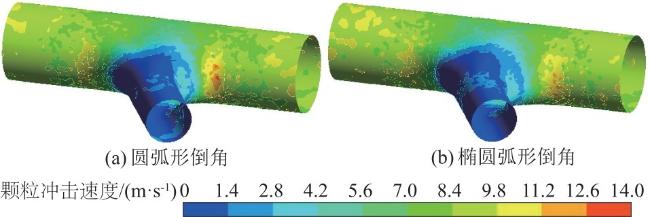
图7 颗粒对2种体型岔管管壁的冲击速度分布云图

Fig.7 Contours of particle impact velocity on pipe walls of two bifurcated pipe types

图8 颗粒对2种体型岔管管壁的冲击角度分布云图

Fig.8 Contours of particle impact angle on pipe walls of two bifurcated pipe types

图9 颗粒作用于2种体型岔管管壁的质量流率分布云图

Fig.9 Contours of particle mass flow rate on pipe walls of two bifurcated pipe types

综合分析颗粒作用于2种岔管表面的冲击速度、冲击角度及质量流率,并与2种岔管表面的磨损分布进行对照,探究影响岔管磨损分布的关键因素。可知,岔管表面的磨损分布主要与颗粒冲击速度和质量流率相关,且后者对磨损分布的影响更大。颗粒作用于2种岔管进口和出口位置的冲击速度较大、质量流率较高,对应的磨损量也较高;颗粒对岔管下游裆部靠近主管侧的冲击速度虽然较高,但由于该位置受到颗粒冲击的质量流率较低,故磨损量较小;而颗粒对岔管下游裆部靠近支管侧的冲击速度虽然较低,但由于该位置受到较高频率的颗粒冲击作用,故磨损量较高。
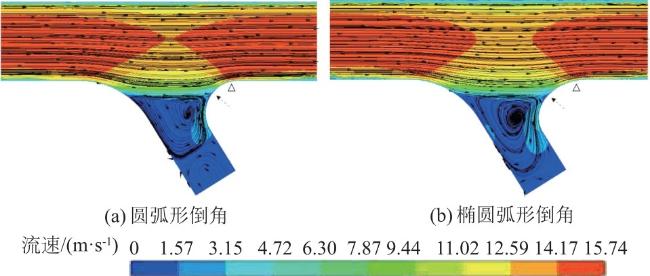
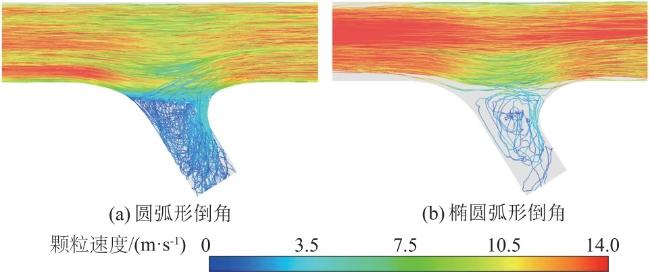
颗粒对管壁的磨损作用是由颗粒在岔管内部的运动轨迹决定的,而颗粒是跟随水流运动的,对2种体型岔管内部水流运动进行分析,图10为主管单独运行时2种体型岔管内部水平剖面上的水流流线和流速分布云图。2种倒角形式岔管内部水流运动规律基本一致,区别主要在于椭圆弧形倒角体型因倒角处空间更开阔、过流断面变化更平缓,支管内部漩涡流动区域更大,漩涡对主流的顶托作用更明显,减轻了主管内水流在主、支管交汇处的偏转程度,将主流绕倒角流动的前驻点(图10中虚线箭头所示)向下游方向推移,进而将倒角末端的高流速区域(图10中三角形标识)向主管下游推移。
图10 主管单独运行时2种体型岔管水平剖面流速分布

Fig.10 Flow velocity distribution on horizontal cross-sections of two bifurcated pipe types during standalone operation of main pipe

对2种岔管内部的540个随机颗粒轨迹进行分析,如图11所示。
图11 2种体型岔管内部颗粒运动轨迹

Fig.11 Particle trajectories inside two bifurcated pipe types

2种岔管内部颗粒跟随水流运动,均在主、支管衔接处,受到支管漩涡卷吸作用而跟随漩涡做旋转运动。区别在于,在圆弧形倒角岔管内部,更多颗粒被卷吸至支管内部,且位于主管内的颗粒运动轨迹更加靠近管壁附近。而椭圆弧倒角岔管因支管内的漩涡对主管内部的水流运动顶托作用增强,主管内部的主流主要沿主管轴线方向运动,使得颗粒能够更加顺畅地离开岔管,具体表现为:颗粒主要跟随主管内的主流运动、仅少量颗粒被卷吸至支管内部,且跟随主流运动的颗粒轨迹主要集中在管道中心区域而离管壁较远,故较少颗粒与管壁发生碰撞,从而降低了颗粒作用于壁面的质量流率。

3 结论

本文采用数值模拟方法,结合物理模型试验,对岔管固液两相流动进行了研究,分析了影响磨损特性的关键因素,并探索了椭圆弧形倒角形状对岔管磨损分布的影响机制。研究结论如下:
(1)岔管磨损严重的位置集中在主管段进口、出口,岔管裆部次之,支管磨损较轻。
(2)岔管表面的磨损分布主要与颗粒冲击速度和质量流率相关,且后者对磨损分布的影响更大。
(3)与圆弧形倒角相比,椭圆弧形倒角岔管因水流运动顺畅,利于颗粒输送,从而降低了颗粒作用于管壁的质量流率,可有效减轻磨损。
(4)本研究成果可为类似工程的岔管设计提供参考,发挥指导和借鉴作用。
[1]
闫霞, 周银军, 姚仕明. 长江源区河流地貌及水沙特性[J]. 长江科学院院报, 2019, 36(12): 10-15.

DOI

(YAN Xia, ZHOU Yin-jun, YAO Shi-ming. Landform and Characteristics of Flow and Sediment of Rivers in Source Region of Yangtze River[J]. Journal of Yangtze River Scientific Research Institute, 2019, 36(12): 10-15. (in Chinese))

DOI

[2]
陈鹏, 金中武, 周银军, 等. 2012—2021年长江源区水沙变化特征调查分析[J]. 长江科学院院报, 2023, 40(10):180-185.

DOI

(CHEN Peng, JIN Zhong-wu, ZHOU Yin-jun, et al. Characteristics of Water and Sediment Changes in the Source Region of Yangtze River from 2012 to 2021[J]. Journal of Changjiang River Scientific Research Institute, 2023, 40(10):180-185. (in Chinese))

[3]
PENG W, CAO X. Numerical Simulation of Solid Particle Erosion in Pipe Bends for Liquid-Solid Flow[J]. Powder Technology, 2016, 294: 266-279.

[4]
范玉. 水沙两相流理论及引水工程管道输沙问题的研究[D]. 天津: 天津大学, 2017.

(FAN Yu. Study on the Theory of Water-sediment Two-phase flow and the Problem of Sediment Transport in the Pipeline of Water Diversion Project[D]. Tianjin: Tianjin University, 2017. (in Chinese))

[5]
李美求, 刘方, 张昆, 等. 管道冲蚀液-固数值模拟的研究进展[J]. 科学技术与工程, 2023, 23(34): 14497-14506.

(LI Mei-qiu, LIU Fang, ZHANG Kun, et al. Advances in Liquid-solid Numerical Simulation of Pipeline Erosion[J]. Science Technology and Engineering, 2023, 23(34): 14497-14506. (in Chinese))

[6]
董志勇, 孙金阳, 李宇航, 等. 含沙量对高速水流空蚀影响的试验研究[J]. 水力发电学报, 2021, 40(10): 10-18.

(DONG Zhi-yong, SUN Jin-yang, LI Yu-hang, et al. Experimental Study of Effects of Sediment Concentration on Cavitation Erosion in High Velocity Flows[J]. Journal of Hydroelectric Engineering, 2021, 40(10): 10-18. (in Chinese))

[7]
常英杰, 吴爱祥, 阮竹恩, 等. 含粗骨料膏体输送管道磨损机理及参数优化[J]. 中南大学学报(自然科学版), 2024, 55(1): 307-316.

(CHANG Ying-jie, WU Ai-xiang, RUAN Zhu-en, et al. Wear Mechanism and Parameters Optimization of Coarse Aggregate-containing Paste Transport Pipes[J]. Journal of Central South University (Science and Technology), 2024, 55(1): 307-316. (in Chinese))

[8]
DET N V. Recommended Practice RP O501: Erosive Wear in Piping Systems: DNV RP O501[R]. Oslo: Det Norske Veritas, 2007: 1-28.

[9]
郭沫川, 谭玉叶, 楚立申, 等. 某铁矿管道自流输送分析及管道磨损研究[J]. 矿冶工程, 2022, 42(5):39-43.

DOI

(GUO Mo-chuan, TAN Yu-ye, CHU Li-shen, et al. Analysis of Gravity Flow Pipeline Transportation and Pipeline Wear for an Iron Mine[J]. Mining and Metallurgical Engineering, 2022, 42(5): 39-43. (in Chinese))

DOI

[10]
季楚凌, 杨紫辰, 马树锋, 等. 含砂天然气管道弯管冲蚀磨损特性研究[J]. 管道技术与设备, 2023(4):18-21,37.

(JI Chu-ling, YANG Zi-chen, MA Shu-feng, et al. Study on Erosion Characteristics of Elbow in Natural Gas Pipeline Containing Sand[J]. Pipeline Technique and Equipment, 2023(4): 18-21, 37. (in Chinese))

[11]
王栋. 煤矸石基充填料浆管道输送流致力学响应特性研究[D]. 徐州: 中国矿业大学, 2023.

(WANG Dong. Study on Pipe flow Characteristics of Coal Gangue-based Filling Slurry and Its Flow-induced Mechanical Response Characteristics of Conveying Pipeline[D]. Xuzhou: China University of Mining and Technology, 2023. (in Chinese))

[12]
ELEMUREN R, TAMSAKI A, EVITTS R, et al. Erosion-corrosion of 90° AISI 1018 Steel Elbows in Potash Slurry: Effect of Particle Concentration on Surface Roughness[J]. Wear, 2019, 430: 37-49.

[13]
BABU P S, BASU B, SUNDARARAJAN G. The Influence of Erodent Hardness on the Erosion Behavior of Detonation Sprayed WC-12Co Coatings[J]. Wear, 2011, 270(11/12): 903-913.

[14]
MOLINA N, WALCZAK M, KALBARCZYK M, et al. Erosion under Turbulent Slurry Flow: Effect of Particle Size in Determining Impact Velocity and Wear Correlation by Inverse Analysis[J]. Wear, 2021, 474: 203651.

[15]
DESALE G R, GANDHI B K, JAIN S C. Effect of Erodent Properties on Erosion Wear of Ductile Type Materials[J]. Wear, 2006, 261(7/8): 914-921.

[16]
王静, 李长俊, 吴瑕. 页岩气集输管道弯头气液固三相冲蚀磨损特性研究[J]. 石油机械, 2022, 50(9):137-144.

(WANG Jing, LI Chang-jun, WU Xia. Study on Gas-liquid-solid Erosion Wear of Elbow in Shale Gas Gathering Pipeline[J]. China Petrolenum Machinery, 2022, 50(9):137-144. (in Chinese))

[17]
顾欣欣, 万五一, 张博然. 大变径卜型岔管的水力特性及优化研究[J]. 水力发电学报, 2018, 37(1): 62-69.

(GU Xin-xin, WAN Wu-yi, ZHANG Bo-ran. Hydraulic Characteristics and Optimization of Y-type Pipes with Large Diameter Difference[J]. Journal of Hydroelectric Engineering, 2018, 37(1): 62-69. (in Chinese))

[18]
梁春光, 程永光. 基于CFD的抽水蓄能电站岔管水力优化[J]. 水力发电学报, 2010, 29(3): 84-91.

(LIANG Chun-guang, CHENG Yong-guang. Hydraulic Optimization of Pipe Bifurcation of Pumped-storage Power Station by CFD Method[J]. Journal of Hydroelectric Engineering, 2010, 29(3): 84-91. (in Chinese))

[19]
周彩荣, 伍鹤皋, 石长征. 埋藏式月牙肋钢岔管布置形式选择和承载特性研究[J]. 水力发电学报, 2014, 33(4): 208-213.

(ZHOU Cai-rong, WU He-gao, SHI Chang-zheng. Study on Layout and Load-bearing Characteristics of Embedded Steel Crescent-rib Reinforced Bifurcated Pipe[J]. Journal of Hydroelectric Engineering, 2014, 33(4): 208-213. (in Chinese))

[20]
陈观福, 伍鹤皋, 王金龙. 内加强月牙肋钢岔管新型结构[J]. 长江科学院院报, 2001, 18(1):23-26.

(CHEN Guan-fu, WU He-gao, WANG Jin-long. New Type of Steel Bifurcation with Inner Crescent Rib[J]. Journal of Changjiang River Scientific Research Institute, 2001, 18(1):23-26. (in Chinese))

[21]
汪碧飞, 李勇泉, 陈美娟, 等. 埋藏式月牙肋岔管内压分担比研究[J]. 长江科学院院报, 2021, 38(6):123-127.

DOI

(WANG Bi-fei, LI Yong-quan, CHEN Mei-juan, et al. Sharing Ratio of Internal Pressure of Embedded Crescent-rib Bifurcated Pipe[J]. Journal of Changjiang River Scientific Research Institute, 2021, 38(6):123-127. (in Chinese))

[22]
张军, 吴俊杰, 刘峰. 高水头扬水工程岔管应力分析[J]. 水资源与水工程学报, 2020, 31(5):176-181

(ZHANG Jun, WU Jun-jie, LIU Feng. Stress Analysis of Bifurcated Pipes in a High Head Pumping Project[J]. Journal of Water Resources&Water Engineering, 2020, 31(5):176-181. (in Chinese))

[23]
刘贤才, 张雨萌, 汤怀萱, 等. 姚家平水利枢纽工程钢岔管结构型式选择与CFD研究[J]. 中国农村水利水电, 2024(1): 231-236.

DOI

(LIU Xian-cai, ZHANG Yu-meng, TANG Huai-xuan, et al. Structural Type Selection and CFD Study of Steel Bifurcation in Yaojiaping Water Conservancy Project[J]. China Rural Water and Hydropower, 2024(1): 231-236. (in Chinese))

DOI

[24]
信佰伶. 抽水蓄能电站岔管导流板偏转角优化设计研究[J]. 东北水利水电, 2022, 40(7): 5-7, 71.

(XIN Bai-ling. Optimization Design of Deflection Angle of Diversion Plate of Bifurcation Pipe in Pumped Storage Power Station[J]. Water Resources & Hydropower of Northeast China, 2022, 40(7): 5-7, 71. (in Chinese))

[25]
刘沛清, 屈秋林, 王志国, 等. 内加强月牙肋三岔管水力特性数值模拟[J]. 水利学报, 2004, 35(3): 42-46.

(LIU Pei-qing, QU Qiu-lin, WANG Zhi-guo, et al. Numerical Simulation on Hydrodynamic Characteristics of Bifurcation Pipe with Internal Crescent Rib[J]. Journal of Hydraulic Engineering, 2004, 35(3): 42-46. (in Chinese))

[26]
于航, 章晋雄, 张宏伟, 等. 抽水蓄能电站卜型岔管水力优化[C]//中国水利学会. 中国水利学会2021学术年会论文集. 郑州: 黄河水利出版社, 2021.

(YU Hang, ZHANG Jinxiong, ZHANG Hongwei, et al. Hydraulic Optimization of U-shaped Bifurcated Pipes in Pumped Storage Power Stations[C]// Proceedings of the 2021 Academic Annual Conference of the Chinese Water Conservancy Society. Zhengzhou: Yellow River Water Conservancy Press, 2021. (in Chinese))

[27]
苏凯, 李聪安, 伍鹤皋, 等. 水电站月牙肋钢岔管研究进展综述[J]. 水利学报, 2017, 48(8): 968-976.

(SU Kai, LI Cong-an, WU He-gao, et al. Review of the Crescent-rib Steel Bifurcation of Hydropower Station[J]. Journal of Hydraulic Engineering, 2017, 48(8): 968-976. (in Chinese))

[28]
程丹, 苏凯, 石怡安. 钢筋混凝土岔管结构优化[J]. 水利水电科技进展, 2015, 35(1):89-94.

(CHENG DAN, SU Kai, SHI Yi-an. Structure Optimization on Reinforced Concrete Bifurcation[J]. Advances in Science and Technology of Water Resources, 2015, 35(1):89-94. (in Chinese))

[29]
丁宇明, 胡建国. 岔管过渡带曲面计算机辅助几何设计[J]. 武汉水利电力学院学报, 1990, 23(1): 71-82.

(DING Yu-ming, HU Jian-guo. The Computer Aided Geometric Design (CAGD) on the Curved Surface of Forked Pipe Transition Zone[J]. Journal of Wuhan University of Hydraulic and Electric Engineering, 1990, 23(1): 71-82. (in Chinese))

[30]
汪洋, 苏凯, 伍鹤皋, 等. 钢筋混凝土岔管锐角区修圆优化的压强分布不均匀性研究[J]. 四川大学学报(工程科学版), 2015, 47(3):6-13.

(WANG Yang, SU Kai, WU He-gao, et al. Study on Asymmetrical Pressure Distribution of Rounding Optimization on Iteinforced Concrete Bifurcation Acute-angle-region[J]. Journal of Sichuan University (Engineering Science Edition), 2015, 47(3):6-13. (in Chinese))

[31]
任炜辰, 戴熙武, 鲍世虎, 等. 卜形岔管水力特性研究[J]. 水力发电学报, 2022, 41(4): 28-36.

(REN Wei-chen, DAI Xi-wu, BAO Shi-hu, et al. Hydraulic Characteristics of Bifurcated Pipes[J]. Journal of Hydroelectric Engineering, 2022, 41(4): 28-36. (in Chinese))

[32]
LI F X, YUAN L, SHI W L. k-ε Turbulent Model and its Application to the FLUENT[J]. Industrial Heating, 2007, 36(4):13-15.

[33]
WALLACE M S, PETERS J S, SCANLON T J. CFD-based Erosion Modeling of Multi-orifice Choke Valves[C]// Proceedings of ASME 2000 Fluids Engineering Division Summer Meeting, Boston, MA, USA. June 11-15, 2000:945-958.

[34]
HABIB M A, BADR H M, BEN-MANSOUR R, et al. Erosion Rate Correlations of a Pipe Protruded in an Abrupt Pipe Contraction[J]. International Journal of Impact Engineering, 2007, 34(8): 1350-1369.

[35]
SHAH S N, JAIN S. Coiled Tubing Erosion during Hydraulic Fracturing Slurry Flow[J]. Wear, 2008, 264(3/4): 279-290.

[36]
ELGHOBASHI S. On Predicting Particle-laden Turbulent Flows[J]. Applied Scientific Research, 1994, 52(4): 309-329.

[37]
CHITRAKAR S, NEOPANE H P, DAHLHAUG O G. Study of the Simultaneous Effects of Secondary Flow and Sediment Erosion in Francis Turbines[J]. Renewable Energy, 2016, 97: 881-891.

[38]
钱忠东, 王焱, 郜元勇. 双吸式离心泵叶轮泥沙磨损数值模拟[J]. 水力发电学报, 2012, 31(3): 223-229.

(QIAN Zhong-dong, WANG Yan, GAO Yuan-yong. Numerical Simulation of Sediment Erosion in Double-suctions Centrifugal Pump[J]. Journal of Hydroelectric Engineering, 2012, 31(3): 223-229. (in Chinese))

Outlines

/