

0 引言
大坝安全是水利工程中的首要问题。通过对大坝变形的高效合理预测,可以及时发现潜在的问题,防止大坝溃决等灾难性事故的发生,保障下游居民生命财产安全。大坝的变形受到水位、温度、时效等多种分量的综合影响,具有非线性时间序列的特性。因此,有效抓住大坝变形效应量与环境量之间的复杂关系对大坝安全监测具有深远的意义。
目前,诸多研究表明影响大坝变形的众多环境因子之间存在着相关性[1-2]。若输入因子数过多,冗余信息加入计算,则会导致模型预测效率、质量以及泛化能力的降低。龙江等[3]利用最大信息系数进行特征的筛选,为模型提供了合理的输入因子集,从而降低模型复杂度。张孟昕等[4]结合空间关联性选取出最优因子集,辅以交叉验证特征因子的有效性,提高模型的泛化程度。特征的选取对模型预测精度具有重要的影响,但在大坝预测模型中对特征的选取往往表现为“黑盒”模式。虽然可以依据输入量给出预测目标,但很难揭示其可靠性。罗璐等[5]在面对大量数据时采用最小绝对值收缩和选择算子(Least Absolute Shrinkage And Selection Operation,LASSO)算法剔除部分因子,提高因子选择的可视度。黄海燕等[6]构建了3种兼顾预测能力和可解释性的模型,全面分析了不同因子对大坝变形的影响程度。陈斯煜等[7]提出稀疏贝叶斯学习(Sparse Bayesian Learning,SBL)驱动的可解释性模型,准确表征水位、气温和时效因子与大坝变形的非线性映射关系。因此,可解释性变量选择对模型高效预测具有重要的意义,同时也为实际工程决策提供了一种可靠的方式。
针对单一预测模型参数调整复杂、训练过拟合和预测结果不稳定[18]等问题,相关学者采用多个模型组合的方法来全面提高预测模型的性能。施彦彤等[19]采用卷积神经网络(Convolutional Neural Network,CNN)提取特征,耦合含有注意力机制LSTM模型,在深层挖掘特征信息的前提下完成时间序列数据的学习。邓思源等[20]提出一种XGBoost-LSTM变权组合预测模型实现了组合模型间灵活结合,最大程度上放大各个单独模型的优点。刘丹等[21]利用遗传算法优化LSTM模型的参数,采用组合的方式有效避免模型陷入局部极值。耦合模型在预测精度提高的同时忽略了各模型交互训练的复杂性。王悦等[22]提出的分类回归树-Bagging (Classification and Regression Tree-Bagging,CART-Bagging)模型组合了机器学习与集成学习的优势,提高预测性能,也提供了一种简单高效的组合方式。Fan等[23]利用Bootstrap方法与Bagging算法的耦合模型挖掘了主成分与响应变量之间的联系结构。综上所述,组合模型通过耦合Bagging集成算法,既保留了预测精度,又在模型鲁棒性和简洁性上有所提升,尤其在多模式、复杂和高维数据处理中表现出色。
因此,本文构建了一个兼具高精度、稳定性和可解释性的耦合预测模型。主要创新在于通过LASSO有效筛选关键环境变量,简化了模型输入并提高其解释性;LSTM捕捉大坝位移数据的时序特征,而引入的注意力机制帮助模型关注于时间序列中的重要特征;Bagging算法则通过并行训练多个子模型,显著提高了模型的泛化能力。以实际案例分析,耦合模型不仅在大坝变形预测中表现出更高的准确性,还在解释性和稳定性上优于常用模型。
1 方法原理
1.1 LASSO回归因子选择
由于大坝位移预测涉及许多潜在的输入变量,使用包含大量变量的传统回归模型可能会导致过拟合问题。LASSO回归通过系数收缩完成特征选择,减少了模型的复杂度,降低计算成本,有助于提高模型在新数据上的计算效率。LASSO回归是一种惩罚回归方法,它在传统的最小二乘法的基础上加入了L1正则化项,通过调整正则化强度参数 ,实现变量选择和系数收缩的功能。其损失函数L(β)的表达式为
式中:yi为第i个观测值的真实值;β0为常数项;xij为第i个测值在第j个特征上的取值;βj为第j个特征的系数;n为数据集中的观测数;p为特征的数量。
在LASSO回归中,惩罚项是各个解释变量系数的绝对值之和乘以系数。其系数则需要通过交叉验证等方法进行选择,当达到合适的值时,一些不重要的输入变量的系数会被缩小到0。模型可根据各影响因子对预测目标的重要程度进行筛选,增强各因子选择的可解释性。
1.2 基于注意力机制编解码LSTM模型
1.2.1 LSTM模型
LSTM是一种改进的循环神经网络(Recurrent Neural Network,RNN),它的优点在于避免在处理长序列数据时遇到的梯度消失和爆炸的问题。LSTM通过引入门结构(Gate)来控制信息的流动,同时新加了一个贯穿整个单元的细胞状态(Cell State)作为记忆存储,从而有效地处理和记忆长序列数据中的信息。结构流程主要由激活函数和点乘法完成,具体步骤如下。
(1)遗忘门:遗忘门会查看前一个隐藏状态和当前的输入,通过一个Sigmoid函数决定细胞状态中的哪些信息需要被遗忘。遗忘门 表达式为
(2) 输入门:输入门与遗忘门相似,其区别为Sigmoid函数决定哪些部分的信息需要更新,以及还通过一个tanh函数生成一个新的候选值,这些信息可能会被添加到细胞状态中。输入门 、输入门相关状态值 、单元状态值 表达式分别为:
式中ct是LSTM网络中长期记忆的载体,通过遗忘门“过滤旧信息”和输入门“添加新信息”的动态组合,实现信息的长期传递与更新。
(3)输出门:首先,利用Sigmoid函数决定细胞状态中的哪些部分将输出到下一个隐藏状态,然后引用tanh函数处理细胞状态,使其输出值在-1和1之间。最后将这个值与Sigmoid门的输出相乘,得到下一个隐藏状态。输出门ot、当前隐藏状态的输出 表达式分别为:
式(2)—式(7)中:σ和tanh为激活函数;t为当前时间距离起测日的天数;xt表示当前时刻的输入;ht-1表示前一时刻的隐藏状态,σ = ,tanh = ,W*为权重矩阵;b*为偏置项。
1.2.2 注意力机制编解码器
注意力机制(Attention Mechanism)是一种在神经网络中模拟人类注意力方式的技术,在处理时间序列数据时,核心思想为动态地关注输入序列的不同位置。其动态性使得模型更加灵活,能够捕捉到序列中的关键信息,提高了处理数据的性能和效率。注意力机制通常与循环神经网络结合使用。编码器-解码器本质上为循环网络,在实际应用中大多选择RNN、LSTM等。
注意力机制编解码预测模型流程如下:
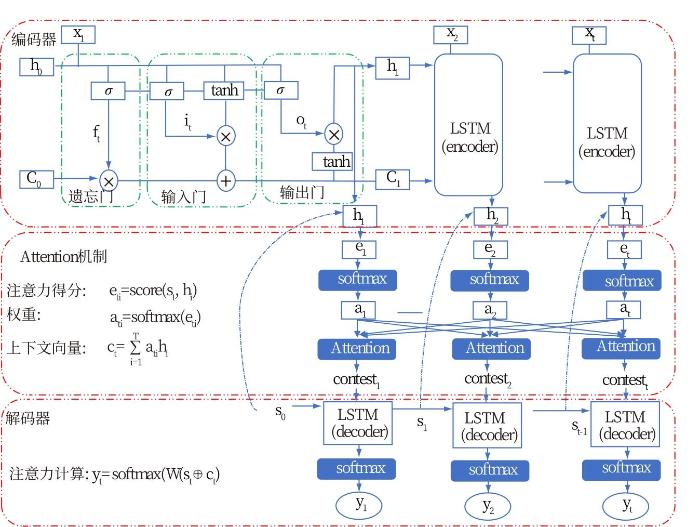
(1)采用LSTM编码器,输入序列X={x1,x2,…,xt},经过上文所描述的单元过程后输出一系列隐藏状态h={h1,h2,…,hT}。通过注意力得分eti来计算解码器隐藏状态st和编码器隐藏状态hi之间的匹配度,即
式中score( )可以是点积、缩放点积及双线性函数。
(2) 采取softmax函数将评分标准化为概率(权重) ,其表达式为
(3)计算上下文向量ct作为编码器隐藏状态hi的加权和,即
(4)解码器LSTM接收前一个时间步的输出 作为输入,更新解码器隐藏状态,当前隐藏状态 和上下文 ,即
式中:yt为t时刻解码器的输出;W是权重矩阵;⊕表示拼接操作。
在经典的编码器-解码器框架中,编码器将整个输入序列编码成一个固定长度的上下文向量,解码器使用这个上下文向量来生成输出序列。注意力力权重与编码器隐藏状态hi相乘,综合了输入序列中当前解码器输出最相关的信息。对于每个输出步骤,解码器使用注意力机制计算加权总和的上下文向量,其权重反映了每个输入元素对当前输出的重要性。模型流程如图1所示。
1.3 Bagging算法
Bagging算法的原理是基于自助采样(Bootstrap Sampling)和模型集成的思想。其核心是通过构建多个独立的模型并将其预测结果汇总起来提高模型的预测性能,减少单个模型可能出现的过拟合问题。
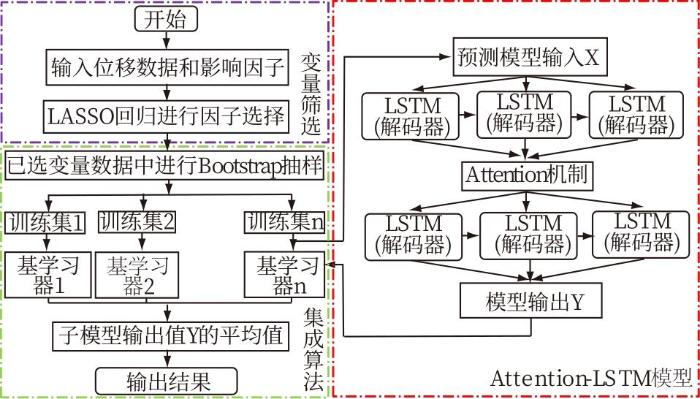
Bagging集成学习算法实现方式是:从原始数据m个样本中有放回地随机抽取n个样本进行训练(n≤m),其中包含重复或未包含的样本。重复上述步骤A次,即可得到A个新的数据集。由于每次抽样都是随机的,因此A个子数据集中分布具有一定的差异,但也会保留原数据集中的规律。采用A个不同的特征子集并进行独立训练,以增加模型的多样性。最后,计算A个模型预测值的平均值,作为最终的预测结果。
1.4 模型耦合
2 算例分析
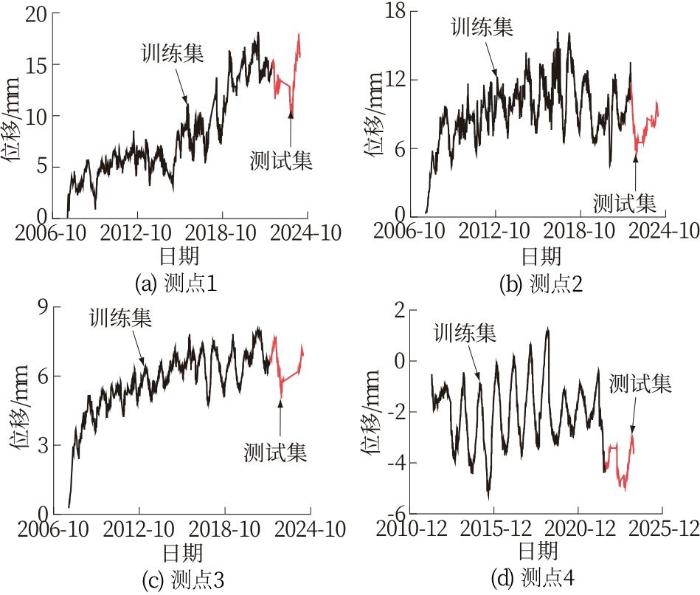
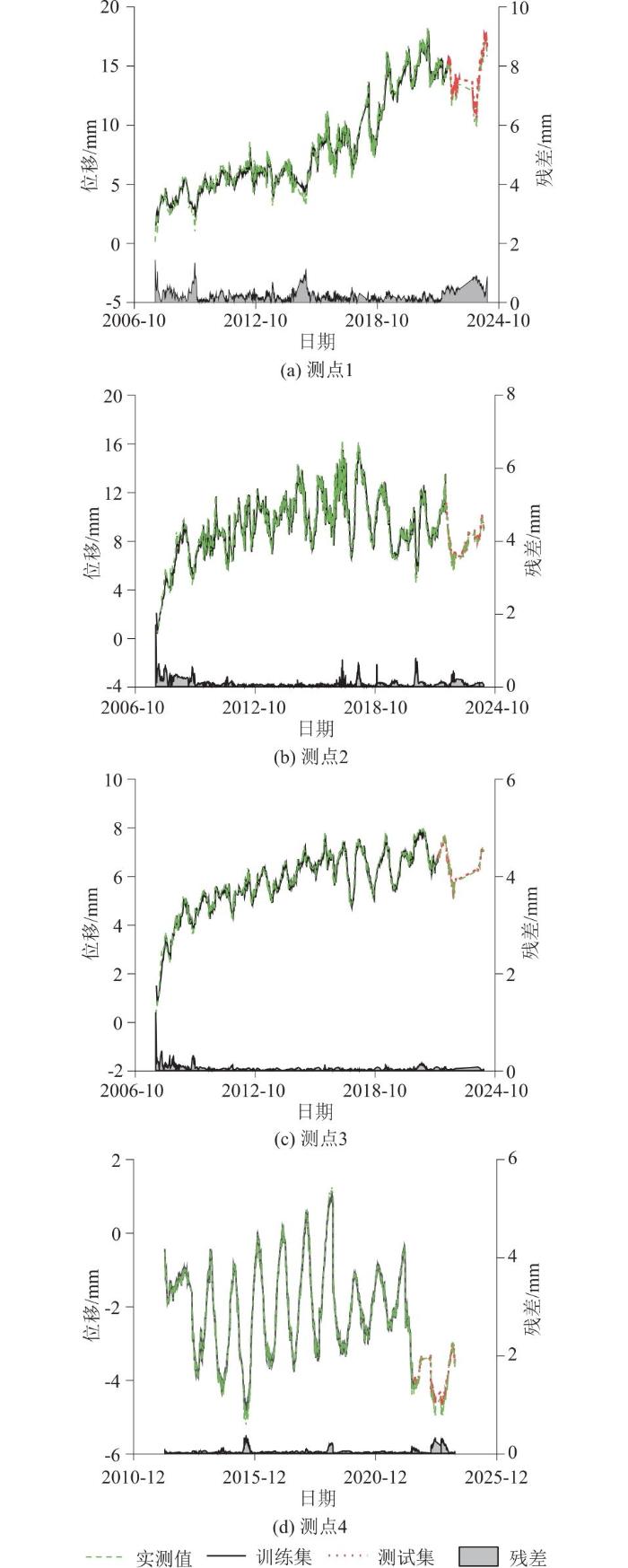
为验证耦合模型的有效性和适用性,本文以某碾压混凝土重力坝的变形监测数据为研究对象进行预测分析。该水利工程控制流域面积3 000 km2,水库总库容14.39亿m3。本文选择4个位移测点作为研究对象,具体位置依次为左岸非溢流坝段的坝顶中间、厂房坝段的坝体中间、厂房坝段的坝顶和河床溢流坝段的坝体中间。其中测点1—3采用起测日2017年11月1日—2024年3月27日的变形监测数据,测点4采用起测日2012年4月1日—2024年3月27日的变形监测数据。剔除异常数据得到样本数据集,取前90%为训练集,后10%为测试集,检验耦合模型拟合预测效果。各测点的位移过程线如图3所示。
2.1 数据预处理
水位的变化直接影响大坝结构的压力分布,造成大坝的变形;大坝材料(如混凝土)会随着温度的变化发生热胀冷缩,导致结构尺寸变化和应力分布的改变;随时间的推移,大坝材料老化,结构性能降低,影响大坝的长期稳定性和变形情况。因此,大坝变形一般由水压分量、温度分量及时效分量组成[24]。
水位因子由H、H2、H3构成,H1=H,H2=H2,H3=H3,其中H=Ht-Ho(Ht为当前上游水位,Ho为初始上游水位)。坝体位移变形受到温度季节性变化的影响,通常表现出周期性的变化模式。因此,在模拟和分析坝体温度效应时,通常采用具有周期性的正余函数来准确表示温度因子,即
$\begin{array}{l} T_{1}=\sin \frac{2 \pi t}{365}-\sin \frac{2 \pi t_{0}}{365}, T_{2}=\cos \frac{2 \pi t}{365}-\cos \frac{2 \pi t_{0}}{365}, \\ T_{3}=\sin \frac{4 \pi t}{365}-\sin \frac{4 \pi t_{0}}{365}, T_{4}=\cos \frac{4 \pi t}{365}-\cos \frac{4 \pi t_{0}}{365} 。 \end{array}$
式中t0为初始时间。温度因子 通过正弦/余弦函数的组合,量化温度的周期性变化(基频周期365 d,二倍频周期182.5 d),并利用 调整相位,以精准模拟坝体温度效应。
时效因子对大坝的长期性能和安全性有着显著影响,通常用I1=ln ,I2=1- ,I3= ,I4=t1,I5= ,I6= ,I7= ,I8= ,共8种形式表示,其中 。时效因子的影响具有多样性和不确定性,选用8个初始时效因子可以最大程度地涵盖可能影响坝体结构的长时间变化因素,保证模型在最初阶段具备更高的灵活性,能够充分考虑多种潜在影响。综上所述,水位因子取3项,温度因子取4项,时效因子取8项,共计15项影响因子作为输入特征。将上述的数据集去除异常值后,结合LSTM模型时间序列的特征,完成归一化处理。
2.2 LASSO筛选输入特征
本文选用上述15项影响因子,引入LASSO回归方法以筛选输入特征。模型中正则化参数为0.01;最大迭代次数为1 000;容差为0.000 1。如图4所示,LASSO特征选择可以直观地看出各影响因子系数,便于识别出关键影响因素。
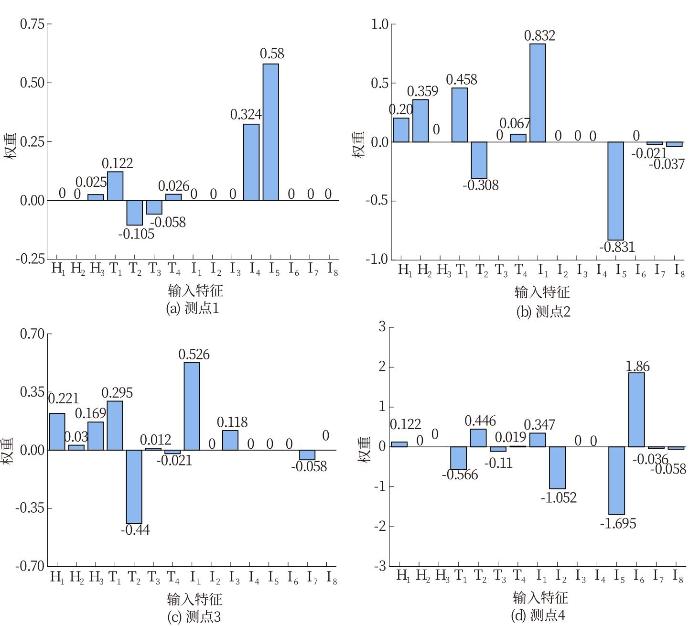
通过剔除系数为0的影响因子,列举出各测点的输入特征选择结果,如表1所示。由表1可知,水位因子在测点2和测点3处筛选较多,由于厂房坝段结构复杂且对水位变化敏感,水位波动会直接影响发电设备的运行和安全,因此水位对其影响远大于其他坝段。本文取混凝土重力坝为研究对象,温度变化会引起混凝土的热胀冷缩,进而影响坝体的变形,所以各测点温度特征选取个数较多。因为河床溢流坝段的测点4长期处于水流作用下,该区域的材料老化和长期变形效应更加显著,所以筛选出的时效因子较多。时效因子能够更全面地反映坝体的长时间累积效应,保留一定数量的时效因子可以确保模型在长时间监测中保持鲁棒性,而不容易受到单一时效因子变动的影响。结果表明,LASSO在特征选择中能够合理地反映各测点的主要影响因子,同时也提供了一种可解释性的变量选择机制。
表1 LASSO回归影响因子选择结果Table 1 Selection results of influencing factors of LASSO regression |
| 测点 | 选择结果 | 个数 |
|---|---|---|
| 1 | H3、T1、T2、T3、T4、I4、I5 | 7 |
| 2 | H1、H2、T1、T2、T4、I1、I5、I7、I8 | 9 |
| 3 | H1、H2、H3、T1、T2、T3、T4、I1、I3、I7 | 10 |
| 4 | H1、T1、T2、T3、T4、I1、I2、I5、I6、I7、I8 | 11 |
2.3 注意力机制编解码器
将以上选取的输入特征输入LSTM网络的编码器(Encoder)部分。编码器可将输入的时序特征进行抽取和编码,并在解码器(Decoder)部分引入注意力机制。模型的编码器和解码器均为1层LSTM结构,隐藏层单元数量为64。采用Adam优化器并设置学习率为0.001,并指定损失函数为均方误差(Mean-Square Error,MSE)。其本质为产生解码器输出和编码器输出之间的注意力权重,再将此权重分布映射到编码器输出,帮助模型更加关注输入序列中的重要特征,忽略次要信息,进而提高模型准确性。
2.4 基于Bagging算法的预测模型
表2 子模型影响因子注意力权重Table 2 Attention weights of influencing factors of sub-models |
| 测点 | 影响 因子 | 子模型 1 | 子模型 2 | 子模型 3 | 子模型 4 | 子模型 5 | 平均值 |
|---|---|---|---|---|---|---|---|
| 1 | H3 | 0.126 | 0.126 | 0.126 | 0.124 | 0.126 | 0.126 |
| T1 | 0.124 | 0.124 | 0.125 | 0.123 | 0.124 | 0.124 | |
| T2 | 0.118 | 0.118 | 0.119 | 0.115 | 0.114 | 0.117 | |
| T3 | 0.123 | 0.123 | 0.123 | 0.119 | 0.116 | 0.121 | |
| T4 | 0.162 | 0.161 | 0.160 | 0.161 | 0.158 | 0.160 | |
| I4 | 0.186 | 0.186 | 0.185 | 0.192 | 0.195 | 0.189 | |
| I5 | 0.161 | 0.161 | 0.162 | 0.165 | 0.167 | 0.163 | |
| 2 | H1 | 0.108 | 0.108 | 0.108 | 0.108 | 0.108 | 0.108 |
| H2 | 0.108 | 0.108 | 0.108 | 0.108 | 0.108 | 0.108 | |
| T1 | 0.110 | 0.111 | 0.111 | 0.111 | 0.111 | 0.111 | |
| T2 | 0.114 | 0.114 | 0.115 | 0.116 | 0.116 | 0.115 | |
| T4 | 0.110 | 0.111 | 0.111 | 0.112 | 0.113 | 0.111 | |
| I1 | 0.105 | 0.106 | 0.106 | 0.107 | 0.107 | 0.106 | |
| I5 | 0.104 | 0.104 | 0.104 | 0.104 | 0.104 | 0.104 | |
| I7 | 0.113 | 0.112 | 0.111 | 0.110 | 0.110 | 0.111 | |
| I8 | 0.128 | 0.126 | 0.126 | 0.124 | 0.123 | 0.125 | |
| 3 | H1 | 0.099 | 0.099 | 0.099 | 0.099 | 0.099 | 0.099 |
| H2 | 0.102 | 0.102 | 0.102 | 0.102 | 0.102 | 0.102 | |
| H3 | 0.101 | 0.101 | 0.101 | 0.102 | 0.102 | 0.101 | |
| T1 | 0.098 | 0.098 | 0.098 | 0.098 | 0.098 | 0.098 | |
| T2 | 0.093 | 0.093 | 0.093 | 0.093 | 0.093 | 0.093 | |
| T3 | 0.092 | 0.091 | 0.091 | 0.091 | 0.090 | 0.091 | |
| T4 | 0.093 | 0.093 | 0.092 | 0.092 | 0.091 | 0.092 | |
| I1 | 0.100 | 0.099 | 0.099 | 0.098 | 0.098 | 0.099 | |
| I3 | 0.109 | 0.109 | 0.109 | 0.109 | 0.109 | 0.109 | |
| I7 | 0.115 | 0.116 | 0.116 | 0.116 | 0.117 | 0.116 | |
| 4 | H1 | 0.090 | 0.090 | 0.090 | 0.090 | 0.090 | 0.090 |
| T1 | 0.089 | 0.089 | 0.089 | 0.089 | 0.089 | 0.089 | |
| T2 | 0.090 | 0.090 | 0.090 | 0.090 | 0.090 | 0.090 | |
| T3 | 0.089 | 0.089 | 0.089 | 0.089 | 0.089 | 0.089 | |
| T4 | 0.091 | 0.091 | 0.091 | 0.091 | 0.091 | 0.091 | |
| I1 | 0.093 | 0.093 | 0.093 | 0.093 | 0.093 | 0.093 | |
| I2 | 0.093 | 0.093 | 0.093 | 0.093 | 0.092 | 0.093 | |
| I5 | 0.094 | 0.093 | 0.093 | 0.093 | 0.093 | 0.093 | |
| I6 | 0.092 | 0.092 | 0.092 | 0.092 | 0.092 | 0.092 | |
| I7 | 0.091 | 0.091 | 0.091 | 0.091 | 0.091 | 0.091 | |
| I8 | 0.088 | 0.088 | 0.088 | 0.088 | 0.088 | 0.088 |
2.5 模型性能评估
在深度学习中,损失函数是衡量模型性能的关键指标之一。如图5所示,展示了5个子模型在训练过程中每个周期(epoch,完整遍历次数)的MSE损失。其中均方误差是一种常用的损失函数,用于衡量模型预测值与实际值之间的差异。MSE损失的计算方式是将每个预测值与实际值之间的差值平方,然后计算这些平方差的平均值。
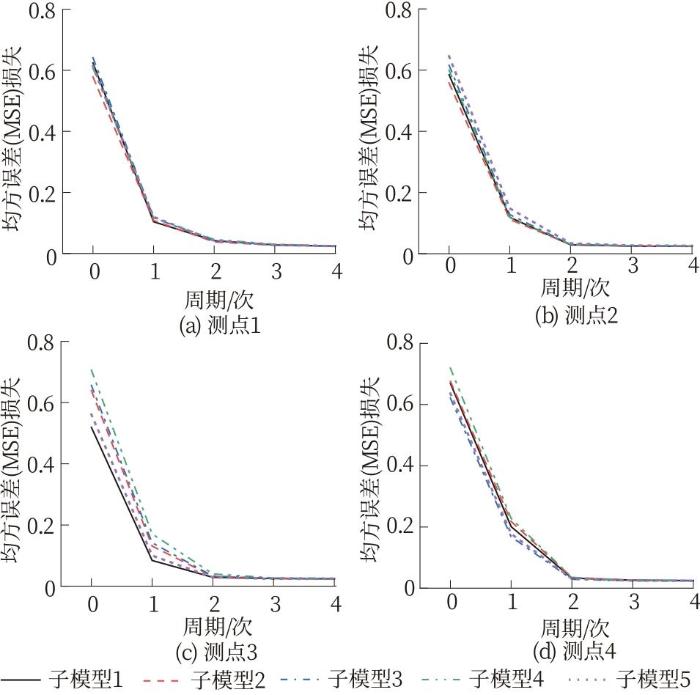
训练的目标是找到一组模型参数,使得损失函数的值最小。本文选用周期数为5,即模型遍历整个训练数据集5次,且每个周期包含一次完整的训练数据。批量大小取32,每次梯度更新时,模型将处理32个样本。从训练数据中划分出20%的数据作为验证集,用于在训练过程中评估模型的性能。如损失函数图所示,损失值的范围大多从0.7左右减低到接近0.0左右,说明由Bagging算法生成的各子模型在训练过程中取得了显著的改进。通过观察损失曲线的变化,可知随着epoch的增加,各测点中5个子模型的训练损失函数都呈下降并趋于平稳,所有模型都呈现出收敛的趋势,这表明其性能在逐渐提高并达到了稳定状态。
2.6 耦合模型预测结果
3 不同模型预测比较
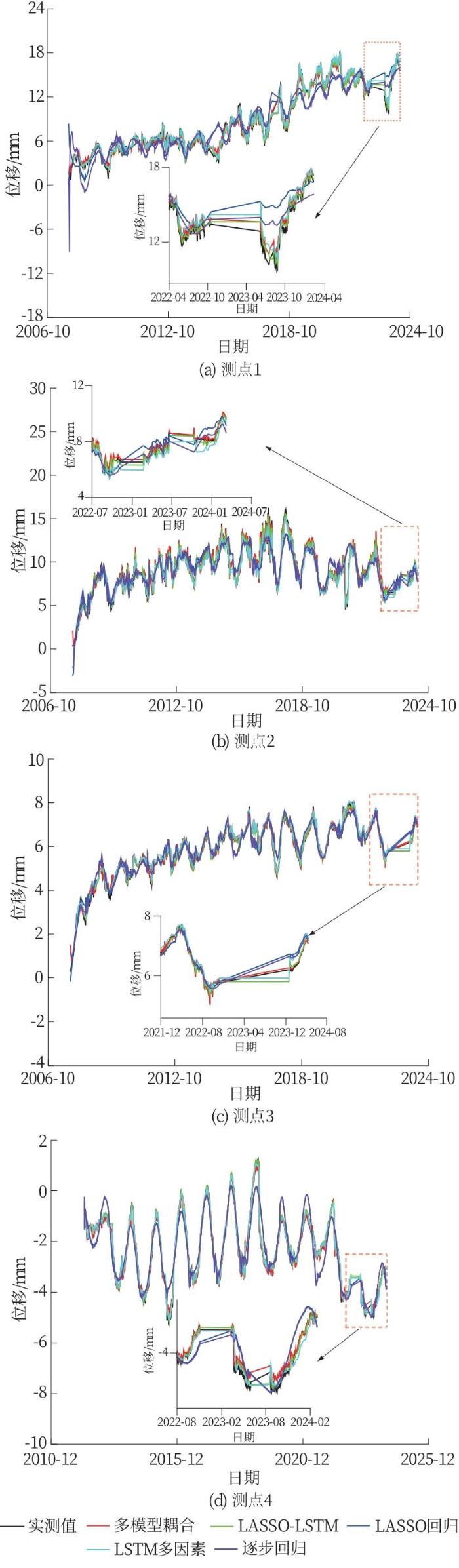
LSTM模型是当下较为成熟的时间序列预测的模型,在大坝预测领域取得了一定的成功;逐步回归模型引领着传统回归分析模型,在相关领域得到了较为成熟且广泛的应用;LASSO回归模型作为一种线性回归模型,利用L1正则化可减少模型的复杂程度并防止过拟合。因此,本文选取同一数据集和相同比例划分,分别引用LSTM多因素模型、逐步回归预测模型、LASSO回归模型、LASSO-LSTM模型进行对比研究。
各模型预测结果对比如图7所示,各模型均能大致描述实测大坝位移的变化总趋势。但对于LASSO回归模型和逐步回归模型预测误差较大,未能预测曲线的细微变化趋势。尽管LASSO回归可能在数据关系非线性的情况下拟合效果不佳,但它使用交叉验证来选择惩罚参数 可以提高特征选择的可靠性,减少模型复杂性。LSTM多因素预测值与实测值之间存在着局部波动序列预测较差的问题。LASSO-LSTM模型与耦合模型的拟合曲线与实测大坝位移曲线基本一致。但在模型训练时,LASSO-LSTM模型耗时过长,效率过低。因此,本文采用Bagging集成学习算法通过对多个简单子模型并行训练,显著提高了模型计算效率。综上所述,本文提出的耦合模型在整体预测趋势和部分波动预测精度都明显优于其他模型。
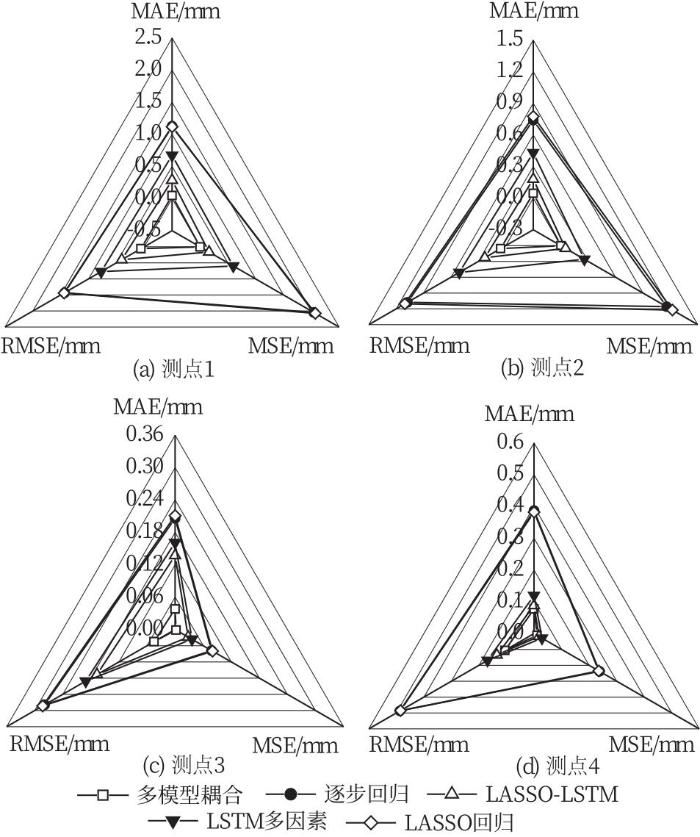
为验证本文提出耦合模型的性能,选取常用平均绝对误差(Mean Absolute Error,MAE)、MSE、均方根误差(Root Mean Square Error,RMSE)作为模型拟合优度评定指标,计算公式分别为:
式中:N表示数据集长度; 表示测点实测值; 表示模型预测值。
表3 各模型的评价指标Table 3 Evaluation indicators of each model |
| 测点 | 模型类型 | MAE/mm | MSE/mm | RMSE/mm |
|---|---|---|---|---|
| 耦合模型 | 0.047 | 0.003 | 0.059 | |
| 逐步回归预测模型 | 1.126 | 2.044 | 1.430 | |
| 1 | LASSO-LSTM模型 | 0.285 | 0.164 | 0.405 |
| LSTM多因素模型 | 0.674 | 0.599 | 0.774 | |
| LASSO回归预测模型 | 1.119 | 2.073 | 1.440 | |
| 耦合模型 | 0.046 | 0.003 | 0.057 | |
| 逐步回归预测模型 | 0.739 | 1.159 | 1.077 | |
| 2 | LASSO-LSTM模型 | 0.180 | 0.053 | 0.230 |
| LSTM多因素模型 | 0.431 | 0.260 | 0.509 | |
| LASSO回归预测模型 | 0.776 | 1.223 | 1.106 | |
| 耦合模型 | 0.038 | 0.002 | 0.045 | |
| 逐步回归预测模型 | 0.206 | 0.078 | 0.279 | |
| 3 | LASSO-LSTM模型 | 0.137 | 0.028 | 0.167 |
| LSTM多因素模型 | 0.161 | 0.036 | 0.191 | |
| LASSO回归预测模型 | 0.211 | 0.080 | 0.283 | |
| 耦合模型 | 0.077 | 0.011 | 0.106 | |
| 逐步回归模型 | 0.387 | 0.238 | 0.487 | |
| 4 | LASSO-LSTM模型 | 0.088 | 0.018 | 0.135 |
| LSTM多因素模型 | 0.120 | 0.029 | 0.169 | |
| LASSO回归预测模型 | 0.382 | 0.235 | 0.485 |
由图8可知,LASSO-LSTM模型评定参数均低于LSTM,说明加入LASSO算法可有效筛选出与大坝位移量有影响的因子,简化模型的因子选择,提高模型预测精度。LASSO回归模型与逐步回归模型优势在于反映线性趋势,但由于大坝位移量受多种因素影响,呈现局部复杂多变的情况,导致模型预测较为困难,其评定参数较高。相较于其他深度学习模型来说,本文提出的耦合模型评定参数均优于其他预测模型,说明加入注意力机制使其具有较好的非线性提取能力,组合Bagging算法提高模型的泛化性和准确性,使模型在处理大量非线性的时间序列数据时更稳定。


4 结论
本文结合LASSO回归特征选择、含注意力机制LSTM模型以及Bagging集成算法的优势,提出了一种多模型耦合的方法。与其他预测模型进行对比分析,得到了以下结论:
(1)在特征数量较多的情况下,LASSO变量选择方法通过添加L1正则化项来减少模型的复杂度并筛选出对坝体位移有重要影响的特征,增强因子选择的可解释性。结合该方法,集成多个含有注意力机制LSTM模型并行训练预测,减少了单个模型可能出现的过拟合问题,提高了耦合模型的泛化能力和预测效率。在实际应用中,基于可解性变量选择的耦合模型为后续组合模型的优化提供了参考依据。
(2)结合实际案例的评价指标显示耦合模型具有较高的预测精度,4个测点的MAE、MSE、RMSE平均值依次为0.052、0.005、0.067 mm。通过与多种常用模型的对比分析,结果表明多模型耦合在工程应用中具备显著的优势,能够更准确地反映大坝结构的动态变化。
(3)本文主要研究对象是以不同坝段内的某一个监测点为主,其构建的多因素单测点模型实现了高效率、高精度的预测。未来的研究方向可考虑从不同坝段的单测点转变到同坝段的多测点,分析测点所在的位置和不同测点之间的关系,构建全面的多测点耦合模型。