工程安全与灾害防治

高心墙堆石坝渗透破坏时变风险分析

  • 周福雄 , 1 ,
  • 赵勋礼 2 ,
  • 刘宏伟 3, 4 ,
  • 卢祥 3, 4 ,
  • 裴亮 3, 4 ,
  • 陈辰 3, 4
展开
  • 1 国能大渡河流域水电开发有限公司,成都 610041
  • 2 四川省南充水文水资源勘测中心,四川 南充 610036
  • 3 四川大学 山区河流保护与治理全国重点实验室,成都 610065
  • 4 四川大学 水利水电学院,成都 610065
卢 祥(1993-),男,湖北黄冈人,副研究员,博士,研究方向为水工结构及基础工程。E-mail: scu-lx@scu.edu.cn

周福雄(1993-),男,四川广安人,助理工程师,硕士,研究方向为水工结构安全。E-mail:

Copy editor: 罗玉兰

收稿日期: 2024-07-02

  修回日期: 2024-09-28

  网络出版日期: 2025-01-02

基金资助

国家自然科学基金项目(52309162)

Time-varying Risk Analysis of Seepage Failure in High Core-wall Rockfill Dams

  • ZHOU Fu-xiong , 1 ,
  • ZHAO Xun-li 2 ,
  • LIU Hong-wei 3, 4 ,
  • LU Xiang 3, 4 ,
  • PEI Liang 3, 4 ,
  • CHEN Chen 3, 4
Expand
  • 1 Guoneng Dadu River Basin Hydropower Development Co.,Ltd.,Chengdu 610041,China
  • 2 Nanchong Hydrological and Water Resources Survey Center of Sichuan Province,Nanchong 610036,China
  • 3 State Key Laboratory of Hydraulics and Mountain River Engineering, Sichuan University, Chengdu 610065,China
  • 4 College of Water Resources and Hydropower, Sichuan University, Chengdu 610065, China

Received date: 2024-07-02

  Revised date: 2024-09-28

  Online published: 2025-01-02

摘要

高心墙堆石坝赋存地质与环境复杂,防渗结构渗透破坏引发的结构故障甚至溃坝现象时有发生,合理评估大坝渗透破坏风险十分关键。针对高心墙堆石坝渗透系数时变规律不清晰、渗透破坏时变风险模型刻画难度大的问题,基于有限元模拟和原观数据,构建了高心墙堆石坝与地基渗透系数反演代理模型,提出了渗透系数的时变规律及表征函数;基于渗透系数时变规律和Monte-Carlo法,构建了高心墙堆石坝渗透破坏时变风险分析模型,并以瀑布沟大坝为案例进行了验证。结果表明:瀑布沟大坝坝与地基渗透系数反演的平均相对误差为0.4%,精度较高,且心墙与覆盖层的渗透系数均呈递增趋稳的时变规律;大坝渗透破坏时变可靠指标β在4.33~5.37之间,β值均大于目标可靠指标,表明该工程渗透破坏风险低,与工程实际相符。

本文引用格式

周福雄 , 赵勋礼 , 刘宏伟 , 卢祥 , 裴亮 , 陈辰 . 高心墙堆石坝渗透破坏时变风险分析[J]. 长江科学院院报, 2025 , 42(9) : 167 -173 . DOI: 10.11988/ckyyb.20240703

Abstract

[Objective] The material composition of high core rockfill dams is complex. Under the influence of hydraulic loading, temperature, and other complex environmental factors during long-term service, the permeability coefficients of these materials inherently exhibit time-varying characteristics, significantly influencing seepage stability and overall dam safety. This study aims to address the limitations of existing research, which predominantly focuses on static parameter inversion or non-time-varying risk assessment, and lacks systematic consideration of the time-varying patterns of material parameters and the influence of long-term operation. [Methods] A time-varying risk analysis method for seepage failure in high core rockfill dams was proposed, integrating data decomposition, finite element simulation, time-varying parameter inversion, and failure risk analysis. First, based on multi-year measured seepage pressure data of the dam, empirical mode decomposition was used to extract the periodic and trend components. Combined with orthogonal experiments and response surface methodology, an inverse surrogate model for the permeability coefficients of the high core rockfill dam and its foundation was constructed. Subsequently, through optimization using a genetic algorithm, this study investigated and revealed the time-varying patterns and characterization functions of permeability coefficients. Finally, based on the time-varying patterns of permeability coefficients and the Monte Carlo method, a time-varying risk analysis model for seepage failure in high core rockfill dams was established to achieve the dynamic risk assessment of seepage failure in the dam structure. [Results] This method was applied to the Pubugou Dam project. The results showed that the relative error of permeability coefficient inversion for both the dam and foundation was less than 2%, with an average relative error of 0.4%. Seepage field simulations based on the inverted parameters showed that the distribution of seepage pressure inside the dam followed the rising and falling trend of the reservoir water level and was consistent with the patterns observed in the measured seepage pressure data. This conformed to the typical seepage field distribution patterns of high core rockfill dams, indicating a high level of inversion accuracy. Furthermore, the permeability coefficients of both the core wall and the overburden layer showed time-varying patterns of gradual increase and stabilization. Reliability analysis of seepage failure in the dam and its foundation indicated that the reliability indicator (β) of the dam consistently exceeded the design target value during the operational period, suggesting that the overall risk of seepage failure was low. Additionally, the reliability indicator for seepage failure in the dam and its foundation exhibited periodic fluctuations with changes in the reservoir water level, showing a generally negative correlation between the reliability indicator and reservoir water levels and a positive correlation between failure probabilities and water levels. This was generally consistent with the seepage characteristics and patterns of dam structures under different water level conditions, validating the applicability of the proposed time-varying risk analysis model. The results confirmed that the reliability indicator for seepage failure of the Pubugou Dam complied with regulatory requirements. [Conclusions] The method developed in this study integrates time-varying parameter inversion, modeling of time-varying patterns, failure path search, surrogate model construction, and time-varying risk analysis. By dynamically identifying and updating time-varying parameters in real time, it enables accurate simulation of seepage failure processes and full lifecycle monitoring of risk evolution, thereby enhancing the timeliness and accuracy of safety risk assessments for high dam structures.

开放科学(资源服务)标识码(OSID):

0 引言

高心墙堆石坝渗控结构复杂,服役期受多种环境因素共同作用,坝与地基渗控结构破坏而导致坝体结构故障甚至溃坝的事件时有发生,如美国Teton坝在初期蓄水时,心墙发生管涌破坏导致大坝溃决,最终造成14人死亡[1]。众所周知,高心墙堆石坝赋存地质与环境复杂,水力载荷大,坝与地基应力水平高,材料参数时变特性显著。因此,合理评价高土石坝与地基渗透系数时变规律与渗透破坏风险对大坝的渗流稳定的影响尤为重要。
国内外学者在土石坝的渗透安全方面进行了大量研究[2-4]。在渗透系数反演方面,余红玲等[5]运用贝叶斯模型集成了支持向量机回归、克里金回归、多元自适应回归样条3种算法的组合模型,进行了渗透系数的反演分析。徐丽等[6]运用极限学习机与遗传算法,对坝体与坝基的渗透系数进行了反演。Song等[7]提出了一种融合拉丁超立方抽样(Latin Hypercube Sampling,LHS)、麻雀搜索算法和混合核极限学习机的渗透系数反演代理模型。Nan等[8]提出了一种考虑渗流与热传递耦合效应的参数反演方法,并应用于室内土石坝渗流和热传递试验。Li等[9]采用Van Genuchten (VG)模型模拟了土石坝的瞬态非饱和渗流场,以极限学习机(Extreme Learning Machine,ELM)为代理模型构建了渗透系数反演的多目标函数,并采用精英非支配排序遗传算法生成pareto最优解。Xu等[10]结合室内试验结果验证了改进的混合蛙跳算法(Improved Shuffled Frog Leaping Algorithm,ISFLA)对大坝渗透系数反演的有效性。Li等[11]基于鲸鱼优化算法(Whale Optimization Algorithm, WOA)与支持向量机(Support Vector Machine,SVM),提出了渗透系数反演方法,并应用于多诺大坝。在渗透破坏风险方面,胡冉等[12]提出了一种将渗流有限元计算与随机响应面方法相结合的渗流稳定可靠度计算方法。欧斌等[13]提出了一种融合径向基函数(Radial Basis Function,RBF)神经网络与LHS法的随机抽样方法,并从坝料参数的变异性与时变性角度表征了大坝动态渗透破坏概率。
然而,高心墙堆石坝赋存地质与运行环境复杂,其材料参数具有显著时变性,当前针对大坝渗透安全的研究主要聚焦于材料参数确定性反演方法,以及渗透破坏发生机理等,而对长期服役过程中大坝渗透系数时变规律、渗透破坏时变安全风险等研究则较少,渗透系数与破坏风险时变规律尚不清晰。因此,本研究构建高心墙堆石坝渗透系数时变反演代理模型,揭示坝与地基渗透系数时变演化规律,提出大坝渗透破坏时变风险评估方法,并以瀑布沟高心墙堆石坝为例,对所构建的模型进行可行性和有效性验证。

1 高心墙堆石坝渗透破坏时变风险分析方法

1.1 渗透系数时变反演分析方法

在高心墙堆石坝渗透系数的反演过程中,其实测值表现为一定的时效趋势性,为提高参数反演精度,采用经验模态分解法(Empirical Mode Decomposition,EMD)将渗压水头实测值分解为周期项和趋势项,并结合有限元数值模拟结果,建立渗透系数与坝体渗压水头间的确定性关系,即可基于渗压水头的周期项分量构建渗透系数反演分析的目标函数。
xi(i=1,2,…,n)为大坝的待反演参数,根据有限元得到渗透系数与渗压水头计算值间的响应关系,依据最小二乘法原理构建渗透系数反演目标函数,即
E = m i n j = 1 k [ ( δ i * - δ i x i ) / δ i * ] 2    
式中:E为反演目标函数;xi为第i个待反演渗透系数,其中参数的上下限根据材料参数的统计指标设定;典型时刻内, δ j *δj分别为测点j的实测值和模拟值;k为测点总数。
大坝的渗流稳定与材料参数为隐式关系,一般可通过构建二者间的响应面方程显式表达[14],即
δ = a + i = 1 n b i x i + i = 1 n c i ( x i ) 2  
式中:δ为拟合值;abici为方程中待计算系数;n为反演参数总个数。
综上,高心墙堆石坝渗透系数时变反演流程如图1所示,具体步骤如下:
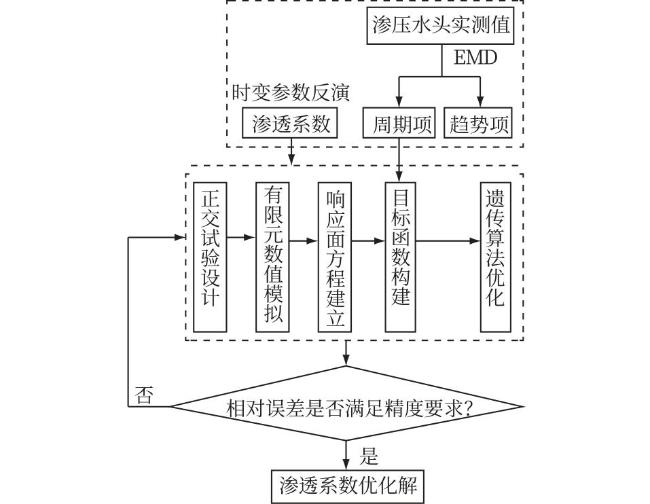
图1 渗透系数反演分析流程

Fig.1 Flowchart of inversion analysis of permeability coefficients

(1)考虑土石坝在稳定运行期的荷载、环境量等因素,合理划分渗透系数的反演时段。
(2)采用EMD方法将渗压水头实测值分解为周期项和趋势项。
(3)对第i时段的渗透系数设计正交试验,由正交试验的数值模拟结果,提取典型测点的计算值。
(4)构建渗透系数与数值模拟结果间的响应面方程;基于渗压水头实测值的周期项和响应面方程建立反演目标函数,并采用遗传算法进行目标函数寻优,确定渗透系数反演值。
(5)将第i次渗透系数反演值作为第i+1次数值模拟中渗透系数的设计值,重复步骤(3)—步骤(4),至各时段参数反演值确定,即可得到不同时段的渗透系数反演值。

1.2 渗透破坏时变风险分析方法

1.2.1 渗透破坏时变功能函数响应面方程构建

土石坝是否出现渗透破坏,可依据防渗结构渗透坡降与临界坡降之间的关系加以确定,渗透破坏时变功能函数可表示为
Z J ( t ) = J c - J ( t )  
式中:ZJ(t)为t时刻的功能函数值;J(t)为t时刻防渗结构潜在失效点的渗透坡降;Jc为防渗结构的临界渗透坡降。当功能函数ZJ(t)<0时,防渗结构将会发生渗透破坏。
鉴于渗透破坏时变功能函数为隐式函数,无法直接用于大坝渗透破坏风险分析,一般可采用神经网络、响应面法等构建功能函数代理模型进行求解。响应面法操作简单,对于处理随机变量的非线性问题效率高且适应性好,因此可采用不含交叉项的二次响应面方程将时变功能函数显式化,即
Z (x) = J c - i = 1 3 a ' i x i + i = 1 3 b ' i x i 2 + c '  
式中:Z(x)为防渗结构的渗透坡降;a'ib'ic'为待求解系数。

1.2.2 渗透破坏时变风险分析Monte-Carlo法

对于高心墙堆石坝的渗透破坏风险分析问题,Monte-Carlo方法适用性更强。设渗透破坏时变功能函数为Z\left(\hat{X}_{t}\right),其中 X t= { x t 1 , x t 2 , , x t n } Tt时刻具有n维随机变量的向量,若Z( X t)<0,则发生渗透破坏,反之未发生渗透破坏。由Monte-Carlo方法计算大坝渗透破坏失效概率 p f t,其表达式为
p f t = 1 N i = 1 n I [ Z ( X t ) i ]  
式中:N为抽样次数;Z ( X t ) it时刻第i次功能函数的计算值,其中Z( X t)<0时,I[Z ( X t ) i]=1;反之Z ( X t ) i>0时,I[Z ( X t ) i]=0。失效概率 p ft与可靠指标β两者间存在对应关系,即
p f t = Φ ( - β ) = 1 - Φ ( β )  
根据高心墙堆石坝渗透破坏潜在失效点,以及渗透系数时变反演结果,采用上述方法即可求得高心墙堆石坝渗透破坏时变风险。

2 案例分析

2.1 工程概况
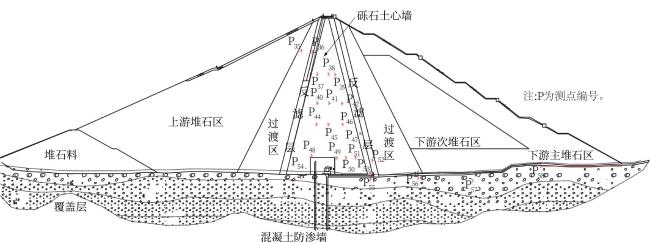
瀑布沟大坝为Ⅰ等大(1)型工程,其坝型为砾石土心墙堆石坝,坝顶高程为856 m,最大坝高为186 m,正常蓄水位为850 m,死水位为790 m。大坝从上游至下游分别为上游堆石区、过渡层、反滤层、砾石土心墙、下游次堆石区与下游主堆石区。大坝最大剖面0+310断面及其监测点布置如图2所示,各种材料的渗透系数设计值见表1
图2 瀑布沟大坝0+310断面剖面及其监测点布置

Fig.2 Cross-section 0+310 of Pubugou Dam and its monitoring layout

表1 瀑布沟大坝不同材料渗透系数

Table 1 Permeability coefficients of different materials in Pubugou Dam

材料分区 渗透系数K/
(cm·s-1)
材料分区 渗透系数K/
(cm·s-1)
覆盖层 7.50×10⁻² 地基 1.00×10⁻⁵
心墙上区 6.94×10⁻⁵ 反滤层 8.00×10⁻³
心墙下区 3.47×10⁻⁵ 上游堆石区 1.00×10⁻¹
过渡区 3.00×10⁻² 堆石料区 1.00×10⁻¹
下游次堆石区 1.00×10⁻¹ 混凝土防渗墙 1.00×10⁻⁷
下游主堆石区 1.00×10⁻¹

2.2 有限元建模及边界条件

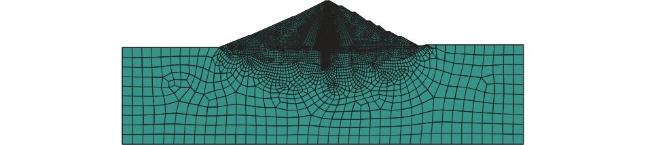
有限元模型的模拟范围为:沿坝体上下游方向及纵向深度方向均延伸2倍坝高,并将有限元模型离散为6 572个单元及13 348个节点,0+310断面的有限元模型如图3
图3 瀑布沟大坝0+310断面有限元模型

Fig.3 Finite element model of cross-section 0+310 of Pubugou Dam

渗流分析的边界条件为:对有限元模型中所有节点的XYZ方向进行固定,锁住模型中每一节点的自由度,其上下游边界设置为透水边界,下游面需设置排水边界。此外,对模型上游面节点逐时刻的孔隙水压力进行计算并赋值,同时将有限元模型中的孔隙比和饱和度均设为1。

2.3 渗透系数时变反演分析

2.3.1 参数反分析时段划分

瀑布沟大坝0+310断面共布设31支渗压计,监控坝内渗压变化,现8支仪器在测,23支仪器已停测或报废。本文选取测点P40(高程747.00 m)、P42(高程747.00 m)、P53(高程670.30 m)与P57(高程670.00 m)进行渗透系数反演分析,其中测点P40与P42位于心墙中部,测点P53与P57位于坝体与坝基交界面。瀑布沟大坝的库水位呈年周期变化,稳定运行期中,以每2个水位周期为时段间隔,分别以2010-05—2012-05、2012-05—2014-04、2014-04—2016-06、2016-06—2018-05、2018-05—2020-05、2020-05—2022-05、2022-05—2023-08作为反演时段进行渗透系数反演。

2.3.2 渗透系数反演结果

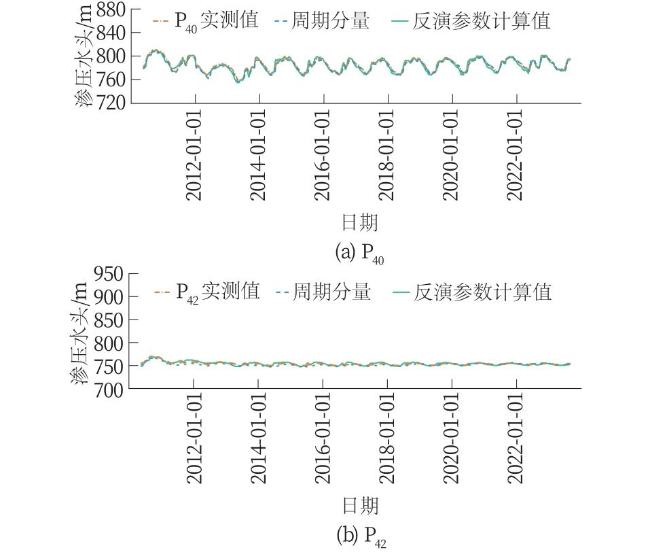
本研究重点针对深厚覆盖层下瀑布沟大坝的心墙与覆盖层的渗透系数进行反演分析。各时段的渗透系数反演结果、误差对比如表2表3图4所示。可知,典型时刻内渗透系数反演的相对误差最大值<2.0%,均值约0.4%,且反演优化参数的计算值与实测值间变化趋势近似一致,表明渗透系数反演精度高。
表2 瀑布沟大坝心墙与覆盖层渗透系数分时段反演

Table 2 Time-phased inversion result of permeability coefficients for core wall and overburden layer in Pubugou Dam

时段 渗透系数/(cm·s-1)
心墙K1 覆盖层K2
第1时段 1.85×10⁻⁵ 7.87×10⁻²
第2时段 2.81×10⁻⁵ 8.03×10⁻²
第3时段 3.68×10⁻⁵ 8.19×10⁻²
第4时段 4.52×10⁻⁵ 8.32×10⁻²
第5时段 5.14×10⁻⁵ 8.40×10⁻²
第6时段 5.38×10⁻⁵ 8.42×10⁻²
第7时段 5.39×10⁻⁵ 8.42×10⁻²
表3 瀑布沟大坝渗透系数分段反演分析典型测点误差统计

Table 3 Error statistics of typical measurement points in segmented inversion analysis of permeability coefficients in Pubugou Dam

时段 日期 相对误差/%
P40 P42
第1时段 2010-06-02 0.22 0.35
2010-06-09 0.34 0.26
2010-12-25 0.28 0.54
2011-01-18 0.45 0.23
第2时段 2013-08-23 0.65 0.28
2013-10-18 0.15 0.68
2014-01-23 1.66 0.42
2014-01-24 1.66 0.41
第3时段 2014-10-30 0.40 0.52
2015-01-08 0.26 0.52
2015-12-20 0.45 0.62
2016-01-07 0.20 0.45
第4时段 2016-11-06 0.36 0.67
2016-11-17 0.27 0.66
2016-12-11 0.04 0.39
2017-10-24 0.49 0.72
第5时段 2018-10-09 0.46 0.66
2018-12-12 0.35 0.47
2019-09-06 0.23 0.40
2020-01-07 0.24 0.16
第6时段 2020-05-27 0.39 0.09
2020-06-05 0.38 0.11
2021-05-26 0.00 0.11
2021-06-23 0.37 0.07
第7时段 2022-06-25 0.42 0.15
2022-11-26 0.66 0.16
2023-02-11 0.18 0.16
2023-07-27 0.77 0.24
图4 渗流反演参数计算值、周期分量与实测值

Fig.4 Calculated values, periodic components values, and measured values of seepage inversion parameters

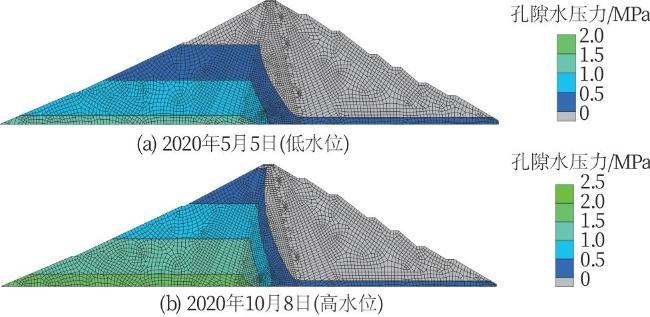
将反演得到的渗透系数代入有限元模型,此时典型时刻瀑布沟大坝渗流场分布如图5所示。由图5可知,坝内渗压分布与库水位的升降趋势近似保持一致,且与渗压实测值规律一致,符合一般高心墙堆石坝渗流场分布规律。
图5 不同水位下坝体孔隙水压力云图

Fig.5 Contour maps of pore water pressure in dam body at different water levels

2.3.3 渗透系数时变规律分析

土石坝的岩土材料参数的时变规律常采用对数型与指数型函数进行拟合[15-16],2种函数的基本表达式分别如式(7)和式(8)所示。
对数型:
f ( t ) = f 0 + m l n ( t )  
指数型:
f ( t ) = f 0 e - r t  
式中:f(t)为t时刻的材料参数值;f0为时变参数在初始时刻的基准值;rm分别为时变函数的系数;t为时间(a)。
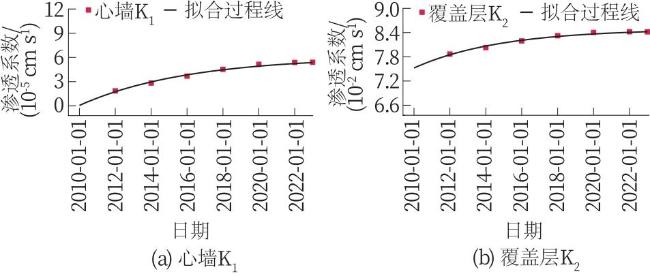
基于心墙和覆盖层渗透系数的反演值,分别采用上述对数型与指数型函数形式进行拟合,结果如表4所示。由表4可知,心墙渗透系数K1与覆盖层渗透系数K2均具有时变特征,且指数型函数的拟合效果好,基于指数型函数的拟合曲线如图6。由图6可知,心墙渗透系数和覆盖层渗透系数均递增后趋于稳定,当前渗透系数分别在(5.14~5.39)×10-5、(8.32~8.42)×10-2 cm/s间平稳波动。心墙与覆盖层渗透系数逐渐增大的原因可能是心墙土体应力水平及超孔隙水压力偏低,压缩变形不显著,同时受干湿循环效应影响,土体渗透系数缓慢增加并趋于稳定。服役期间大坝上下游库水位差较大,覆盖层中渗透坡降亦较大,此时受颗粒级配变化等因素影响,渗透系数会逐渐增大,后续逐渐稳定。
表4 渗透系数时变规律函数表达式

Table 4 Functional expressions of time-varying patterns of permeability coefficients

部位 参数 时变函数 复相关系数
心墙 K1 y=6.06×10⁻⁵-
7.09×10⁻⁵exp[-0.17(t-200 9)]
0.987 8
覆盖层 K2 y=0.085-
0.012exp[-0.21(t-200 9)]
0.985 7
图6 渗透系数时变反演值与拟合曲线

Fig.6 Time-varying inversion values and fitting curves of permeability coefficients

2.4 渗透破坏风险分析

在进行渗透破坏风险分析时,将心墙与覆盖层的渗透系数及库水位作为随机变量,其余部位如堆石体、过渡层、反滤层、防渗墙和地基的渗透系数视为常量。其中,心墙与覆盖层的渗透系数均具有时变特性,在渗透破坏可靠指标求解中,均值取为相应时段渗透系数反演值,其余非随机变量的渗透参数则取为设计值。心墙和覆盖层渗透系数的统计特征则主要根据类似心墙坝工程统计分析得到,如表5所示。
表5 瀑布沟大坝渗透破坏随机变量统计特征

Table 5 Statistical characteristics of random variables for seepage failure in Pubugou Dam

部位 参数 变异系数 分布特征
心墙 K1 0.291 对数正态
覆盖层 K2 0.259 对数正态
库水位 H 0.120 极值Ⅰ型
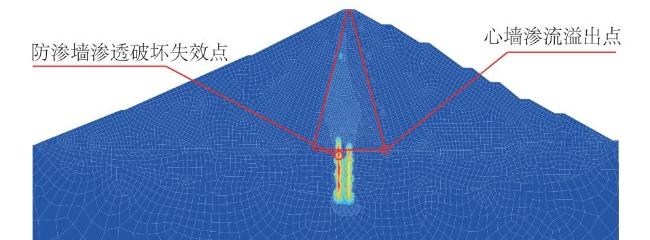
结合相关研究,瀑布沟大坝心墙临界渗透坡降取为4[17],且心墙渗流溢出点处出现渗透破坏的可能性较大;防渗墙临界渗透坡降取为120[17]。此外,以心墙渗流溢出点与防渗墙潜在失效点作为渗透破坏的主要失效点,如图7所示。
图7 渗透破坏潜在失效点示意图

Fig.7 Schematic diagram of potential seepage failure points

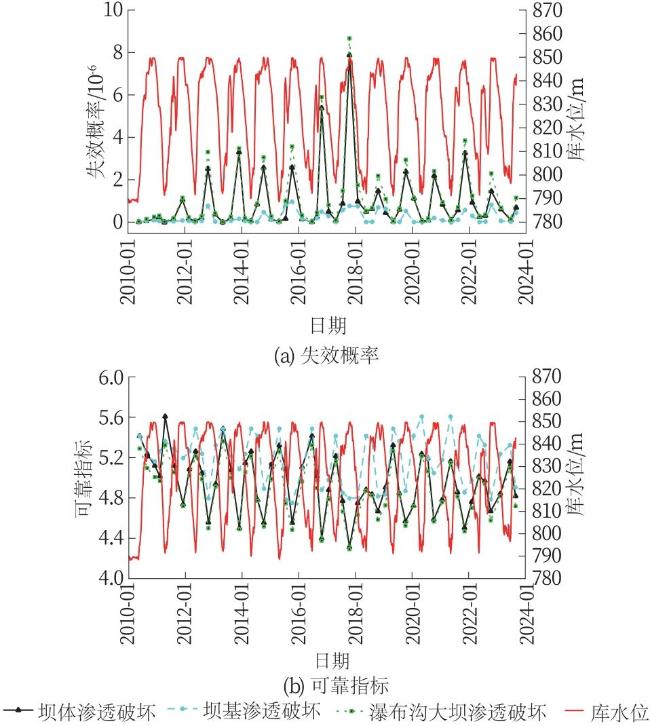
基于提出的大坝渗透破坏时变风险分析模型,运用Monte-Carlo法进行抽样,即可得到瀑布沟大坝心墙(坝体)和防渗墙(坝基)渗透破坏失效概率和可靠指标,如图8所示(其中,大坝渗透破坏风险可依据贝叶斯模型推演得到[18-19])。
图8 瀑布沟大坝渗透破坏失效概率与可靠指标

Fig.8 Failure probability and reliability indicator of seepage failure in Pubugou Dam

图8可知,坝体与坝基渗透破坏的可靠指标与库水位大致呈负相关关系,失效概率与库水位呈正相关关系。高水位状态时,上游水体对坝体的渗透力较大,导致防渗结构的渗透坡降抬升,降低相应结构的渗透破坏可靠指标;低水位运行时,心墙与防渗墙的渗透坡降略有降低。在运行过程中,心墙渗透破坏可靠指标由5.6略有降低后趋于稳定,最终稳定在4.8左右;防渗墙渗透破坏可靠指标随库水位大致呈周期性变化规律,在运行初期可靠指标为5.4,分析时段末的可靠指标为4.9。大坝与地基的渗透破坏可靠指标大致呈周期性降低趋势,波动范围在4.3~5.4之间,近3 a在4.8附近波动。整体来看,瀑布沟大坝渗透破坏可靠指标满足规范要求,破坏风险低。由图4可知,瀑布沟大坝长期运行以来坝体渗压计监测数据规律基本稳定,佐证了大坝渗透破坏潜在风险低,与风险分析结果一致。

3 结论

渗透破坏风险是评估高心墙堆石坝运行性态的关键指标之一,但受渗透系数时变特征影响,其时序演化过程难以合理评估。因此,基于大坝渗透系数时变反演分析,建立了高心墙堆石坝渗透破坏时变风险分析模型,得到以下结论:
(1)通过EMD、正交试验设计、响应面方程建立、目标函数构建、遗传算法优化等,构建了瀑布沟大坝渗流时变参数反演代理模型,结果表明其渗透系数反演平均相对误差为0.4%,精度较高。瀑布沟大坝心墙与覆盖层的渗透系数均呈递增趋稳的时变规律。
(2)建立了渗流稳定功能函数代理方程,形成了集失效路径搜寻、响应面代理方程等于一体的高心墙堆石坝渗透破坏时变风险分析方法。瀑布沟大坝应用表明,其渗透破坏时变可靠指标β在4.3~5.4之间,大于目标可靠指标4.2,表明该工程渗透破坏风险低。
[1]
汝乃华, 牛运光. 大坝事故与安全·土石坝[M]. 北京: 中国水利水电出版社, 2001.

(RU Nai-hua, NIU Yun-guang. Embankment Dam Incidents and Safety of Large Dams[M]. Beijing: China Water & Power Press, 2001. (in Chinese))

[2]
尹川, 吴震宇, 王媛, 等. 土质心墙堆石坝非饱和渗流参数反演[J]. 水利规划与设计. 2021(8):130-136.

(YIN Chuan, WU Zhen-yu, WANG Yuan, et al. Inversion of Unsaturated Seepage Parameters of Soil Core Rockfill Dam[J]. Water Resources Planning and Design, 2021(8):130-136. (in Chinese))

[3]
沈宇扬, 沈振中, 李佳杰, 等. 基于思维进化算法优化BP神经网络的渗透参数反演研究[J]. 水电能源科学, 2020, 38(2):102-105,121.

(SHEN Yu-yang, SHEN Zhen-zhong, LI Jia-jie, et al. Research on Inversion of Permeability Parameters Based on BP Neural Network Optimized by Mind Evolutionary Algorithm[J]. Water Resources and Power, 2020, 38(2):102-105,121. (in Chinese))

[4]
CHEN C, ZHANG L. Hydro-mechanical Behaviour of Soil Experiencing Seepage Erosion under Cyclic Hydraulic Gradient[J]. Géotechnique, 2023, 73(2): 115-127.

[5]
余红玲, 王晓玲, 王成, 等. 贝叶斯框架下大坝渗流参数反演组合代理模型研究[J]. 水利学报, 2022, 53(3): 306-315, 324.

(YU Hong-ling, WANG Xiao-ling, WANG Cheng, et al. Research on Ensemble Surrogate Models of Dam Seepage Parameters Inversion under Bayesian Framework[J]. Journal of Hydraulic Engineering, 2022, 53(3): 306-315, 324. (in Chinese))

[6]
徐丽, 沈振中. 基于ELM-GA的复杂土石坝渗透系数反演模型及其应用[J]. 水电能源科学, 2021, 39(9): 86-90.

(XU Li, SHEN Zhen-zhong. Inversion Model of Permeability Coefficient for Complex Earth-rock Dam Based on ELM-GA[J]. Water Resources and Power, 2021, 39(9): 86-90. (in Chinese))

[7]
SONG J, YUAN S, XU Z, et al. Fast Inversion Method for Seepage Parameters of Core Earth-rock Dam Based on LHS-SSA-MKELM Fusion Surrogate Model[J]. Structures, 2023, 55: 160-168.

[8]
NAN S, REN J, MA Z, et al. Inversion of the Seepage Parameters of Earth/Rockfill Dams Considering the Coupling Effect of Seepage and Thermal Transfer[J]. Computers and Geotechnics, 2024, 165: 105882.

[9]
LI J, CHEN C, WU Z, et al. Multi-source Data-driven Unsaturated Seepage Parameter Inversion: Application to a High Core Rockfill Dam[J]. Journal of Hydrology, 2023, 617: 129171.

[10]
XU L Q, LI L. Inversion Analysis of Seepage Parameters Based on Improved Shuffled Frog Leaping Algorithm[J]. Mathematical Problems in Engineering,Doi:10.1155/2021/6536294.

[11]
LI H, SHEN Z, SUN Y, et al. A New Approach for Seepage Parameters Inversion Analysis Using Improved Whale Optimization Algorithm and Support Vector Regression[J]. Applied Sciences, 2023, 13(18): 10479.

[12]
胡冉, 陈益峰, 李典庆, 等. 心墙堆石坝渗透稳定可靠性分析的随机响应面法[J]. 岩土力学, 2012, 33(4):1051-1060.

(HU Ran, CHEN Yi-feng, LI Dian-qing, et al. Reliability Analysis of Seepage Stability of Core-wall Rockfill Dam Based on Stochastic Response Surface Method[J]. Rock and Soil Mechanics, 2012, 33(4): 1051-1060. (in Chinese))

[13]
欧斌, 傅蜀燕, 林志祥, 等. 基于土料参数时变特性的土石坝渗透破坏概率动态分析方法[J]. 水利水电科技进展, 2019, 39(4): 64-68.

(OU Bin, FU Shu-yan, LIN Zhi-xiang, et al. Dynamic Analysis Method for Seepage Failure Probability of Earth-rock Dams Based on Time-varying Characteristics of Soil Parameters[J]. Advances in Science and Technology of Water Resources, 2019, 39(4): 64-68. (in Chinese))

[14]
袁艳玲, 郭琴琴, 周正军, 等. 考虑参数相关的高心墙堆石坝材料参数反分析[J]. 岩土力学, 2017, 38(增刊1): 463-470.

(YUAN Yan-ling, GUO Qin-qin, ZHOU Zheng-jun, et al. Back Analysis of Material Parameters of High Core Rockfill Dam Considering Parameters Correlation[J]. Rock and Soil Mechanics, 2017, 38(Supp.1): 463-470. (in Chinese))

[15]
甘珩佚. 高面板堆石坝原观性态与结构安全可靠度分析[D]. 成都: 四川大学, 2022.

(GAN Heng-yi. Original Behavior Analysis and Structural Safety Reliability Analysis of High Concrete Face Rockfill Dam[D]. Chengdu: Sichuan University, 2022. (in Chinese))

[16]
成晓炜. 岩质边坡锚固工程时变可靠性分析模型及可靠度计算方法[D]. 长沙: 湖南大学, 2010.

(CHENG Xiao-wei. Time-varying Reliability Analysis Model and Reliability Calculation Method of Rock Slope Anchorage Engineering[D]. Changsha: Hunan University, 2010. (in Chinese))

[17]
中国电建集团成都勘测设计研究院有限公司. 瀑布沟水电站大坝防渗体系设计报告[R]. 成都: 中国电建集团成都勘测设计研究院有限公司, 2010.

(China Power Construction Group Chengdu Survey Design and Research Institute Co.,Ltd. Design Report on the Anti-seepage System for the Dam of Pubugou Hydropower Station[R]. Chengdu: China Power Construction Group Chengdu Survey Design and Research Institute Co.,Ltd, 2010. (in Chinese))

[18]
LU X, CHEN C, LI Z, et al. Bayesian Network Safety Risk Analysis for the Dam-Foundation System Using Monte Carlo Simulation[J]. Applied Soft Computing, 2022, 126: 109229.

[19]
PEI L, CHEN C, HE K, et al. System Reliability of a Gravity Dam-foundation System Using Bayesian Networks[J]. Reliability Engineering & System Safety, 2022, 218:108178.

文章导航

/