

0 引言
基于遥感影像资料的水沙数值模拟方法被广泛应用于其他河流冲淤演变规律研究。林诺菲等[7]基于1999—2020年黄河下游游荡河段的遥感影像及实测地形资料,分析了典型断面主槽与深泓线的横向摆动特点,发现该河段96.5%的断面深泓线平均摆动幅度大于主槽,且主槽与深泓线的摆动趋势在典型断面上具有一致性;李洁等[8]基于1986—2015年黄河下游91个淤积断面汛后实测地形资料,分析了近30 a来黄河下游河道深泓线摆动特点,发现深泓线摆动方向具有往复性,各断面深泓线摆动幅度沿程差异较大;柳明洋等[9]利用二维水深平均浅水方程建立了河床侵蚀数学模型,模拟了黄河宁夏永丰渡口连续弯道中水流流速和水深变化过程;孙东坡等[10]与张春晋等[11]采用遥感影像和数值模拟相结合的方法,探究了黄河下游游荡型河段河床时空演变特点;赵科锋等[12]在模型边界间等间距取节点,并进行编码,实现河道断面地形精细化插值,提高了数值模型的模拟精度;Han等[13]模拟了雅鲁藏布江中游宽谷河段大型辫状河流系统的地貌动力学过程;Zhao等[14]以塔里木河干流为研究对象,采用MIKE 21软件模拟不同洪水事件对河床形态的响应,探讨了洪水泥沙负荷、流量峰值与沙含量在河床形成中的关键作用;Jang等[15]对冲积扇三角洲演化过程进行了数值模拟,估算了床面和岸滩随时间的演变过程。
本文考虑各水文因素与断面冲淤的关联性,采用一二维泥沙输运模型探讨影响塔里木河河道断面冲淤变化的主要驱动因素,以期为河道治理和生态保护提供科学依据。
基于水沙输运模型与地理信息系统(Geographic Information System,GIS),以塔里木河干流中游塔提里克村段8.41 km河道为研究对象,于枯水期(2023年4月1日)使用无人机搭载激光雷达测深系统测量形成数字高程模型(Digital Elevation Model,DEM)数据,此时河道流量和含沙量均处于全年低位,可最大限度减少悬移质泥沙对测深的干扰,确保地形数据的精度。将乌斯满、阿其克水文站提供的含沙量数据与实测数据进行对比验证。利用一维数学模型模拟推求水位、流量时间序列及乌斯满水文站提供的日含沙量等数据,建立该研究河段平面二维水沙输运数学模型,模拟河道在不同水文条件下的断面冲淤演变趋势,分析不同来水情况对河道形态的影响规律,为预测河道演变趋势提供重要参考。
1 研究区概况及研究方法
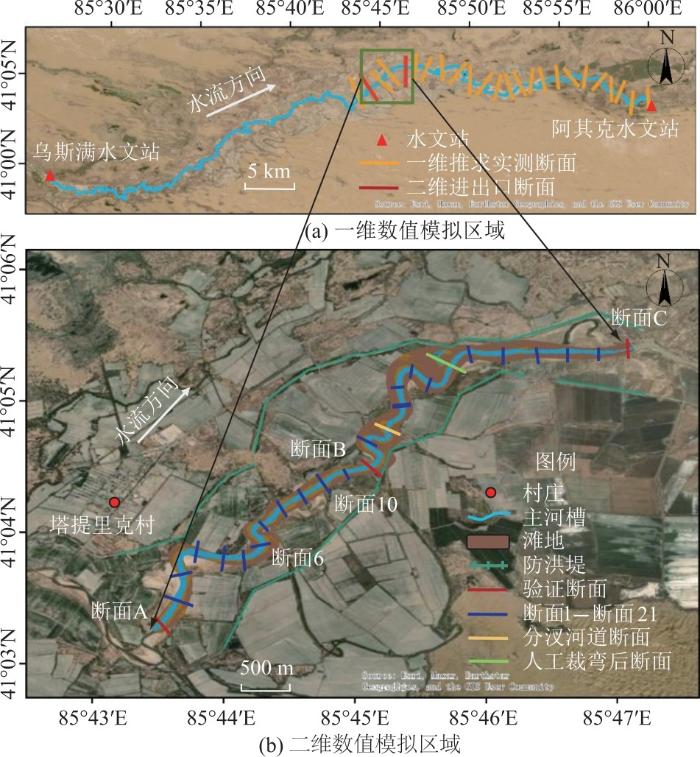
模拟时段为2023年4月1日—11月30日,以每天0:00为一个节点,共输出244组数据,涵盖河道2023年汛前枯水期、汛前中水期、汛期以及汛后期的典型水文过程。在河道上每间隔400 m布置1个断面,共21个断面,在分汊河段和人工裁弯取直河段增设断面,以全面分析河槽冲淤变化特征,模型验证断面(断面A、断面B、断面C)分别设置在河道起点、中间及终点处。
2 水动力及泥沙输运模型的建立与验证
2.1 一维水沙数学模型建立与验证
由于本研究进出口边界不在水文站处,进出口水位-流量关系曲线采用一维数值模拟推求,以阿其克水文站为起始断面向上游推求水面线。能量方程为
式中:z1,i、z2,i分别为上、下断面第i级水位;A1,i、A2,i分别为上、下断面第i级水位对应的过流面积;Qi为第i级水位对应的流量;Δs为上、下断面间距;α为动能校正系数; $\stackrel{-}{\zeta }$ 为平均局部阻力系数;g为重力加速度;Ki为河段第i级水位对应的输水率, ${K}_{i}={A}_{i}{R}_{i}^{2/3}/{n}_{i}$ ,Ri为第i级水位对应的水力半径,ni为第i级水位对应的糙率。
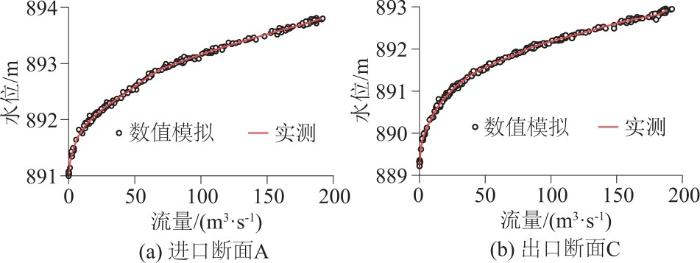
经率定河道糙率为0.021,选取河道进口断面A和出口断面C作为验证断面,对比实测与模拟计算得到的水位-流量关系曲线(图2),两者误差相对较小,因此,数学模型能够较好地反映实测水位流量变化,可用于模拟水位-流量关系曲线。
由一维水沙数学模型模拟结果得到二维水沙数学模型模拟进口边界流量过程、出口边界水深过程。
2.2 二维水沙数学模型构建
本研究所用地形数据来源于2023年4月1日无人机实地航测,精度为3 m,对塔里木河塔提里克村段地形资料进行概化处理(删除异常高程点)。在网格生成器中导入实测地形文件,根据地形数据确定河道边界范围及进出口边界,断面A和断面C为二维模型的开边界,两侧堤线为模型的闭边界。
二维水沙数学模型水动力模块二维非恒定浅水方程组主要由连续性方程、动量方程组成。
连续性方程为
x方向动量方程为
y方向动量方程为
式中:h为总水深;h=η+d,η为水位(水面到基准面的高度),d为静水深(床面与基准面之间的距离);t为时间;x、y为笛卡尔坐标; $\stackrel{-}{u}、\stackrel{-}{\upsilon }$ 分别为x、y方向上的平均速度分量;f为科氏力系数, $f=2\omega sin\varphi,\omega $ 为地球自转角速度, $\varphi $ 为当地纬度;S为源项;ρ为当地水密度;ρ0为参考水密度;Pa为当地水表面大气压强;Sxx、Sxy、Syy为辐射应力分量;τsx、τsy为水面切应力在x、y方向上的分量;τbx、τby为河床边界切应力在x、y方向上的分量;Txx、Txy、Tyy为水平黏滞应力分量;us、υs分别为源汇项在x、y方向上的水流流速。
根据研究需求,模型基于水动力模块增加了泥沙模块进行模拟。二维水沙数学模型泥沙模块根据水流作用计算输沙率,初始淤积(冲刷)利用泥沙质量守衡确定[18]。
泥沙输运扩散方程为
式中: $\stackrel{-}{c}$ 为泥沙平均浓度;Dx、Dy分别为x、y方向上的分散系数;S1表示沉积或侵蚀源汇项;QL表示单位水平区域内点源排放量;CL表示点源泥沙排放浓度。
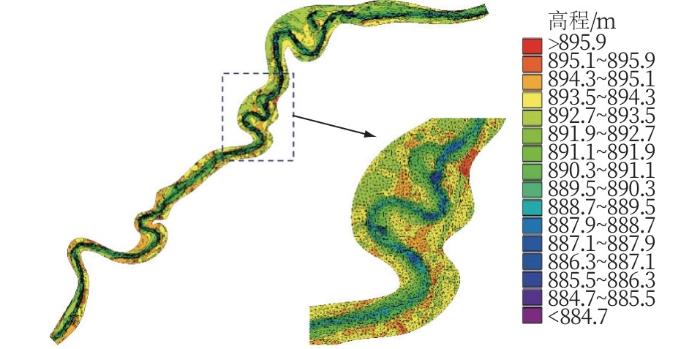
研究区域采用非结构化网格划分,网格尺度为15 m2,网格单元总数19 679个,节点10 426个,通过插值法将生成的XYZ格式散点数据转化为mesh文件,mesh文件模型网格如图3所示。
2.3 二维水沙数学模型率定及验证
模型进口边界条件为上游流量过程、含沙量过程,出口边界条件为下游水深过程。塔里木河水文站提供的资料显示,塔里木河河道输移泥沙几乎为悬移质,依据悬移质泥沙级配确定泥沙中值粒径为0.096 mm。基于乌斯满水文站与阿其克水文站提供的糙率,参考文献[19]中天然河道粗糙率范围,设置糙率初始值,并根据模拟结果进行率定,设置时间步长为6 min,模拟率定时段为2023年4月1日—7月31日,率定后糙率为0.021。
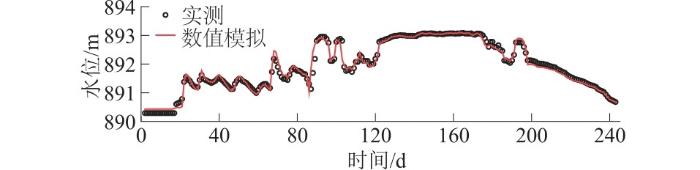
表1 典型断面误差分析Table 1 Error analysis of typical cross-sections |
| 断面编号 | 各测点地形高程 平均误差/m | 各测点高程相对 误差/% | 冲淤量误差/ m3 |
|---|---|---|---|
| A | 0.145 | 0.026 | 0.003 |
| B | 0.117 | 0.014 | 0.038 |
| C | 0.158 | 0.015 | 0.013 |
可知,实测水位与数值模拟水位误差相对较小,误差在-0.20~0.20 m之间,244 d的平均误差为0.11 m。因此,数学模型模拟结果能够较好地反映断面实际水位的变化趋势。
平均误差 $\overline{E}$ 为
相对误差 $\overline{{E}_{r}}$ 为
式中:n为天数或DEM数据点个数;ZR为实测水位或断面地形高程;Z为数学模型模拟的水位或断面地形高程。
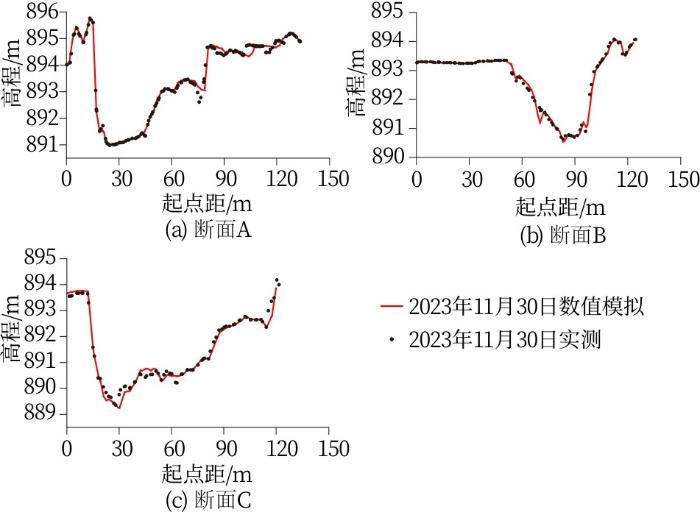
为进一步验证模型的可靠性,对比2023年11月30日3个断面实测DEM数据及二维水沙输运模型的模拟结果,可知模拟的水位与DEM数据空间分布基本一致,两者差异较小。以高程889 m为基准面,沿河道纵向取1 m单位长度,比较实测和数值模拟得到的河槽泥沙体积,可知断面A、断面B、断面C处的泥沙冲淤量误差分别为0.003、0.038、0.013 m3。断面A各测点高程误差在0~0.34 m之间,平均误差为0.14 m,相对误差为0.026%;断面B误差在0~0.30 m之间,平均误差为0.11 m,相对误差为0.014%;断面C误差在0~0.33 m之间,平均误差为0.15 m,相对误差为0.015%。由不同断面水位和断面形态验证发现,数学模型模拟能够较准确地反映河道变形、沉积和侵蚀过程,表明该数学模型可用于模拟塔里木河中游塔提里克村段河流演变过程。
3 结果分析
3.1 河道断面深泓点变化规律
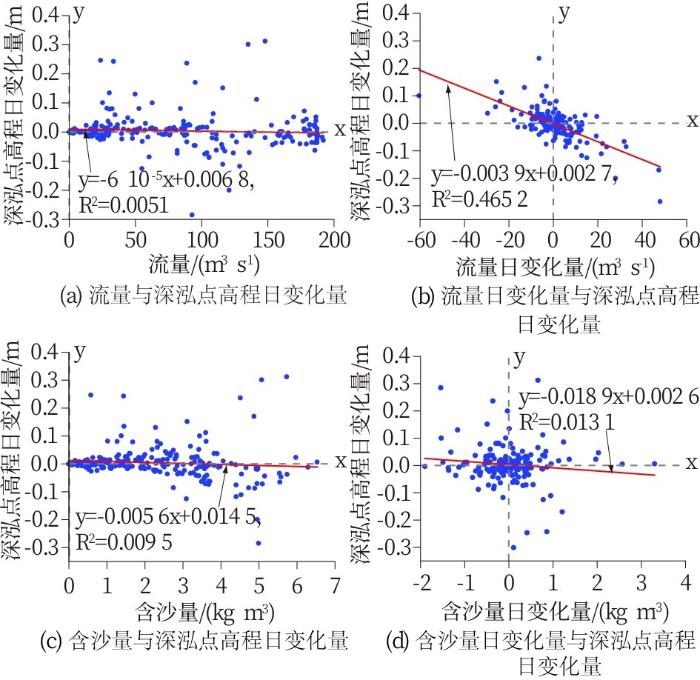
分析结果表明,断面6流量日变化量与深泓点高程日变化量的相关性最为明显,绝对系数为0.465 2,经统计各断面绝对系数的波动幅度为10%~47%,表明流量波动对深泓点的冲淤变化具有直接影响,尤其在水流流量变化波动较大的汛后期,流量的变化对深泓点高程的影响尤为显著。其他3个要素(流量、含沙量、含沙量日变化量)与深泓点高程日变化量的相关性较弱,各断面绝对系数均<0.02,这表明尽管这些要素是河道泥沙输运的重要影响因素,但在深泓点的冲淤变化中作用相对较小。
为分析2023年流量过程特点,将流量过程所处时段划分为4个时段:汛前枯水期(4月1日—5月31日)、汛前中水期(6月1日—7月31日)、汛期(8月1日—9月30日)以及汛后期(10月1日—11月30日)。
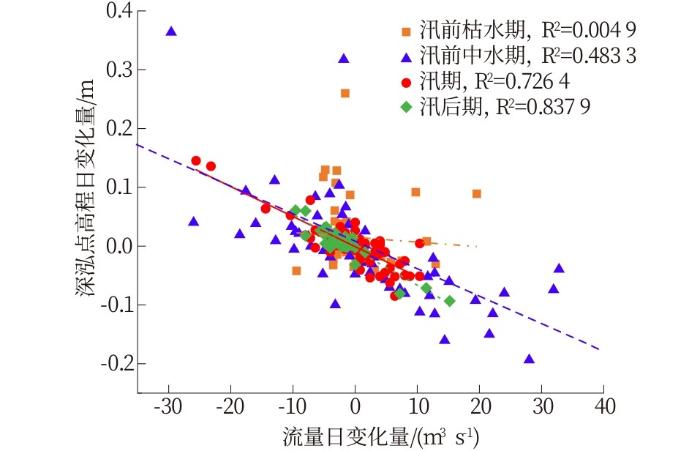
表2为21个断面在各时段流量日变化量与深泓点高程日变化量的相关关系;断面10各时段流量日变化量与河道深泓点高程日变化量的相关关系如图7所示。由表2可知,各水文时段各断面流量日变化量与河道深泓点高程日变化量的相关性排序为汛后期 > 汛期 > 汛前中水期 > 汛前枯水期。由图7可知,断面10汛前枯水期、汛前中水期、汛期、汛后期流量日变化量依次为-9.44~19.58、-60.48~48.08、-25.6~10.4、-39.6~15.2 m3/s,与深泓点高程日变化量的相关性决定系数R2分别为0.004 9、0.483 3、0.726 4、0.837 9,表明汛后期流量日变化量与深泓点高程日变化量的相关性更好。
表2 汛前、汛期、汛后期流量日变化量与深泓点高程日变化量的相关性(绝对系数)Table 2 Correlations (absolute coefficient) between daily discharge variations and daily thalweg elevation variations in pre-flood, flood, and post-flood periods |
| 水文时段 | 断面1 | 断面2 | 断面3 | 断面4 | 断面5 | 断面6 | 断面7 | 断面8 | 断面9 | 断面10 | 断面11 |
|---|---|---|---|---|---|---|---|---|---|---|---|
| 汛前枯水期 | 0.17 | 0.05 | 0.00 | 0.02 | 0.11 | 0.21 | 0.00 | 0.00 | 0.20 | 0.00 | 0.14 |
| 汛前中水期 | 0.01 | 0.03 | 0.15 | 0.22 | 0.00 | 0.09 | 0.07 | 0.25 | 0.03 | 0.48 | 0.20 |
| 汛期 | 0.35 | 0.00 | 0.66 | 0.00 | 0.71 | 0.57 | 0.00 | 0.71 | 0.05 | 0.72 | 0.31 |
| 汛后期 | 0.03 | 0.16 | 0.58 | 0.02 | 0.63 | 0.76 | 0.11 | 0.88 | 0.16 | 0.83 | 0.78 |
| 水文时段 | 断面12 | 断面13 | 断面14 | 断面15 | 断面16 | 断面17 | 断面18 | 断面19 | 断面20 | 断面21 | 平均 |
| 汛前枯水期 | 0.01 | 0.17 | 0.00 | 0.00 | 0.00 | 0.31 | 0.00 | 0.45 | 0.00 | 0.12 | 0.09 |
| 汛前中水期 | 0.13 | 0.22 | 0.00 | 0.03 | 0.00 | 0.00 | 0.00 | 0.04 | 0.01 | 0.30 | 0.11 |
| 汛期 | 0.82 | 0.36 | .00 | 0.16 | 0.59 | 0.48 | 0.07 | 0.13 | 0.48 | 0.60 | 0.37 |
| 汛后期 | 0.89 | 0.63 | 0.23 | 0.43 | 0.57 | 0.50 | 0.05 | 0.14 | 0.36 | 0.66 | 0.45 |
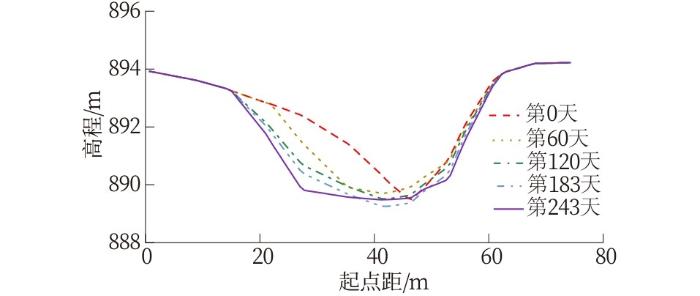
在模拟时段(2023年4月1日—2023年11月30日)内提取汛前枯水期、汛前中水期、汛期、汛后期结束时刻点(第60天、第120天、第183天、第243天0:00)河槽断面形态。
图8为断面10不同水文时段的断面形态。由图8可以看出,汛前枯水期(第60天)河槽变浅,其原因是此时段水流速度慢,水深较浅,河道两侧沉积物易堆积;汛前中水期(第120天)流量增大,河槽演变加速,向宽浅形发展;汛期(第183天)流量达到峰值,流速加大,河槽在深度和宽度上扩展;汛后期(第243天)水位逐渐回落但仍高于枯水期,受生态闸调控影响,流量波动幅度大,河床冲淤始终处于接近冲淤平衡,当净冲刷量达到峰值时河槽断面拓宽最为显著。不同水文时段,深泓点高程变化幅度相对较小,未表现出显著规律性。因此,以890 m高程为基准面,计算长度1 m河段(单位河段)各水文时段的河槽泥沙体积为初始河槽(第0天)213.63 m3,汛前枯水期(第60天)为211.88 m3,汛前中水期(第120天)为227.92 m3,汛期(第183天)为211.18 m3,汛后期(第243天)为177.12 m3。单位河段汛前枯水期净冲刷量为1.75 m3,汛前中水期淤积体积为16.04 m3,汛期净冲刷量为16.74 m3,汛后期净冲刷量为34.06 m3。各水文时段对河道主槽调整效果排序为汛后期>汛期>汛前中水期>汛前枯水期。
3.2 分汊河道断面演变
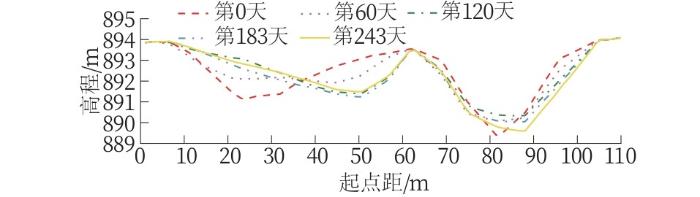
分汊河道断面位置如图9所示。基于汛前枯水期、汛前中水期、汛期、汛后期断面地形数据,计算单位河段泥沙冲淤变化量,研究不同水文条件对分汊河道断面形态的影响。
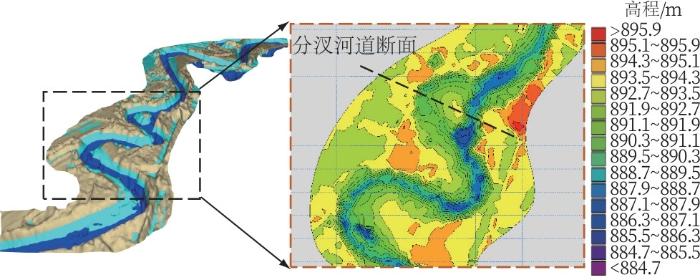
分汊河道断面冲淤时空分布如图10所示,相较初始河槽,汛前枯水期累计冲刷量为7.95 m3,河道左侧(弯曲段凹岸侧)断面形态发展为宽浅型,右侧深槽区因处于凸岸缓流区,同期展现为少量淤积。尽管断面左侧较之右侧变化明显,但分汊河道断面过流能力未发生显著改变,亦印证了水沙耦合系统的自适应平衡机制。至汛前中水期,分汊河道断面累计淤积量为3.61 m3,其中,58%(2.11 m3)淤积量集中于分汊右侧深槽区,其原因是此时段水流速度慢,悬移质沉降通量超过水流挟沙力。在强径流作用下汛期分汊河道断面冲刷量为17.72 m3,其中,右汊贡献率为45%(冲刷量8.11 m3),其原因与弯道二次环流增强引起的床面剥离效应相关。汛后期分汊河道断面淤积量为3.60 m3,但右侧深槽区表现为冲刷(冲刷量9.15 m3),这一结果反映了左侧浅河道滞后性沙波发育过程。因此,右侧深槽区冲淤强度排序为汛后期>汛期>汛前中水期>汛前枯水期。而左侧河道断面形态变化较为剧烈,在枯水期向宽浅型发展,汛前中水期向右侧河道靠拢,淘刷中间心滩,变化程度排序为汛后期(淤积12.75 m3)>汛期(冲刷9.61 m3)>汛前中水期(淤积1.50 m3)>汛前枯水期(淤积1.20 m3)。
3.3 人工裁弯取直后河道断面演变
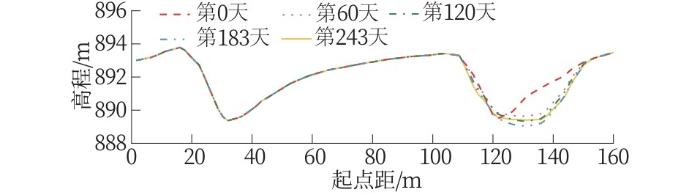
人工裁弯取直后河段及断面如图11所示,该河道于2021年由裁弯取直断面1开始进行了人工裁弯取直。
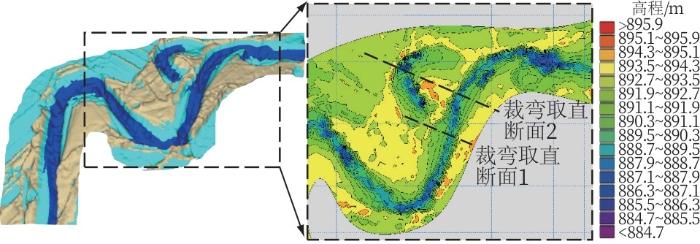
人工裁弯取直后河道断面(截弯取直断面2)形态变化如图12所示。人工裁弯取直改变了河道的水动力条件,河床比降与流速增大,水流挟沙能力增强。在初始调整时段,水流主流集中在新河道轴线,河道断面展宽,枯水期累计冲刷量为21.31 m3,断面宽深比显著增大。随流量周期变化,冲刷机制呈阶段性特征:汛前中水期(冲刷量7.81 m3)与汛期(冲刷量9.38 m3)的高能水流促使河床垂向下切,在河道中心区域形成深度侵蚀槽,断面过流面积增加了15%~34%,河道输水能力提升;汛后期时段(淤积量3.87 m3)水流能量衰减、粗颗粒沉积,在弯道缓流区悬移质发生再沉积。各水文时段河槽调整冲淤变化程度排序为汛前枯水期(冲刷21.31 m3)>汛期(冲刷9.38 m3)>汛前中水期(冲刷7.81 m3)>汛后期(淤积3.87 m3),表明人工裁弯河道断面形态发育在不同水文时段具有显著的非均衡性,变化程度受来水来沙条件制约。


4 结论
本研究通过水沙数学模型模拟了不同水文时段塔里木河中游典型河道断面形态演变规律。主要结论如下:
(1)流量、流量日变化量、含沙量、含沙量日变化量是影响河道深泓点变化的主要水文因素,其中,流量日变化量是最主要因素,绝对系数在不同断面间波动幅度为10%~47%,其他变量平均绝对系数均不足0.02。
(2)在不同水文时期,流量日变化量与河道深泓点高程日变化量之间的相关性排序为汛后期>汛期>汛前中水期>汛前枯水期。不同水文时段对河道主槽演变效应影响表现为汛前枯水期河床变浅,汛前中水期河槽变宽浅,汛期强径流作用下河床深度和宽度调整,汛后期冲刷强度进一步增大。
(3)分汊河道断面冲淤呈现显著时空分异性,右侧深槽区汛后期冲刷最强;左侧浅河道各时段表现则不同,河槽调整冲淤变化程度排序为汛后期(淤积12.75 m3)>汛期(冲刷9.61 m3)>汛前中水期(淤积1.50 m3)>汛前枯水期(淤积1.20 m3)。
(4)人工裁弯后河道形态发育具有非均衡性特征,受来水来沙条件制约,整体以冲刷为主,河槽冲淤变化程度排序为汛前枯水期(冲刷21.31 m3)>汛期(冲刷9.38 m3)>汛前中水期(冲刷7.81 m3)>汛后期(淤积3.87 m3)。